In the Hot Tub with Marta

Marta

I was watching ESPN the other day and caught a VERY fleeting glimpse of Marta in PUMA’s “Forever Faster/Calling All Troublemakers” commercial. This campaign’s narrative is centered on Usain Bolt, but framed by a series of other athletes, including Mario Balotelli and Marta. Depending on which national/linguistic edition of the ad you watch, you might catch a glimpse of Marta in a hot tub. All of the athletes appear in hot tubs. The only women athletes in these ads are Lexi Thompson (golfer) and Marta. Thompson appears in the tub with men, of course. Marta, kindof wonderfully, appears in a hot tub with a man and a woman. Nobody is near her. One must assume PUMA couldn’t handle putting her in the hot tub with only women.

I am picturing Marta arriving on set.

She throws on a bikini, as required. She’s body proud, doesn’t mind really. She leaves the dressing room, and heads to the set.

There she sees two men in the hot tub, and refuses to get in it.

Puma might use the word “troublemaker” to brand itself as badass, but Puma isn’t actually badass. It’s a corporate brand looking to sell out even the feeling of disenfranchisement. If it was really bad ass, it’d have had Marta in the hot tub with a gaggle of blond women draped over her just as they are draped over the men.

Marta demands women for the hot tub. This is what the male athletes get, after all. She declares: It’s sexism! Don’t they know she’s filed a law suit about this sort of thing? Negotiations ensue, and someone proposes that she climb into the hot tub with what looks like a straight couple. She says fuck it, OK. Collects a check that is, of course, much smaller than Balotelli’s and Bolt’s. Whatever.

Below the version of this ad with the most seconds of Marta that I could find.

Whither Toronto?

Point 81, in the law suit filed by women players against the Canadian association and FIFA.

One of the mysteries of the decision to play Women’s World Cup matches on turf is why one would need to, when there are existing alternatives, like BMO Field in Toronto. Not one Women’s World Cup match is currently scheduled in Toronto, even though it has a great option in BMO—located right in the heart of the city. It’s downright bizarre.

Screen shot 2014-10-04 at 6.07.36 PM

This is what the fight against sexism looks like!

Screen shot 2014-10-02 at 12.35.34 PM

Click on the link below to access the actual complaint filed by women players against Canada’s FA and FIFA. Seems like a pretty clear case to me—but then again, the Laws of the Game define women as a debilitated group for whom all aspects of the game might be adjusted to address their limits. It’s actually written into the FIFA bible: Women are like children and old men. The World Cup could be played in 15 minute segments and that would be totally legit.

Players v CSA and FIFA

The Sound of Sport

DPA-5100-in-Amsterdam-Arena-1280x852

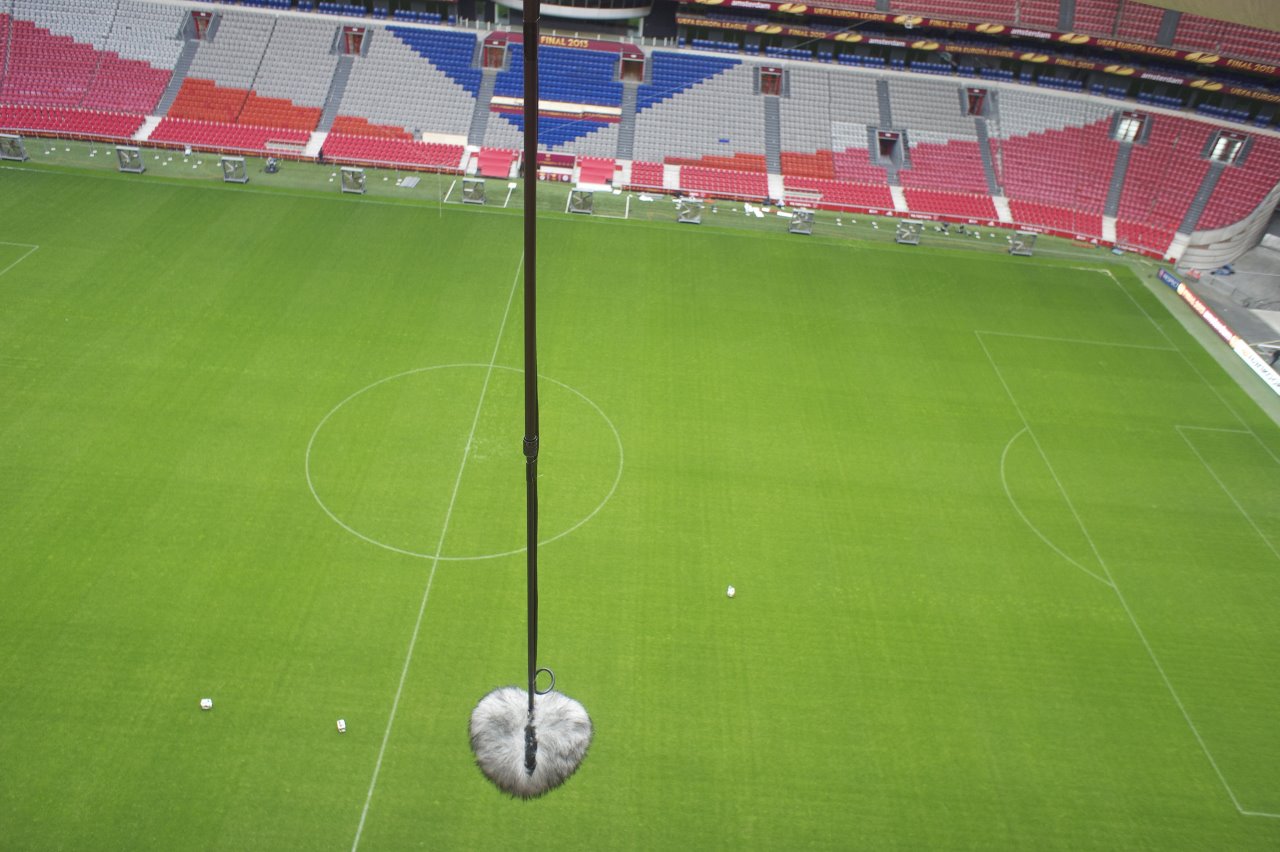
99% Invisible, a San Francisco-based independent radio program exploring design practice, posted a wonderful, hour-long documentary on sound production for sports broadcasts. It’s totally engrossing. “The Sound of Sports” was produced by Peregrine Andrews, and originally broadcast in 2011 on BBC Radio. LISTEN HERE.

Mensplaining

Screen shot 2014-09-29 at 12.36.56 PM

Why did I click through on this? It’s Taylor Kwellman and Alexi Lalas advising Hope Solo to sit down, like a good girl. When ESPN covers women’s sports equitably, then it can stage this discussion however it likes. Until then, I don’t care to hear Twellman and Lalas opine about what Hope Solo should or shouldn’t do. This story gets more play than does the fact that USWNT players are gearing up to sue FIFA! ARGH.

ABC’s Rock-N-Roll Sports Classic (1978)

Music was different. Sport was different. Television was different. Courtesy of Please Kill Me.

A New World Cup Anthem

Sia’s Chandelier is vast improvement over We Are One (Ole Ola) [The Official 2014 FIFA World Cup Song]. Backed up the Gay Men’s Chorus, Ryan Heffington’s choreography…the lyrics…I don’t know, it works for me. Especially now that Uruguay is going home.

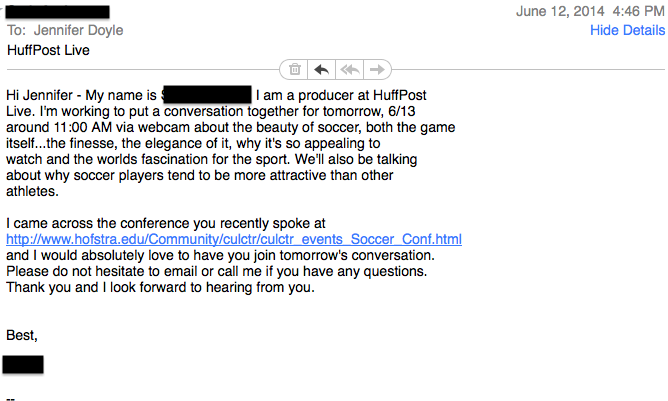
Things I Get in the Mail (Media Requests for World Cup Commentary)

Screen Shot 2014-06-12 at 7.18.44 PM

My reply: Just wondering, do you intend to run a story like this about the women’s game?

Heavy Breathing: Pro Wrestlers with “Absolutely No Words”

Youtube is, frankly, the best place to for an artist and art critic to check herself. What you see in a museum was probably done by a fan and posted on Youtube – and discussed on Reddit – years ago.

Andrew Esiebo’s “Grannys”

This slideshow requires JavaScript.

Nigerian artist Andrew Esiebo’s diptych series, Alter Gogo (2010) juxtaposes portraits of women standing on their home ground in their team uniform with portraits of the same women surrounded by their grandchildren.  The Los Angeles County Musem of Art just opened a show celebrating contemporary art about “the beautiful game” – but women’s football is intensely marginalized in the exhibition. I’ve been cruising the interwebs looking for work centered on women’s relationship to this sport, and was reminded of Esiebo’s work as I was looking up work from “Beyond Football – shifting interests and identity,” an exhibition that was on view in Berlin (at Savvy Contemporary) during the 2011 Women’s World Cup; the exhibition was also staged in Lagos through the Goethe Institute there.

From the artist’s website:

“Alter Gogo” is a diptych portrait series featuring a group of grandmothers who are members of the Gogo Getters Football Club in Orange Farm, South Africa. For them, playing football is more than a recreational activity; it’s also had a profound social and physical impact on their lives. In a community plagued with social and physiological problems like high unemployment, crime, alcoholism, diabetes and high-blood pressure, football serves as a salve. And all too often in collective imaginary, African women are located in the sphere of tradition and oppression, especially when they reach old age. With the grandmothers’ regalia and their proud postures both on the pitch and at home, “Alter Gogo” creates a powerful socio-cultural scenario in which soccer is the means and expression of a new gender and generation identity.”