
On Holly Holm Giving Us What We Need

Jeffrey Gibson, What We Want, What We Need (2014).

Jeffrey Gibson, What We Want, What We Need (2014).

Holly Holm picked Ronda Rousey apart. An undefeated fighter is there to be defeated. We root for the upset. We relish the agony, the dark thrill of watching the takedown of a champion. We need someone who can knock the stuffing out of the hype. That’s what we got. It’s what we wanted, and what we needed.

Art+Sport: On the Sonic and Material Properties of Bounce

This Sunday (Nov 8), Machine Project and Cabinet magazine team up to present two new episodes in the life of bounce from artist (and former professional squash player) Carlin Wing. Episodes in the Life of Bounce is hosted by Sabrina Chou’s experimental sporting exhibition, HR.

From 1pm to 4pm, artist Carlin Wing, assisted by Luke Fischbeck, will present Live Ball Orchestra, a workshop about the sonic and musical properties of bounce. Participants will use balls of all types to sound out the architectural space of Sabrina Chou’s exhibition at HRLA. (One can play tennis with the gallery — bouncing the ball of the wall and objects in the space.) Participants will explore the aural characteristics of bouncing objects, test the range of acoustic relationships between ball and surface, and experiment with building tonal and rhythmic arrangements. Some bounce audio will be recorded. Balls will be provided but participants are also encouraged to BYOBall.

Following the workshop at 5pm, the event moves to the bleachers for Episodes in the Life of Bounce, an illustrated talk by Carlin about rubber as the foundational material of modern sport. All cultures play games with balls, but the rubber ball has a special history. In their time, the Aztec and the Maya built entire cosmologies around rubber bounce, while in recent centuries sport-crazed Europeans and North Americans have tirelessly experimented with rubber’s uncanny properties in pursuit of “true bounce.”

Balls: Michelle Grabner’s Soccer Mom Art

This slideshow requires JavaScript.

Last year, the artist Michelle Grabner was subjected to a tremendously sexist review of her work by the New York Times’s Ken Johnson. He ticked many of the boxes for “most ignorant things you can say about a woman artist’s work.” Is her work narrow because it references the domestic? Yes, he says! Is her work childish for her having children? Why yes! Is her work boring and meaningless, just like housework? God, yes! He makes zero reference to the feminist contexts through which one might read her work. He punctuated this now notorious review with the following two sentences.

Nothing in all this is more interesting than the unexamined sociological background of the whole. If the show were a satire of the artist as a comfortably middle-class tenured professor and soccer mom, it would be funny and possibly illuminating, but it’s not.

So, in response, the feminist professor made a gingham soccer ball. You can buy one for yourself, perhaps you can kick it around with your kids. It’s actually less expensive than official tournament balls.

As Grabner well knows, the kind of things Johnson said about her work have been said for the past couple hundred years about women artists (e.g. Rosa Bonheur, Jane Austen) — esp. those who work from the textures of everyday life. In his review, Johnson faults Grabner for not providing a “sociological” angle to her practice — a ludicrous expectation, frankly, for Grabner’s work. (What is sociology in the context of contemporary art, really? What would make it feel sociological enough?) That kind of demand — that things feel “sociological” and REAL — is not made of masculinist artists like, say, Frank Stella. Stella makes big art from manly things like steel, and produces them in factory like conditions romancing an idea of Productive Labor. This manly work is made by a MAN and in a manly way — and that tidy lining up of masculine signifiers is enough to give it meaning and value.

Reproductive labor is always abject, even when it’s really beautiful — it’s very beauty becomes the signal of its worthlessness (the abjection of feminine/reproductive labor is explored by a wild range of artists — e.g. Mary Kelley, Toni Morrison, Virginia Woolf, Kara Walker, Faith Wilding). I have more to say about this, but other deadlines are pressing on me!

Some good articles responding to Grabner’s work and Johnson’s review:

Jillian Steinhauer, “On Ken Johnson and the Question of Sexism,” Hyperallergic

Mary Louise Schumacher, “Why Michelle Grabner warrants more scrutiny,” Milwaukee Journal Sentinel 

Zuzanna Janin: Fight (2001)

A short performance video, from Janin’s series of fight performances based on training with and fighting the heavyweight boxer Przemysław Saleta.

Boxing Painting

This is what happens when you google “Jackson Pollock” and “boxing.”

Mixed Results

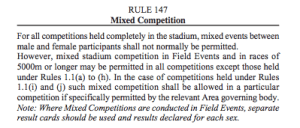
IAAF Mixed Competition Rule 147

International Association of Athletic Federations rule 147, regarding mixed-gender competition:  Generally not OK. Especially not OK in a stadium. Basically, if I’m reading this correctly, this rule is meant to foreclose the possibility that anyone might accidentally think that men and women compete directly against each other. Because then the earth might open up and swallow the stadium whole.

CrossFit Performance

https://vimeo.com/38662094

David Getsy writes about Amber Hawk Swanson’s work in “Queer Exercises: Amber Hawk Swanson’s performance of Self Realization” (in GLQ‘s fall 2013 issue, which I edited). I can’t get enough of this.

Franko B – Milk & Blood

https://youtu.be/T3RW2DIGNwU

UK-based artist Franko B’s most recent work—a contribution to a recent wave of compelling/challenging sports-related performance art.

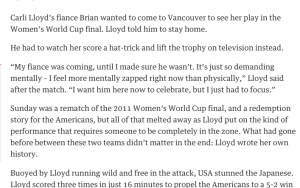
If the boyfriend is told to stay home, maybe he should not be in the lede for a match report.

Carli tells man to stay home

I am trying to recall a story about a men’s team winning the World Cup, or any match, in such spectacular fashion that opens with an anecdote about the MVP telling their girlfriend to stay home. I’m happy to read this kind of thing in a feature, a profile of the player—but in what I understood to be a match report? For a World Cup Final?

This match report appeared in the Guardian; I was lured by the headline “Carli Lloyd shreds Japan.” But I couldn’t get past that intro! Otherwise, the author’s work on the tournament was OK; I just can’t understand that intro. It feels like it was cribbed from Gwen Oxenham’s feature story on Lloyd? (For a good match report, see Grant Wahl’s.)

Profiling Alex Morgan: routine sexism and a little plagiarism from FIFA.com

In advance of Tuesday’s match, FIFA.com published an article about Alex Morgan. This English professor feels compelled to explore the quality and character of FIFA.com’s writing.

Morgan looking for a fairytale finish

Headline declares: do not be confused by gender ambiguous name. Alex Morgan is a girl, with girlish aspirations.

One might have selected an image that showed Alex-Morgan-the-girl in action—but FIFA.com would rather give us the chance to appreciate her perfect eyebrows.

Rather than feature an image of Princess Morgan in action, FIFA.com gives us the chance to appreciate her perfect eyebrows.

Alex Morgan is one of the most popular players in USA women’s football.

Alex Morgan is a popular girl.

A talented goalscorer with a style that is very easy on the eye and good looks to match, she is nothing short of a media phenomenon.

Where to start?

Describing Morgan as a “talented goalscorer” suggests she that has talents other than goalscoring—talents related to her popularity (e.g. she can twirl a baton and sing the Star-Spangled Banner; she makes a mean Negroni).

“A style that is very easy on the eye” is the kind of phrasing one associates with a real estate listing, or a QVC pitch. “A layout that is perfect for your entertaining needs.” “A cut that is easy on the figure.” It is, here, terrible writing—a poor use of “that.”

In general, this is a confusing sentence—it moves from her popularity, passes over her skills as a player (entertaining to that one, singular eye) and then lands on her beauty as an explanation for how well she works as an advertisement. A player that is very useful to your corporate sponsor.

There is more to Morgan than meets the eye, however.

That eye, again. Lest you missed FIFA’s obsession with looking at women’s bodies (what is underneath their kits? can they be tighter? more revealing? Are they really MEN?), FIFA.com reminds you that there is more to women than what you see with your eye.

A successful children’s writer, she has just published Hat Trick, the fourth book in her series The Kicks.

Women are women because, of course, they give birth to and then look after children. This is Alex Morgan’s ultimate purpose — this whole World Cup thing is a youthful enterprise. You can feel FIFA.com’s relief here: Princess Morgan’s physical skills, talent and competitive drive are ultimately oriented not toward destroying her opponents. It’s fodder for her children’s book series—which is not a business enterprise. It is an affirmation that Alex Morgan is, really, a girl. Interested in girls. But, you know, like, more like a mom rather than…well, never mind.

FIFA.com only markets itself, so there is no link to these books. So if you want to check them out, here you go.

The saga follows the adventures of Devin, a 13-year-old girl who moves from Connecticut to California and discovers in football a way to make friends and experience new adventures.

Rather wonderfully, FIFA.com misses the gender play of a woman writer named Alex centering a children’s book on a girl named Devin. It reminds me of the character Jo March, who slouches through Little Women declaring she wants to be a writer. She writes poems, plays and publishes a little newspaper. Little Women turned lots of girls into women writers—one would pretend to be Jo March, and write as Jo March. You become an author, in other words, by pretending to be the author you most admire. In Little Women, that act of imagination involves some cross-gender identification, because there were so few examples of successful women writers. There’s some slippage, in other words, between wanting to be a writer and not wanting to be a girl, and wanting to be a boy. It is not unlike the situation for girl athletes. There is a boyishness to the whole situation, and it is more generous to embrace that than to try to shut it down in some sort of homophobic panic.

I imagine Alex Morgan has these aspirations regarding the potential athleticism of the girls reading her books—that she’s making room for them. This is an extension of her operation as a role model–it is a way of capitalizing on that.

“I never imagined that I’d enjoy doing this so much,” the footballing wordsmith tells FIFA.com. “The opportunity came up in 2012 and I didn’t want to pass it up. I’m very happy with how popular it’s proved with young girls. It’s children’s literature and it’s easy to read.”

The use of “wordsmith” is evidence of a lack of wordsmithing.

Even children can learn about women’s football, Alex Morgan explains patiently to FIFA.com. Even you, FIFA.com can read Hat Trick.

Not content with that, she has also written a book about her experiences at the London 2012 Olympic Games, where she won gold with her country, while a pilot episode of the cartoon version of The Kicks has just aired on TV.

One might, here, consider Morgan’s business acumen. One might invoke Mia Hamm—whose Go for the Goal sat on the New York Times Best Seller’s list for ages. Hamm also published a children’s book, as well as a skills-based DVD. She is an important model for young women athletes looking to capitalize on the very limited possibilities afforded to them, when it comes to making money off the game. One might remind readers that when women try to market themselves, they are pressured to market themselves to children, because the superstructures of sports have a great deal of trouble believing that one might use women’s ferocity, competitiveness and ability to sell goods to adults.

Alex Morgan knows that the lazy eye of FIFA.com is more interested in her marketability than in her skills as a player—and that this is an extension of the larger problem regarding FIFA’s stupid aggression towards all things related to the women’s game.

“If it’s a success, they might show the whole season, which is based on the first of the three books I wrote, called Saving The Team,” said the Portland Thorns forward, clearly excited at the prospect of her stories potentially becoming the female version of the hugely successful Captain Tsubasa series.

Yes, a girl can dream. Even a girl who plays on a football team. I bet Marta had dreams like this. But. Lesbian.

For the time being, however, the intrepid Morgan has other things on her mind than her successful writing career, not least Tuesday’s FIFA Women’s World Cup Canada 2015™ semi-final against Germany in Montreal, a game in which she will be hoping to add to the one goal she has scored in the tournament so far.

Intrepid is a strange word choice. Here it serves to render Morgan into a cartoon character not unlike those that people her books. And by the way, there’s this thing happening — FIFA Women’s World Cup Canada 2015™.

“The two best teams in the world are coming face to face,” said the striker, who turns 26 on Tuesday.

[Happy Birthday Alex Morgan. Milk those bastards for all that they are worth.]

“It’s virtually a final. Germany are a great side. We’ve watched nearly all of their games, and they’re very strong in defence and dangerous in the air and with the ball at their feet.

“We need to watch out for the knockdowns too and for Celia Sasic and Anja Mittag, who are both a big threat up front.”

Thank goodness FIFA.com got some quotes from Princess Morgan, because FIFA.com does not know enough about either team to make any informed observations about the match.

It was seven years ago that Morgan burst on to the international scene at the FIFA U-20 Women’s World Cup Chile 2008, which USA won, after beating Germany in the semis. As well as a winner’s medal, the forward also walked away with the adidas Silver Ball and the adidas Bronze Boot, and scored the goal of the tournament in the final.

Here we have FIFA.com plagiarizing from US Soccer: “She burst onto the international scene at the 2008 FIFA U-20 Women’s World Cup.” You can spot FIFA.com plagiarism by the appearance of movement in a sentence. The sentence falls apart once US Soccer’s writer leaves the pitch. Also, and here I am just being petty, I’m pretty sure “adidas” is supposed to be “Adidas.” [I stand corrected, the one thing FIFA.com does not get wrong is the spelling of its corporate collaborators.)

“A lot has changed since then,” she said, casting her mind back. “I’ve matured as a person, a player and a team-mate, and it’s been a great journey.

“That was my first tournament in front of more than 500 people and I’ve learned to deal with the difference at this level.”

The crowd at Montreal’s Olympic Stadium will be a good deal bigger than that.

Morgan throws some words at FIFA.com. There is no one on the other end of the line.

And with the US border lying so close, Jill Ellis’ side can expect plenty of support in the stands.

I love the image of the US-Canada border just lying around, like someone forgot to pack it into the van.

FIFA.com promises a dutiful crowd. We can expect support. Here I am, FIFA.com tells us, showing up for my job. Supporting the women. Because I have to. You can expect that much.

“It’s a World Cup with a little bit of a difference,” explained Morgan. “There have been so many USA fans at the last few games that it’s felt like we’ve been playing at home, even though we’re in Canada. We have a lot of support and our families come to see us more often.”

FYI, people from the United States think of Canada as a kind of attic.

One person close to Morgan’s heart who has not been around, however, is her husband, Sporting Kansas City midfielder Servando Carrasco, who is on duty with his team in MLS.

Don’t worry readers. Alex Morgan is not a lesbian. You can always tell who is a lesbian because there is no mention of partners, often no mention of family at all. Lesbian athletes crawled as babies out of smoldering meteors sent to Earth from planet Badass; they roam the world scoring goals with no sense of purpose beyond the game.

“We’ve hardly seen each other lately,” she explained. “We’re obviously both very busy right now, though the fact that we’re both soccer players means we understand each other better. We understand the commitment involved and we support one another.”

Thank god for that.

Touching her wedding ring, she added: “We have to make a lot of sacrifices for our work and our marriage, though it’s just a question of finding a balance and helping each other to keep pushing on.”

In case you missed it, Madame Morgan is married, and she has clearly studied her heterosexual talking points. Sacrifice, commitment, something, something.

But as she fiddles with her ring, you know her mind is elsewhere. (Note: her US Soccer profile focuses on her relationship with her sisters, and the fierce sense of competition that characterizes her family. In general, US Soccer has gotten better at fighting its sexist and homophobic impulses.)

As busy as they are, Morgan and her husband are determined to see each other on Sunday, when the Final of Canada 2015 takes place.

“We’re taking it one game at a time,” said Morgan, a member of the USA side that finished runners-up to Japan at Germany 2011. “We’ve been playing better and better as the tournament has gone on and obviously our goal is to take that trophy back home again.”

The amount of attention FIFA.com gives to her marital status is actually MORE offensive than the attention FIFA.com gives to her looks. She tries to redirect the conversation back to something related to her actual job.

The last time the Stars and Stripes did that was in 1999.

FIFA.com does not know the difference between a flag and a soccer team.

Sixteen years on, Morgan has the chance to fashion another happy ending for American women’s football.

Morgan. Girl. Style. Fashion. Wedding. Something like that.