A Game of Two Halves

[Slowly starting up my football writing practice. Sorry I sat on this a couple days, in general I’ll try to post within a day or two of games I watch.]

A part of me knew the game would end this way. Kansas is playing barn storming, take-no-prisoners attacking football. In their last three home games, they have scored a lot of goals (5, twice; 4 in a game against us). But their opponents are getting their cuts in (Portland, 4; us, 2; Bay, 2). Questions about their defense have been drowned out by goal differentials.

Nevertheless, we won the first half. Their attack was smothered by Jasmine Spencer, Megan Reid, and Sarah Gordon. Rocky Rodríguez and Madison Hammond played their opponents right out of their socks. Alyssa Thompson was phenomenal. There was so much give and go — Claire Emslie’s goal felt like the manifestation of the team’s collective will.  

We all knew, however, Kansas was going to come out of half time with a fire in the belly. And subs. One scary player after another stepped onto the field: to name just three: Lavogez, Debinha, Labonta. And sure enough, we were put on the backfoot. Our game became glitchy—the passing game was slowly unglued. We were defending, defending, defending. When the ball broke through, our attack looked sticky. For the most part, our defenders worked magic against very creative and unrelenting attack but Kansas is so good — you can’t give them the tiniest inch of possibility. Basically, they broke us down. So, we lost.

Still, this was one of those games were the football was so good you just couldn’t leave the stadium demoralized. That game offered lots of nasty fun. It made me miss playing.

For a few minutes, I stopped thinking about the Zionists in the ownership group.

By anti-Semitism here, Alexis Ohanian means the national movement on U.S. campuses demanding an end to the arming of Israel’s genocidal campaign to wipe Palestine—by which we mean Palestinians—off the map. Here he equates the call for Palestinian liberation (“from the river to the sea…”) with the chants shouted by the white supremacists at the “Unite the Right” rally in Charlottesville, Virginia. If he hears a genocidal call in “from the river to the sea, Palestine will be free,” it is because he has allowed Zionists to naturalize the association of Jewish life with Palestinian death. I’m sickened by the idea that ACFC’s ownership puts their shoulder to the Zionist project.

But there I was, in my excellent seat at a stadium named after first one bank and then another, rooting for the players on the field (I love them!)—my spirits alternately crushed by the weight of this moment, and lifted by the Palestine flags waving in the middle of the supporters’ section.
Next for Spain: The Gauntlet of Complaint

[Revised after the news broke re RFEF demanding Rubiales’s resignation]

When the head of their sport’s federation harasses them, what can national team players do? This is the question hanging over the sports world right now, because it should not take winning the World Cup for players’ grievances to be heard.

Luis Rubiales’s behavior on the biggest stage in women’s football has made all too clear not only the everyday sexism that shapes interactions between men and women in the game: it has made clear the sense of impunity that characterizes leadership in the sport and the gothicism of the architecture which maintains the sport’s patriarchal structure. Consider this: The RFEF (Spain’s federation) is made up of 140 members. 120 of those members are elected (the rest are ex-officio). This body includes the presidents of Spain’s 19 regional federations, elected members from clubs, players, referees and coaches. Of its 140 members, only 6 are women.

Women have never not played football, but women’s access to the game has a long history of suppression. The Franco regime banned women from the sport in late 1930s. Like players in other countries living under these prohibitions (e.g. England, Brazil), women continued to play underground. In the 1970s, a Spanish team played international tournaments although not while wearing the federation badge (learn more about this generation here). The first officially recognized national team in Spain was formed in 1980. There is, in other words, a history of women’s football in Spain and a large community of former athletes whom one might reasonably expect to be represented in the federation’s governance body. If only 6 of the federation’s 140 members are women, it is because after lifting the ban against women playing the game, men have worked for over forty years to maintain exclusive ownership over it. That work is not easy. It is requires constant vigilance.

“Little” kisses like the one imposed on Hermoso are part of that system. We see this in Rubiales’s behavior around that kiss—from his locker room joke presenting an Ibiza trip as a celebration of his marriage with Hermoso, to his dismissal of his critics as idiots, to his attempt to coerce Hermoso into appearing on camera beside him while he downplayed the significants of his behavior, to the federation’s false statement about how she felt, to his attempt to intimidate her by threatening to sue her for defamation, to his attempt to blame her for the kiss because she lifted him off his feet (something he had done to several other players on the podium), to his mention of her missed penalty in his Friday statement, to the framing of the entire crisis as a form of social assassination engineered by false feminists (that phrase is a right-wing dog whistle), to the outrageous statement posted on RFEF’s website casting Hermoso as a liar—you get just a taste of what ordinary women in the sport face when they say, “I didn’t like that.”

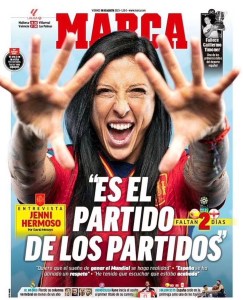
The week before the final, Jenni Hermoso was on the cover of MARCA: almost none of the women with discrimination and sexual harassment complaints against their federation officials have this kind of visibility. Yves Jean-Bart was removed from his leadership position in Haiti’s federation after accusations of sexual abuse were made against him by players. (See Laurent Dubois’s July article on this.) Victims and advocates have been fighting to get the case heard in Haiti’s criminal court system while Jean-Bart has used the administrative processes unique to sports to de-legitimize the complaints made against him. FIFA had banned him from football for life: the Court of Arbitration in Sports overturned that ban, and, in June 2023, FIFA lost its appeal of that decision. Jean-Bart is accused of molesting adult and youth players at the national team training camp. He wants to return as the federation’s president: this is one of the most upsetting, most demoralizing situations in soccer—fans of the women’s game would be right to have some kind of feelings about the way this story has been lost in the shadows. Is Spain looking at some version of that story?

Coverage of the Spanish team’s struggle makes frequent mention of the players excluded from the selection. The whole history of that team is populated by stories of this kind of exile—sometimes chosen by the player, and sometimes enacted as a form of retribution. Other teams in the tournament this year also have this shadow bench, including one of the tournament favorites, Colombia. Yoreli Rincón, one of Colombia’s strongest and most experienced players, has not been called up for the national team since 2018. The 29-year old player has been banished for taking a leadership role in spotlighting the injustices that players in that country endure. In a June article for Global Sports Matters, Brenda Elsey wrote about the situation of women working within Colombia’s federation: her essay tracks the way the complaints against abusers disappear into a gauntlet of committees—this is an important read for people who are wondering about the shape of the next chapter in this story.

Soccer’s governance structure is intentionally confusing. The more labyrinthine it is, the easier for those in charge to shirk responsibility. Whenever there’s mention of corruption and sexism in soccer, most people immediately jump to FIFA. However, FIFA is, at its heart, an assembly of sovereign national federations. Those national federations, like the Colombian Football Federation, oversee all aspects of soccer, including amateur and youth divisions, professional leagues, and national teams. Federation leaders oversee ticket sales, development money, hiring, and policy. Men and women players, coaches, and staff operate within the same structure.

To add to the confusion, the men who run different branches of football often hold positions in multiple governance bodies. For example, the president of the Colombian federation, Ramón Jesurún, simultaneously serves on the FIFA Executive Council and holds the position of Vice President and Chair of Finance for CONMEBOL (Confederación Sudamericana de Fútbol), the regional governing body that lies between FIFA and South America’s national federations. When players have a complaint about their treatment by the Colombian federation, they could approach CONMEBOL or FIFA, but Jesurún wields influence in both those spaces. There isn’t a truly independent governance body to help players and staff when they have workplace complaints. (The Colombian Football Federation did not respond to requests for interviews regarding the allegations in this story.)

Officials like Jesurún further neutralize players’ complaints by portraying their relationship with athletes as personal rather than professional. When Jesurún says that he thinks of his national team players as his “daughters and others as my granddaughters,” he is portraying himself as a benevolent patriarch rather than a responsible public official.

Brenda Elsey, “Cafe con mala leche”

Elsey and I discuss this in a recent podcast. I also recommend reading Suzanne Wrack’s overview of one case against Colombia’s U17 coach, Didier Luna, which is part of the story Elsey covers. This is a case of quid-pro-quo harassment, in which a person demands sexual favors as a condition for their employment. According to the complainant in this case, he openly exploited her commitment to the national team in an attempt:

“I was sexually harassed by the manager as soon as I went into the job,” says Carolina Rozo, the former physiotherapist of Colombia Women Under‑17s. “It started with words. He would tell me I was very pretty and then he would try to take advantage of me when we were together at mealtimes and other places. Saying goodbye he would push himself against me very hard and whisper into my ear how much he liked me.

The tipping point for Rozo came in January 2018. “He came to the dining room where we were eating with a photograph of me,” she says. “He pointed at the photograph and said: ‘That’s the woman I want,’ and: ‘Be careful, because if you’re not careful I’ll kiss you.’ So I said to him: ‘Don’t you dare do that, we are just eating.’

That evening, when I was going to my bedroom, he was there, he met me on the way. He said he was being serious about wanting to have something with me, to be ‘his special friend’ and that he could bring me to great things in Colombian football. And then he pointed to the logo of the team on my chest and he said: ‘I want you to give me a piece of your heart.’

Suzanne Wrack, “Carolina Rozo: ‘It started with words. He would say I was very pretty.'”

So, so many people have stories like this. And those victims will tell you that this form of sexual extortion is a key feature in the sport’s toxic ecology.

Personally, I have been worried about where Spain’s story is headed. Today (Aug 28), the national prosecutor invited Hermoso to lodge a complaint against Rubiales. He has already received a number of complaints about the incident, but, according to El Pais, he is reluctant to move forward without her participation. If she files a complaint herself, however, what is it about? The kiss? Or everything Rubiales did afterwards?

How many of the RFEF 134 members who are not women are afraid that we might come for them?! How many of them see this as the kind of harassment for which you shouldn’t be fired? The fact that they have demanded his resignation feels like a miracle, as does the structural change they, after an emergency session, have promised.

It has been in Rubiales’s interest to turn this story into a question of consent. Every harassment victim, and especially women, enter into these scenes suffering from a credibility deficit. Within rape culture, the truth of an accusation will be turned into a mist. The common sense of rape culture is that the truth of sexual assault cannot be known, and/or that the man’s intentions were innocent. This is what Eve Sedgwick described as “the privilege of unknowing.”

The epistemological asymmetry of the laws that govern rape […] privilege at the same time men and ignorance, inasmuch as it matters not at all what the raped woman perceives or wants just so long as the man raping her can claim not to have noticed (ignorance in which male sexuality receives careful education).

Eve Kosofsky Sedgwick, Epistemology of the Closet

In general, criminal courts do not offer the kind of justice people are demanding when they declare “se acabó.” The criminal court system requires an isolated criminal event and a single perpetrator who can be punished. So much more is at stake with this struggle. Rubiales weaponized the federation against a player because she said she didn’t like the kiss gave her. That federation is not a machine: it is a large group of people. Even if the RFEF or EUFA or FIFA had excellent policy regarding accusations of sexual harassment and discrimination (and by all accounts, they don’t), that policy is only as good as the people who are charged with enforcing it. In a system that is this dominated by men and that is also this rife with corruption, you would have to be very naive to think that something like justice was right around the corner.

FIFA issued a 90-suspension against Rubiales, prohibiting him from working in football. They also issued a remarkable-for-them no contact order, prohibiting him from contacting Hermoso, her family, and her team. This is the first thing any organization around this fiasco has gotten right. When your institution gets wind of bullying, harassing behavior your first obligation is to do whatever you can to stop that bullying, abuse, and/or harassment. That they issued this no-contact order shows that they understand the problem is not about whether or not that kiss was consensual: they understand that Hermoso, her circle, and the whole team are being subjected to harassment. FIFA in issuing that no-contact order behaved as if his behavior was dangerous, and they were right to do so. Rubiales used his position to paint a target on Hermoso’s back. But how that order is enforced is a not obvious!

Under Rubiales, the Spanish federation asked UEFA to ban it—UEFA and FIFA both have rules that punish federations where they are manipulated by their national governments. This is a very hollow set of regulations unevenly applied, but that is a story for another day. In this case, RFEF tried to position the various investigations and explorations of disciplinary action mobilized this week as governmental interference. This is widely accepted as a last-ditch effort on the part of the federation to save Rubiales. Thankfully UEFA said no.

FIFA, UEFA, and the Spanish criminal court system will not set things right. That work falls squarely on the shoulders of players and their union, FUTPRO. In a statement made today, the union president Amanda Gutiérrez was explicit: “Measures must be taken so that we can improve the working conditions for our soccer players so that they are not subject to discrimination and we can put an end to the problems that we have been having for so many years.” This will require “structural change.” The union positions what happened to Hermoso in perspective—complaints filed against the manager of Alhama, a club in Spain’s top league, led to an investigation which found that 68% of the club had experienced harassment and yet “the club has done absolutely nothing.” (For more, read this.)

With the federation’s call for Rubiales’s resignation, they show that they are, for the moment, following the players’ lead. Too much is on the line: Spain has been aiming to host the men’s World Cup in 2030, and to do that, now, thanks to the women who play in Spain, the federation will have to clean house.

Meanwhile, Rubiales’s mother has retreated into a church where she is threatening a hunger strike. A bizarre reminder if ever we needed one that women also buy into the patriarchy’s empty promises, and this rarely serves them well.

Attendance Record for Women’s Football! [whispers] was set in 1971

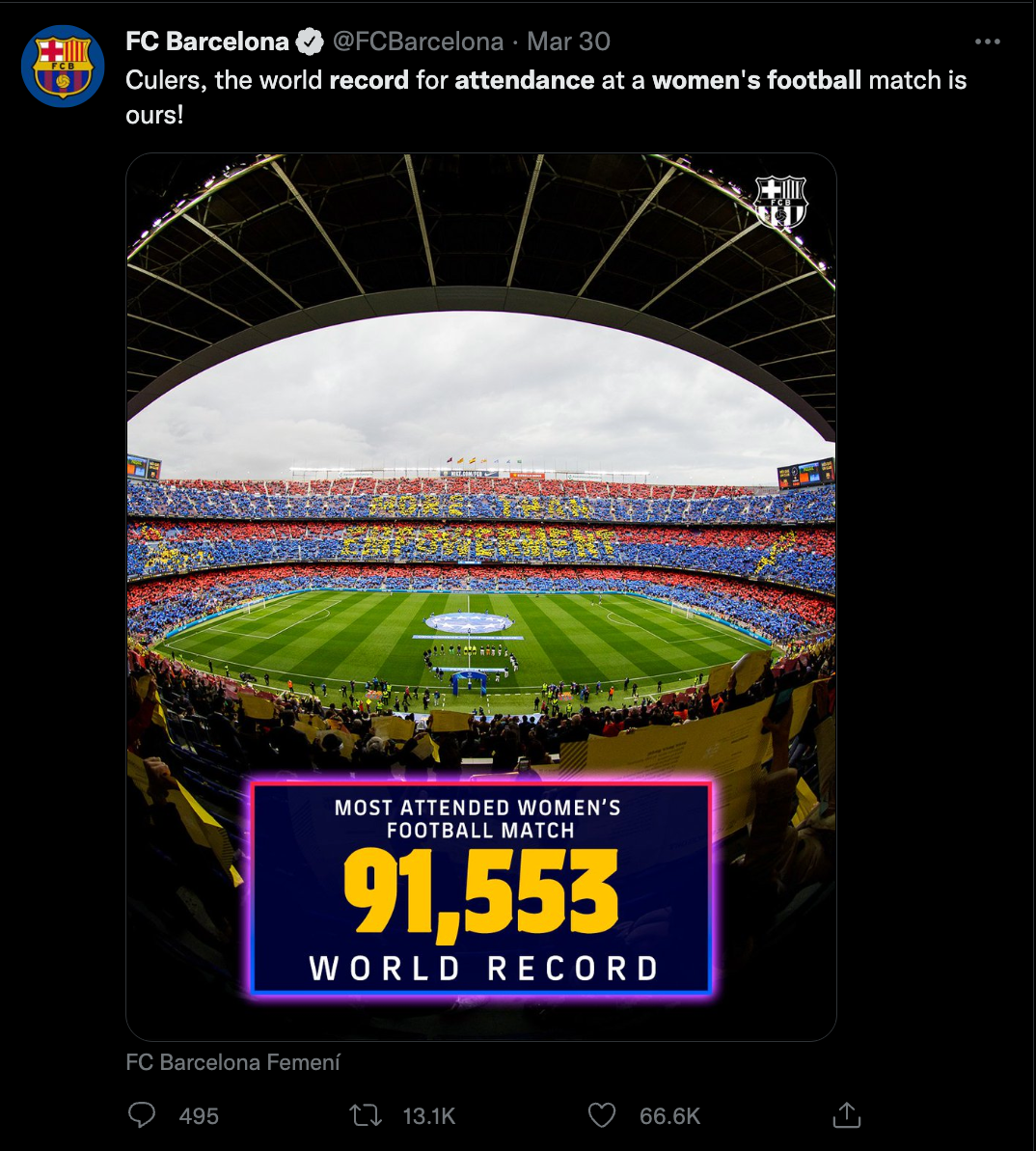
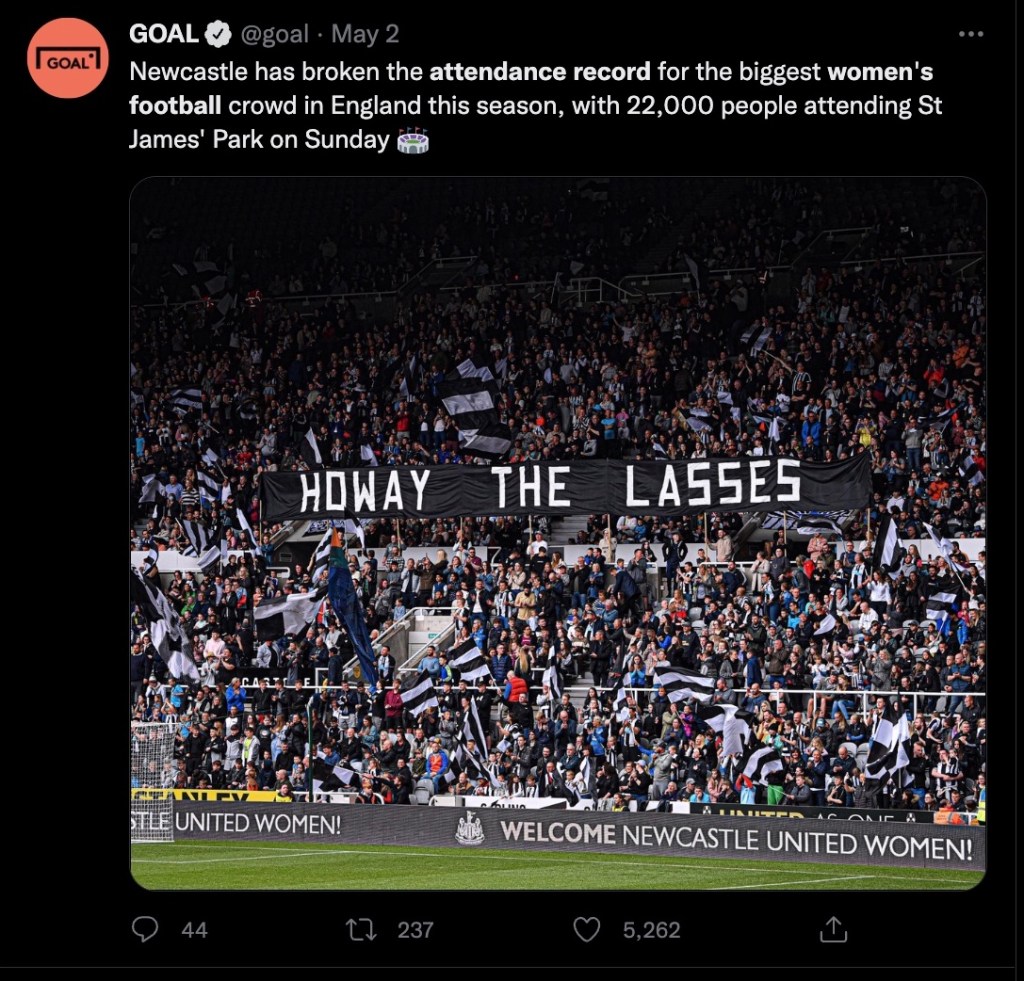
On March 30, in a new take on El Clasico, Barcelona’s women’s team beat Real Madrid. These two teams had played each other before, but never in Camp Nou. Women’s games are normally scheduled in stadiums used as training facilities for the men. Even big games, like Champions League matches, have been scheduled in smaller stadiums tucked out of the view of all but the most ardent fans. Fans, encouraged by a good promotional effort from the club, packed Camp Nou to watch their team clean Real Madrid’s clock. And when the game was over, fans stayed and sang to the team. That’s when I cried.

The club celebrated the win and quickly posted on Twitter that its crowd of 91,553 was the largest ever gathered for a women’s soccer match. I went from tears of joy to eye-roll, and then side-eye and then furrowed brows. Barcelona drew an even larger crowd for its next Champions League match; this story of record setting attendance figures at Camp Nou gained steam. It is now treated as a given, as fact. But it’s actually not true.

As numbers of news articles and television programs have detailed in recent years, Mexico hosted an international tournament in 1971. Tens of thousands of people turned up for those games: you can see the figures for those matches here, on a website maintained by sports statisticians. Two early matches featuring the home team drew 90,000; another, 80,000; the final was attended by 110,000.

In 2018, the BBC posted this lovely article about the history of that tournament. In 2019, the Guardian cited this tournament’s final as one of the most important moments in women’s football. There are quite well-research stories about this tournament out there.

Why, then, is this not mentioned in reporting on the fantastic turn-out for the women’s game this year? There is a really shitty answer for that. Those 1971 matches were not organized by FIFA. The tournament is thus regularly framed as an “unofficial” World Cup, as if the fact that it was not organized by FIFA means that it was not an actual, real, authentic football tournament. FIFA and UEFA enable this, along with news media which defers to the posture adopted by these governing bodies when they are confronted with the history of the women’s game. The history of women’s football does not belong to these organizations. In the early 1970s, FIFA and its partner organizations weren’t just uninterested in the women’s game—they actively worked to hobble it. How much that is true is not focus of this post, but let me just point out that FIFA hosted its first convention for the women’s game in 2019. (When they returned from that 1971 tournament, English players were punished by the FA with a ban; the manager who brought them was banned from the game, for life.)

We have over twenty years of World Cup and Olympic tournaments documenting the scale of interest in the women’s game: these attendance and audience statistics indicate that when the game is accessible, people show up. When it is not, people don’t. We have a hundred years of women’s football history manifesting that truth for us in so many different ways.

FIFA wants you to think that until they got involved with the game, there was nothing. That’s just a lie and its shameful to see a club participate in this gaslighting.

The history of people showing up for women’s sports is not one of slow development from primordial nothing! The people who went that 1971 match are real, actual football fans who showed up for a football match. That match was broadcast on television, covered by newspapers and was part of a series of international tournaments. Fans actually showed for — gasp — quarterfinals! Semis! Group matches! These matches are remembered, discussed, and cherished by the people who witnessed them. That tournament is a real, authentic, true part of the history of the game in Mexico, and one nice context for understanding impressive attendance figures for the still-young Liga MX Feminil (founded in 2017). If we weave 1971’s figures into list of records for attendance at women’s football matches we get something like this (WoSo stat nerds: I am very happy to correct):

  • 1971 110,000 Final Campeonato Mundial de Fútbol Femenil, Estadio Azteca in Mexico City, MX | Mexico – Denmark
  • 2022 91,648 UEFA Champions League semifinal at Camp Nou in Barcelona, SP | Barcelona – Wolfsburg
  • 2022 91,553 UEFA Champions League quarterfinal at Camp Nou, Barcelona, Spain | Barcelona – Real Madrid
  • 1999 90,185 World Cup Final at the Rose Bowl in Pasadena, CA | USA – China
  • 1971 90,000 Group A Final Campeonato Mundial de Fútbol Femenil, Estadio Azteca in Mexico City, MX | Mexico – Argentina
  • 1971 90,000 Group A Final Campeonato Mundial de Fútbol Femenil, Estadio Azteca in Mexico City, MX | Mexico – England
  • 2012 80,203 Olympics Final at Wembley in London, UK | USA – Japan
  • 1971 80,000 Semifinal Campeonato Mundial de Fútbol Femenil, Estadio Azteca in Mexico City, MX | Mexico – Italy
  • 2019 77,768 International Friendly at Wembley, London, UK | England – Germany
  • 1996 76,481 Olympics final, Sanford Stadium, Athens, Georgia | USA – China
  • 2016 70,454 Olympics semifinal, Maracanã, Rio de Janeiro, BR | Brazil – Sweden
  • 1996 64,196 Olympics semifinal, Sanford Stadium, Athens, Georgia | Norway – USA
  • 2019 60,739 Copa de la Reina Semifinal, Wanda Metropolitano, Madrid, SP | Atlético Madrid – Barcelona

Anyone following the women’s game knows that very large numbers are possible for every world cup final, if women’s world cup finals are scheduled into the largest stadiums and properly marketed. Stade de France holds 20,000 more people than Groupama, which hosted the 2019 final. The 2011 final was held in Frankfurt; that stadium was at capacity at 48,817. There are nine stadiums in Germany with larger capacities. FIFA has a terrible history of treating the women’s game as an obligation, of neglecting the women’s game in its thinking, and undervaluing the World Cup tournament itself.

There are a lot of reasons to keep our own records and insist on the integrity of our own history. One might argue that FIFA’s interest in the women’s game is motivated primarily by the desire to ward off the emergence of alternative governing structures that grow around the spaces it neglects—organizations like that which staged the tournament in Mexico in 1971. Michele Krech makes this suggestion in a terrific essay on the contradictions between Fifa’s stated intentions and its material practice:

Given FIFA’s only very recent (and tentative) embrace of women’s football, we are early in the process of witnessing the extent to which a new phase of football, under the auspices of FIFA, “offers women discursive tools to oppose oppressive power relations” or rather “enmeshes them in normalizing discourses that limit their vision of who and what they can be.” We must therefore pay close attention to how this tension plays out in the implementation of FIFA’s Women’s Football Strategy and other initiatives purported to advance gender equality. Using girls and women to grow the game will be anti-feminist if it simply brings more of them into a sport premised on masculine (and other intersecting forms of) superiority and dominance. While women’s participation challenges this premise, overturning it will require active cooperation from those who have long dominated FIFA football.

Michele Krech, “Fifa for women or women for Fifa?: The inherent tensions in Fifa’s women’s football strategy”

What we are seeing now is what happens when you give the women’s game just a piece of what the men’s game gets in terms of stadiums, and media attention. It is important to understand that in the actualization of that potential we experience a version of the game that challenges what FIFA and its structures continue to think about not just the women’s game, but the sport.

FIFA wants you to think that the history of the women’s game begins in 1971, with a match played between France and the Netherlands, attended by 1,500 people. UEFA, FAs, clubs want you to think there was nothing until they got involved. They want you to forget the history of the women’s game because the culture of their organizations is threatened by a history which suggests that other organizations and networks are capable of putting on successful tournaments and stewarding the game.

Returning to Barcelona: I cried when when fans sang to their team not because I never thought it was possible to have a full Camp Nou for a women’s match, I cried because I’ve known for so long that it was. It is really, really hard, I think, to communicate that feeling to people who haven’t shared it.

In sum: it’s important to remember that 110,000 audience record, set by fans in Mexico City in 1971, as the actual standing record for the largest-ever audience. When we forget them, we contribute to the erasure of generations of fans who have been here for this game all along and we let the gentlemen of FIFA, UEFA, and our FAs off the hook for what they did and do to the women’s game when they think no one is watching.

Outer Limit: More Notes on Losers

Cameroon’s performances in the group matches hinted at the possibility that they might explore the outer limits of the possible. Every game they’ve played in this tournament has been characterized by the sense that anything might happen. They played the edge until it wasn’t playable.

They lost to the Netherlands (3-1) in a match that had the audience riveted. The pace and intensity of that game was glorious. I saw players race around the pitch with a tornado like intensity. They were really good at loosening the ball from their opponent’s intention and exploiting the chaotic episodes of a match. Canada shut them out (3-0), but Cameroon fought from start to finish. They made Canada work. They beat New Zealand (2-1) in a barn-burner, scoring on literally the last touch of the match. One of their players was stretchered off the field at the end of the match: she had collapsed from exhaustion.

At the group stage, they played by tearing the game open — they can appear very emotional but that emotion doesn’t necessarily mean they are out of control. I think they like discombobulating their opponents —  some teams work like that. They’ll push — literally — and how you perform against them has a lot to do with how you respond to the provocation. I don’t think any of their opponents (even the ones that beat them) really played “their” game. It felt like Cameroon was authoring these matches, even from the losing side.

England’s first goal was the direct result of Cameroon’s mistake: Ejangue, in a scramble in front of the goal, kicked the ball into the keeper’s hands — a miserable mistake — Houghton converted the indirect free-kick. Cameroon seemed to feel the call against them was somehow not fair — I would say it was more humiliating than unjust and that the refusal to acknowledge this mistake was a very bad sign.

England scored again just as VAR-enhanced extra-time wound down: the goal was initially waved off as off-side but then awarded after VAR review corrected an indisputably bad call. Cameroon nearly stopped playing; for a good bit, they refused to kick-off.

photo debating the ref.png

Apparently, after all that, at half time, Cameroon’s coach, Alain Djeumfa, told players that the referee wanted England to win.

THEN, at the start of the second half, the truly incredible Nchout Ajara scored — only to have VAR take that goal back because a sliver of her heel (her back was to the goal) had crossed the line. The validity of that call is debatable.

The misery that ensued made me think of the following: When you get a red card, you have to leave the field — not just the field of play. You have to remove yourself from the game entirely. This happens because there is a real risk of fighting if that player doesn’t go to the locker room. It is a very, very bad idea to let a struggling team that feels like they’ve been cheated stand on the field contemplating the injustice of a bad decision while referees commune with the VAR apparatus. A better team, a more grounded team, a team with a stable situation, a team that trusted the refereeing might use that time to center themselves. But this team was convinced the fix was in.*

Cameroon’s coach was dropped into this position in January, after the team’s head coach and goalkeeping coach were unceremoniously fired. Why? Federation politics? Is it related to the political situation in Cameroon (Anglophone regions are threatening to secede)? Is is corruption? Were they cleaning house or the opposite? I would love to know the answer to that.

In any case, Cameroon’s players were not concerned by the question as to why none of them were given red cards — an elbow to the face, a cynical tackle which might have broken an ankle, the shove of the referee’s back, spitting on an opponent, refusing to get off the pitch at half time — the players had been tempting that fate from the start of the game and they were all spared.

And for all but the opening minutes of the second half, England did not let themselves get sucked in by the game’s drama. They very nearly paid for the few minutes they lost that focus.

People who haven’t spend much time with women athletes may find that Cameroon’s combination of attitude, playing style and tactic challenges their ideas about the women’s game. People who only watch the most intensely regulated and produced versions of the sport might have been shocked by what they saw on television. But people who watch a lot of the sport and who have played it will know that things like this can happen — in a way, the game is actually always threatening to fall apart and it takes a lot of effort on the part of match officials, event producers, coaches, support staff and players to give viewers a good game.

When a team starts to feel that the game is fixed, and that all is hopeless, they have to actively fight off the desire to stop playing. So very many national teams in the women’s game must struggle with this.

We might judge the Cameroonian side harshly, but we can do that with compassion—and perhaps use this moment to appreciate the losers who have lost well — to send some good wishes to teams like Nigeria, Thailand and especially to Brazil, who lost their match against France last night. An incredible constellation of stars are rotating out of the sky.


*a side note: in a very, very corrupt sport we should pause and reflect before dismissing players for feeling this way.

Their Loss, Our Loss

As the USWNT moved from dominating Thailand to obliterating them, people watching the game wondered, “is this OK?” Shouldn’t there be a mercy rule? As players and supporters celebrated the 8th, 9th, 10th, 11th, 12th and 13th goals, people wondered — are those goal celebrations…necessary?

There are many ways to answer that question. The importance of goal differentials to establishing one’s path out of a group is the easiest. Other teams playing Thailand in the group will likely score a lot. Any attempt on the part of teams in the group to collaborate in capping scoring against Thailand would also challenge the rules governing the game — while this is certainly the decent thing to do in amateur league play, it’s not the kind of community-oriented practice supported within a World Cup tournament.

There are, however, other angles into this match’s scenario.

Some of us have played in games like this. There are the games in which one’s team scarcely touches the ball. Games where, for example, a team might pass the ball amongst themselves while limiting each player to two touches. In which they might, oh, count off each pass they complete—turning your game into their drill. Last night’s situation may be unheard of at the highest levels but it isn’t terribly unusual for an amateur league.

When your opponent is at a level you would normally never get close to, it’s possible to play, lose big, and to take a lot from that experience. But you won’t get that kind of experience from a team that withholds its game from you.

For the USWNT team to stop scoring in that game, they would have needed to abandon any pretense towards attacking. They would have needed to turn a World Cup match into a drill. That is actually, in my view, not respectful to opposing players.

It is also makes for terrible television. That sort of thing is, for the spectator, even worse than the one-sided win.

Last night, the USWNT played as they play. Thus the Thai-American player Miranda Nild described it as “amazing” and “as a really cool experience.”

Pushing back against those who chastise US players for scoring too much, and – horrors — for enjoying scoring lots of goals — numbers of people have been pointing to similar kinds of results in the men’s game. Generally, men are not criticized for the lopsidedness of their wins, nor is their affect and composure monitored in the same way. But their losses are also very different. When Brazil collapsed in their 2014 World Cup semifinal, giving up five goals in the first half, we experienced that collapse quite differently than we experienced Thailand’s loss. Brazil’s loss manifested as an existential crisis. It was a spectacular melt-down; a shame spiral of epic proportion. We conjured a thousand reasons for that collapse, none of those explanations, however, centered on the team’s ability. The mess of that game, in fact, was all the more spectacular because we know those players, we know what they can do.

Last night’s match was a different experience entirely; we glimpsed the systematic debilitation of the women’s game. There is a lot of nobility to Thailand’s performance. Being up for a game like that takes a ridiculous amount of fortitude. But there is nothing noble about the state of the women’s game globally — even the world’s most privileged players are fighting for equal treatment within their federations. Let us remember that last year’s golden boot winner hasn’t played for her national team in two years because she expects her national team program (Norway) to be as professional as her club team (Lyon). USWNT players are suing their federation; Thailand and Jamaica’s teams are supported by private benefactors who are compensating for the lack of support the programs get from their federations; Afghanistan’s players were subjected to horrifying abuse; women’s teams are less likely get the money they earn in competition (and the money they earn is insanely less than that earned by men); federation official will give coaching positions to friends of friends who use the team to feed their egos while the federation turns away from the program’s losing record. You will find struggles against material forms of inequity at every level of the women’s game. (See Shireen Ahmed’s blistering statement on this fact.)

There are a lot of reasons to feel angry about that game. The way the USWNT played is not one of them. We should not feel shame for the losers, or for the winners. That shame, in my view, belongs entirely to FIFA and to mainstream sports media — which honestly, even now, when it is doing so much more than it used to, still does so very little serious reporting regarding the corruption, incompetence and abuse that hinders the development of the women’s game.

I can imagine a situation in which teams might collaborate in refusing to produce a lopsided result. This action would not be staged in order to spare Thai players a humiliating loss. It would be a protest, a labor action — the athlete’s version of a work-slowdown. In such a game, women might pass the ball to each other. They might refuse to defend but also refuse to score. Thai players might abandon the pretense of defending, and lose even bigger. These actions, however, only make sense for teams committed to destroying the World Cup as we know it!

France-US-Thailand-WWCup-Soccer-600x379


Passions United, a review

The bored room.

A FIFA boardroom, in which passions are united.

United Passions is fascinating. Not as a movie, of course. FIFA’s 30 million-dollar self-portrait is, instead, fascinating evidence. FIFA leaves its fingerprints on every aspect of the work’s form and content.

Structurally, the film stages a bold intervention against story-telling practice. United Passions demands that cinema catch up with the times: the dominant narrative form used by the people who govern our lives from conference rooms is that of the bullet-point presentation. This biography of a corporation thus appropriately takes the form of Powerpoint Cinema.

Blocks of information are presented in a static visual form, usually in a manner that is not entirely unlike this sentence: a passive presentation of the way things are. Randomly-generated transitions move the viewer from one information block to the next. A cause-effect relationship will be implied by the flow of one slide to the next. Sequencing is, in and of itself, all one needs in terms of structure. Information flashes across the screen; the audience is spared the burden of understanding and insight. This presentation of information is usually accompanied by an image grabbed through a google search.

One might call this a “lie-back-and-think-of England” approach to one’s audience.

This phrase, “lie-back-and-think-of England,” for the reader lucky enough to not know, refers to the advice given to women regarding the inevitability of sexual coercion in their married lives. United Passions gives us a new spin on that phrase, as several bullet points are dedicated to demonizing the men of the English Football Association. The English FA’s pomposity is here developed as a background — perhaps the only available background — against which FIFA leadership might indulge the idea that they are merely humble servants to the beautiful game. FIFA/the English FA: this the film’s most compelling face-off. Or perhaps I should say, “most compelling bullet-point sequence.”  The only thing that unites the passions of FIFA’s founding characters is their shared hatred of that other imperialist congress of entitled white assholes. (To be clear, true to its form, this is indicated in the film, rather than, say, written and acted.)

Passions United is admirably open about the scale of self-serving ambition that lies at the root of the organization. FIFA was founded, we are told, for the sole purpose of having total control over the game everywhere such control matters, mainly because a few European men were annoyed that a few English men were bitchy to them. Men in suits, largely indistinguishable from each other, declare that the only rules of the game that will matter are their rules, that the only associations that matter will be FIFA associations. Voilá! FIFA Article I: Football will not exist outside of FIFA. This naked desire for monopoly is presented by the film’s swelling score as a “win” for the game.

Sprinkled throughout Passions United (I can’t get enough of this title) is imaginative thinking which presents FIFA’s so-called political neutrality as a simultaneously anti-fascist and populist politics — e.g. a party sequence in which an English FA executive spews racist and sexist nonsense at a horrified woman (Rimet’s daughter, more on her below), a bizarre boardroom scene that recycles debunked myths regarding wartime matches (these stories are also so badly told that one can’t actually follow them anyway, so their veracity is perhaps less an issue than their coherence). These moments are reassuringly familiar as staple elements of FIFA’s pantry: bad faith and pure bullshit.

Of course, as a feminist football critic, I was pleasantly surprised to discover that women are not only not forgotten by United Passions, they are all over its Powerpoint script, as is, shall we say, the idea of Africa.

The film confirms something we have long suspected: women and Africa occupy similar, even perhaps the same symbolic territory for FIFA. The film wonderfully maps out FIFA’s psychopathology so that we might better understand the exact roles that women and Africa play in the organization’s self-understanding. Women and Africa appear in United Passions as spaces of conquest, ownership, and creepy intimacy.

Africa functions as a scapegoat for FIFA’s corruption. One scene (one bullet-point) identifies Africa’s increased participation in FIFA as a “pandora’s box”—Africa functions in this film at once as a territory to be rescued, the locus of all foul play, as cash cow, and as a trophy. Women operate as both an alibi guaranteeing FIFA’s good intentions and, also, as evidence demonstrating the nature of FIFA’s bad intentions.

This slideshow requires JavaScript.

The daughters of Jules Rimet and Sepp Blatter are given a shocking amount of screen time.

Nary a scene happens without one or the other fille: they are represented as essential conversation partners—the people with whom Rimet and Blatter talk out all of their ideas—within the script they are, really, the only people that these patriarchs can trust. This creates a little confusion. Normally, when a man talks this much at a woman in a film, it is because she is the object of his sexual interest; possession of her functions as an affirmation of his phallic power.

In short, the father-daughter partnerships of United Passions are startlingly incestuous. This is in no small part because Rimet, played by Gerard Depardieu, constantly puts his hands on his daughter (played by Jemima West), and because in at least one scene, in which the two are standing in an empty, large open public space, they stand so closely that Depardieu’s belly touches poor West. It is also because both women “characters” (that is really not quite the right word for them) function as fluffers: their sole function is to pump up Daddy’s ego. Take one of the most infamous lines of the film—as Rimet worries that playing a World Cup during the Great Depression might be wrong, his daughter says: “When have dreams ever been appropriate?” Indeed.

I appreciate the way that United Passions re-envisions Hollywood casting practices, in which women young enough to be the daughters/granddaughters of the male lead will be cast as their romantic object of interest as if such sexual relationships were fun to watch. Here, at least, that romance is called out as fundamentally incestuous—and it is presented as extremely uncomfortable viewing.

But this perhaps also reflects FIFA’s actual world, in which women can never function as equal partners, or should I say co-conspirators? The only appropriate position for a woman is as a “daughter” to FIFA’s “daddy.” Lie Back…

[I now have to wash out my eyeballs and scrub down my brain.]

Readers totally unfamiliar with the most banal conventions of the sports film might be surprised to learn that the film’s narrative superstructure is provided by a joyous pick-up game, played by children who have taken over a dusty pitch in a worn-out stadium on the edge of a city in an “emerging” nation. They are the children of the world—one of every color, and even one of the “other” gender (fair-skinned, of course). This sequence, which opens and closes the film — a “bullet point” which declares the game’s universal appeal — was filmed in Azerbaijan, whose government generously funded Passions Uniting Racketeer Influenced and Corrupt Organizations, and is therefore listed as a production partner.

This slideshow requires JavaScript.

This sequence, ironically depicting exactly the kind of game over which FIFA has no control whatsoever, as well as a kind of match (mixed-gender football) that FIFA explicitly prohibits, is the part of United Passions that one might equate with the google-search-produced image dropped into a Powerpoint slide. Of course, at first the lone girl resigns herself to playing goal. And she doesn’t know how to defend, apparently, because she makes barely a gesture to blocking shots—accepting humiliation and uselessness as her gendered lot—until, at the last moment and for no particular reason, she takes the ball, dribbles it up the field, shoots and scores. Her teammates are overwhelmed with joy. “Who would have believed this!” The film’s audience is asked this in a voice-over—an editorial accident superimposes the surprise that FIFA has lasted as long as it has, “accomplished” as much as it has, over an image which suggests a community’s surprise that a girl knows how to kick a ball.

Embedded below, the film’s conclusion. “Enjoy” it while you can.

https://youtu.be/ssIB2QLT740?t=1h22m38s

Women: They are all the Same to Sepp

This slideshow requires JavaScript.


Grant Wahl’s Sports Illustrated article on FIFA’s sexism opens with story from Abby Wambach:

U.S. forward Abby Wambach tells one from the time she and her now-wife, Sarah Huffman, were backstage in a VIP room in January 2013 before the World Player of the Year awards gala in Zurich, Switzerland. “[FIFA president] Sepp Blattercame into our little area, and he walked straight up to Sarah and thought she was [Brazilian star] Marta,” says Wambach.

“Marta!” Blatter said, hugging a bewildered Huffman, who doesn’t look much like Marta. “You are the best! The very best!”

“He had no idea who Marta was, and she’s won the award five times,” says Wambach. “For me, that’s just a slap in the face because it shows he doesn’t really care about the women’s game.”  Read the rest of Wahl’s story here.

Blatter has not only met Marta Viera da Silva many times; his organization has used her and Wambach as alibis for the “good work” FIFA does for the world. Marta is not just another great player—she functions quite specifically as a poster-image for the world game.

There’s a lot more to say about the incidents recounted in Wahl’s article—but that one moment speaks volumes.  Imagine if Blatter mixed up, say, Kaká and Klose. (Men in suits—who can tell them apart?!) Given the difference in the game’s scale, however, the bar of our expectations regarding Blatter’s ability to recognize women players is actually quite low. One would expect him to be familiar with only a handful of people who look nothing like each other—Wambach, Marta, Nadine Angerer, Birgit Prinz, Homare Sawa and Hope Solo. Sepp Blatter can’t even manage THAT.

A People’s Cup

Each broadcast of FIFA’s World Cup opened with plastic samba and cartoon favelas—the actual streets of Brazil were off-limits as far as FIFA’s marketing department was concerned. They are not up to standard, and so they were replaced, like so much else.

Around the world, however, people practice the sport according to a different set of guidelines.  Las Futbolistas, for example, offer a weekly kickabout where “anti-sexist, anti-imperialist, liberation-minded lovers of the sport [can] go to relearn the game.” This past weekend, the Los Angeles collective staged a small game in Skid Row, a neighborhood in downtown LA with a large homeless community. They then marched to the Federal Detention Center, and projected the 3rd place match on a wall across the street from the building. Las Futbolistas were kind enough to share video highlights from the day.


FIFA’s Official Poster for 2015: It’s Pretty

Canada 2015 Women's World Cup Poster

Long, flowing hair. Clearly beautiful. At the center of this poster’s story is an ambiguous relationship between a woman and a ball. Something about this reminds me of the association of women with “the land.” The beautiful game is beautiful, we are reassured, even when women play it. Especially if they have long flowing hair. Isn’t the poster beautiful? It’s is! Because I can’t see anything good in anything that FIFA does, I am a wee bit afraid of this:

pocahontas

So some things to celebrate. No ponytail, for example. Some things to furrow one’s brows over: no image of a woman in action.

A reminder of how the men’s game is pictured:

pressrelease_282663_1379007819

Not only are players figured into the design above; they are figured into the design as in competition with each other. It would be interesting to see a similar gesture applied to representing the women’s game—but, from an advertising/marketing perspective, this is one of the “no-go” zones in the women’s game. Women competing directly against each other, physically challenging each other? Not as pretty as flowing hair, pretty eyes and high cheekbones.

That said, the 2015 Women’s World Cup has the best World Cup mascot ever. EVER. Someone please make me a lucha libre version of this:

owl

Goal Deficit: a note on Brazil’s loss and David Luiz’s tears

Luiz

The World Cup is an intensely produced spectacle. Each goal is a world-defining event. The televisual audience watching from home, thousands of miles from the stadium, luxuriates in the experience of proximity to the match. We race down the pitch behind an attack, we are inside the goal as the ball hits the back of the net. Players rush across the field to celebrate, a camera suspended from wires flies behind and above them, like a bird. Suddenly, we’ve parachuted into the celebratory huddle. We are as close to the players’ ecstasy as they are to each other. Cut to views of jubilant crowds watching in public parks and in bars across the country. A goal yields a surplus of joy.

But oh, when the event goes sour!

A goal is only pleasurable in an economy of scarcity. In a match like today’s, in which a team is simply annihilated, a surplus of goals ruins the story. One side takes what it wants; the other is helpless.

There is no suspense, there is no release. First there is only shock, and shame. Then we settle into the grim situation. Perhaps a cold curiosity takes over. A team knows that it is lost, and there are still 70 minutes to play. We watch the rest of the match, bearing witness to the humanity of the losing side.

A realism shadows the broadcast. It is the shadow of an alternate world to the World Cup—the shadow cast by the world in which we live.

David Luiz, in a post-match interview, cries openly. (The women in Émile Zola’s novels grow more beautiful as they are beaten by their lovers; something about this scene reminds me of this.)

Through his tears, Luiz apologies. He “wanted to bring joy to the people who suffer so much.” He and his team failed—of course they did. Not even the people running this event—the show runners—believe that the success or the failure of the World Cup rides on any single team’s performance, or even that it will be measured by the quality of the spectator’s pleasure. It will be measured by the seamlessness of the production and the direction of capital flow.

As Luiz cries, he and his teammates are carried away by the tide.