Grant Wahl’s Utopianism

In 2011, Grant Wahl announced his intention to run for President of FIFA. His platform included the introduction of term-limits for FIFA officials, hiring the best referees for the World Cup and requiring them to explain controversial calls, ending the use of yellow cards for stupid things like removing shirts in goal celebrations, and the dismantling of the system which effectively excluded women from FIFA leadership. It’s worth reading Grant’s take on his “half-serious, half-satire” campaign and watching his campaign ad: “There’s a cure for FIFA’s Blatter infection!

The prescience of this interventionist project is hard to appreciate. He promised to appoint a woman as FIFA’s General Secretary, its most powerful position. The role is now served by Fatma Samoura, appointed in 2016. He advocated for the introduction of goal-line technology and instant replay. We now have a new sports writing sub-genre: complaints about VAR. He promised a “wikileaks”-level release of FIFA’s records which would allow the organization to being to reckon with the rot within its structure and culture. Football leaks, a massive data dump exposing the scale of corruption in the sport, launched in 2015. In recent years, FIFA has been the subject of sustained forms of scrutiny and global reflection on the question of what accountability and change might be for an organization this incestuous, this rotten.

At the time, however, for a candidate to advance to the election, FIFA required the official endorsement of just one of its 208 football association: not one would take the risk of alienating themselves from the affections of the men who run the organization. The action of soliciting a nomination from the 150 FAs that Grant selected as the “least corrupt” in FIFA’s system made visible the shamefulness of FIFA’s so-called democratic process. Without a nomination, his candidacy was stopped before anyone had a chance to vote for him. Sepp Blatter ran unopposed.

Today FIFA requires the endorsement of five FAs, a change attributed to Wahl’s action and one designed to make interventions like his less feasible. But in the wake of his candidacy, Grant wrote, “ordinary fans in countries around the world talked a little bit more about the absurdities of Fifa’s electoral process.”

This is a good moment to reflect on what FIFA might have been under Grant’s leadership, and on the importance of journalism to the project of wrestling this sport away from the hyper-exploitative systems we’ve been tricked into thinking of as inevitable and insurmountable.

Truth tellers with utopian impulses are to be cherished. We saw a little of this side of Grant in the photo he shared of himself in a rainbow shirt when he was stopped from entering the stadium near the start of the tournament. He was eventually allowed to proceed to his seat in the press zone; reporting of his death often includes a photo of Grant in that shirt sitting at a desk, writing. He of course knew he was likely to be stopped, and I am sure he understood the action as pure symbol. But in a week marked by a mass shooting at yet another LGBTQ bar, in a season shadowed by the violent repression of young revolutionaries in soccer-mad Iran and the question of how one honors them at the tournament when the team is used ruthlessly by the country’s dictatorship as if their wins could wash away its sins, at a time when anti-trans hate has been perfectly fused into fascism’s psychosis, Grant’s gesture of solidarity from inside the machine mattered. It was a signal for those of us watching the game and feeling driven to the edge of madness by the gaslight—it was a way of letting us know that there are allies in the press who are also struggling with the structure and with the moment.

I don’t know how he managed to balance his love for the sport with his awareness of the awfulness of the organizations which manage it—I’m in constant awe of the people who write about this day-in, day-out. He clearly understood the importance and the value of that work himself: he was a constant ally and champion of feminist, queer, and anti-racist sports writing. He often let us know when, in our own work, we hit the nail on the head, and via his social media platform he amplified our voices. He read our work.

Great sports writers make you feel the passions invoked by the subject, and, often in equal measure, the frustration and outrage we feel when our love is exploited and betrayed. This has been especially true of Grant’s writing about this World Cup, the enjoyment of which is shadowed and corrupted not only by the ruthlessness of Qatar’s development practice but by the resonance of that practice with those of FIFA itself. Those of us struggling to manage our relationship to this tournament are responding not only to the present, but to decades of the abuse of our love for the sport and for the people who play it. We have really and truly had enough and want a different FIFA, maybe even something that isn’t FIFA at all.

The very deep grief so many of us feel at the news of Grant’s death is tied to the forms of grievance that Grant helped us to name, even as he wrote the story of our love for this game.

Note. There are many sharing their affection and respect for Grant. Although I’m using his name like he was a personal friend, I only met him IRL a few times. There are so many people out there who collaborated with him, worked alongside him, and really knew him and who are writing their grief and sharing stories. Richard Deitsch included a beautiful list on The Athletic as an addendum to the moving sketch of his own sense of loss. If you are feeling sad, I encourage leaning into this community of people who are sitting down at their desks and honoring his memory by giving our love and our grief a shape we can share.

Attendance Record for Women’s Football! [whispers] was set in 1971

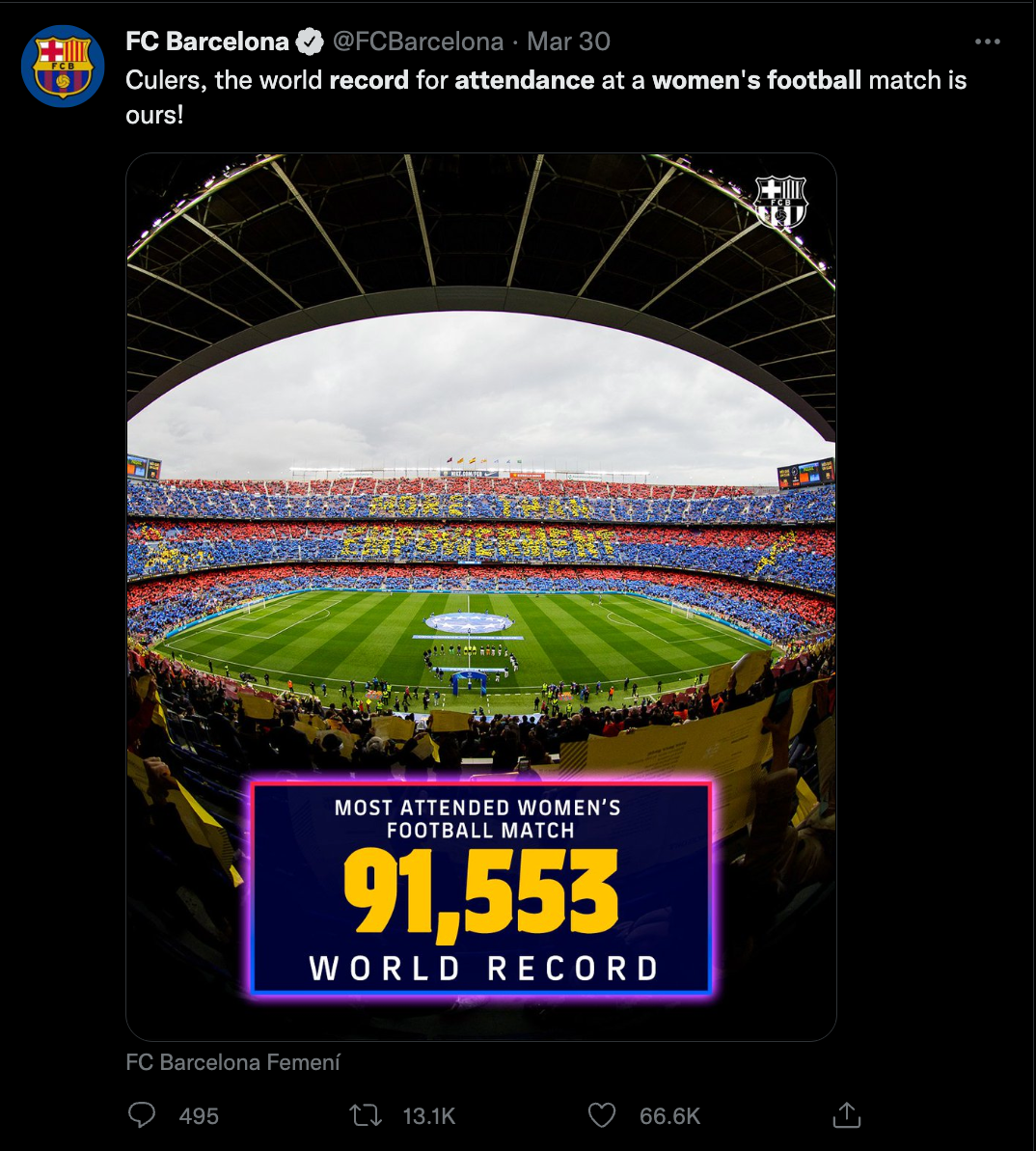
On March 30, in a new take on El Clasico, Barcelona’s women’s team beat Real Madrid. These two teams had played each other before, but never in Camp Nou. Women’s games are normally scheduled in stadiums used as training facilities for the men. Even big games, like Champions League matches, have been scheduled in smaller stadiums tucked out of the view of all but the most ardent fans. Fans, encouraged by a good promotional effort from the club, packed Camp Nou to watch their team clean Real Madrid’s clock. And when the game was over, fans stayed and sang to the team. That’s when I cried.

The club celebrated the win and quickly posted on Twitter that its crowd of 91,553 was the largest ever gathered for a women’s soccer match. I went from tears of joy to eye-roll, and then side-eye and then furrowed brows. Barcelona drew an even larger crowd for its next Champions League match; this story of record setting attendance figures at Camp Nou gained steam. It is now treated as a given, as fact. But it’s actually not true.

As numbers of news articles and television programs have detailed in recent years, Mexico hosted an international tournament in 1971. Tens of thousands of people turned up for those games: you can see the figures for those matches here, on a website maintained by sports statisticians. Two early matches featuring the home team drew 90,000; another, 80,000; the final was attended by 110,000.

In 2018, the BBC posted this lovely article about the history of that tournament. In 2019, the Guardian cited this tournament’s final as one of the most important moments in women’s football. There are quite well-research stories about this tournament out there.

Why, then, is this not mentioned in reporting on the fantastic turn-out for the women’s game this year? There is a really shitty answer for that. Those 1971 matches were not organized by FIFA. The tournament is thus regularly framed as an “unofficial” World Cup, as if the fact that it was not organized by FIFA means that it was not an actual, real, authentic football tournament. FIFA and UEFA enable this, along with news media which defers to the posture adopted by these governing bodies when they are confronted with the history of the women’s game. The history of women’s football does not belong to these organizations. In the early 1970s, FIFA and its partner organizations weren’t just uninterested in the women’s game—they actively worked to hobble it. How much that is true is not focus of this post, but let me just point out that FIFA hosted its first convention for the women’s game in 2019. (When they returned from that 1971 tournament, English players were punished by the FA with a ban; the manager who brought them was banned from the game, for life.)

We have over twenty years of World Cup and Olympic tournaments documenting the scale of interest in the women’s game: these attendance and audience statistics indicate that when the game is accessible, people show up. When it is not, people don’t. We have a hundred years of women’s football history manifesting that truth for us in so many different ways.

FIFA wants you to think that until they got involved with the game, there was nothing. That’s just a lie and its shameful to see a club participate in this gaslighting.

The history of people showing up for women’s sports is not one of slow development from primordial nothing! The people who went that 1971 match are real, actual football fans who showed up for a football match. That match was broadcast on television, covered by newspapers and was part of a series of international tournaments. Fans actually showed for — gasp — quarterfinals! Semis! Group matches! These matches are remembered, discussed, and cherished by the people who witnessed them. That tournament is a real, authentic, true part of the history of the game in Mexico, and one nice context for understanding impressive attendance figures for the still-young Liga MX Feminil (founded in 2017). If we weave 1971’s figures into list of records for attendance at women’s football matches we get something like this (WoSo stat nerds: I am very happy to correct):

  • 1971 110,000 Final Campeonato Mundial de Fútbol Femenil, Estadio Azteca in Mexico City, MX | Mexico – Denmark
  • 2022 91,648 UEFA Champions League semifinal at Camp Nou in Barcelona, SP | Barcelona – Wolfsburg
  • 2022 91,553 UEFA Champions League quarterfinal at Camp Nou, Barcelona, Spain | Barcelona – Real Madrid
  • 1999 90,185 World Cup Final at the Rose Bowl in Pasadena, CA | USA – China
  • 1971 90,000 Group A Final Campeonato Mundial de Fútbol Femenil, Estadio Azteca in Mexico City, MX | Mexico – Argentina
  • 1971 90,000 Group A Final Campeonato Mundial de Fútbol Femenil, Estadio Azteca in Mexico City, MX | Mexico – England
  • 2012 80,203 Olympics Final at Wembley in London, UK | USA – Japan
  • 1971 80,000 Semifinal Campeonato Mundial de Fútbol Femenil, Estadio Azteca in Mexico City, MX | Mexico – Italy
  • 2019 77,768 International Friendly at Wembley, London, UK | England – Germany
  • 1996 76,481 Olympics final, Sanford Stadium, Athens, Georgia | USA – China
  • 2016 70,454 Olympics semifinal, Maracanã, Rio de Janeiro, BR | Brazil – Sweden
  • 1996 64,196 Olympics semifinal, Sanford Stadium, Athens, Georgia | Norway – USA
  • 2019 60,739 Copa de la Reina Semifinal, Wanda Metropolitano, Madrid, SP | Atlético Madrid – Barcelona

Anyone following the women’s game knows that very large numbers are possible for every world cup final, if women’s world cup finals are scheduled into the largest stadiums and properly marketed. Stade de France holds 20,000 more people than Groupama, which hosted the 2019 final. The 2011 final was held in Frankfurt; that stadium was at capacity at 48,817. There are nine stadiums in Germany with larger capacities. FIFA has a terrible history of treating the women’s game as an obligation, of neglecting the women’s game in its thinking, and undervaluing the World Cup tournament itself.

There are a lot of reasons to keep our own records and insist on the integrity of our own history. One might argue that FIFA’s interest in the women’s game is motivated primarily by the desire to ward off the emergence of alternative governing structures that grow around the spaces it neglects—organizations like that which staged the tournament in Mexico in 1971. Michele Krech makes this suggestion in a terrific essay on the contradictions between Fifa’s stated intentions and its material practice:

Given FIFA’s only very recent (and tentative) embrace of women’s football, we are early in the process of witnessing the extent to which a new phase of football, under the auspices of FIFA, “offers women discursive tools to oppose oppressive power relations” or rather “enmeshes them in normalizing discourses that limit their vision of who and what they can be.” We must therefore pay close attention to how this tension plays out in the implementation of FIFA’s Women’s Football Strategy and other initiatives purported to advance gender equality. Using girls and women to grow the game will be anti-feminist if it simply brings more of them into a sport premised on masculine (and other intersecting forms of) superiority and dominance. While women’s participation challenges this premise, overturning it will require active cooperation from those who have long dominated FIFA football.

Michele Krech, “Fifa for women or women for Fifa?: The inherent tensions in Fifa’s women’s football strategy”

What we are seeing now is what happens when you give the women’s game just a piece of what the men’s game gets in terms of stadiums, and media attention. It is important to understand that in the actualization of that potential we experience a version of the game that challenges what FIFA and its structures continue to think about not just the women’s game, but the sport.

FIFA wants you to think that the history of the women’s game begins in 1971, with a match played between France and the Netherlands, attended by 1,500 people. UEFA, FAs, clubs want you to think there was nothing until they got involved. They want you to forget the history of the women’s game because the culture of their organizations is threatened by a history which suggests that other organizations and networks are capable of putting on successful tournaments and stewarding the game.

Returning to Barcelona: I cried when when fans sang to their team not because I never thought it was possible to have a full Camp Nou for a women’s match, I cried because I’ve known for so long that it was. It is really, really hard, I think, to communicate that feeling to people who haven’t shared it.

In sum: it’s important to remember that 110,000 audience record, set by fans in Mexico City in 1971, as the actual standing record for the largest-ever audience. When we forget them, we contribute to the erasure of generations of fans who have been here for this game all along and we let the gentlemen of FIFA, UEFA, and our FAs off the hook for what they did and do to the women’s game when they think no one is watching.