raising a fist at the fix

“Since the time of Jesse Owens it has been presumed that any poor but rugged youngster who was able to jump racial fences into a college haven was happy all day long.” So wrote Harry Edwards in The Revolt of the Black Athlete (p. 75). The observation describes the ruling common sense, which is to say, a ruling ideology – in which an education is a blue ribbon or trophy (something you win, rather than earn); a college campus is “a haven” and the black male athlete is imagined as the eternal supplicant, “happy all day long” because he has been saved (from what? himself? his world? his color?). Any poor but rugged youngster – any “Jesse Owens” – must be running with joy, he must run as a means of joyful escape – running isn’t his job; it isn’t his work. If he’s happy all day long, it is because this discipline is his pleasure.  This is perhaps, more true today than it was in 1969, the year Edwards published his account of the radicalization of the black athlete, of the movement that led to one of the most enduring images in sports history – Tommie Smith and John Carlos, on the Olympic medal stand, heads bowed and fists raised.

NKU @ Garmsville1968_BlackPowerSalute1

Tommie Smith (the gold medalist) has a dim view of college athletics (even as he has a real love for his sport). Smith is one of the greatest sprinters to have ever taken to the track – he was, of course, a stand-out at San José State, then known as “speed city” for its sprinting program. Smith’s memoir, Silent Gesture, is remarkable for many reasons – he is an incredible person – but many would likely find his lack of nostalgia for his college years bracing. Smith describes his relationship to his alma mater as a big fat blank. Recalling a trip to San José State to participate in events honoring Smith and Carlos’s shared legacy, he writes,

I didn’t feel anything from the faculty and the administration when I was a student, I didn’t feel anything after I graduated and I didn’t feel anything that night [when he and John Carlos were honored] or since.

Smith is clear in his memoir: college sports is a fraud. Black athletes playing big-time sports then and now are ruthlessly exploited; they are treated as frauds (as undeserving), they are abandoned to a world of lowered expectations, used until they are used up. Smith doesn’t think that much has changed since the late 1960s, neither does Edwards.

The myth of the grateful black athlete puts a gloss on the collusion between universities, the NCAA, media and sports corporations – systems that bank on the spectator’s investment in the idea that this athlete is, indeed, “happy all day long” because the world is doing him one favor after another. That spectator’s pleasure is easily purchased, but the cost for the athlete is high. 

Fraud charges were filed last month against a former professor at UNC Chapel Hill, the latest plot twist in an old fashioned college sports scandal that’s been at a gentle boil for over three years. (See The Daily Tar Heel’s “Tracking a Sports Scandal”) It’s a particularly depressing story. 

Professor Julius Nyang’oro (who retired in 2012) chaired the African and Afro-American Studies Department at the University of North Carolina, Chapel Hill for 20 years.  Today, he stands accused of defrauding UNC by accepting pay for a 2011 course that he basically didn’t teach. That summer course, according to the Raleigh News and Observer

is one of more than 200 such lecture-style classes dating back to the mid-1990s that show little or no evidence of any instruction. These classes included roughly 500 grade changes that are either confirmed to be or suspected of being unauthorized. (See Dan Kane, “Former UNC Official Nyang’oro will fight felony charge”)

The  course in question had enrolled only current and former athletes, and athletes in the school’s football and basketball programs dominate the roster for the other classes. It seems pretty clear from media reports that this faculty member, with the support of administrative staff, helped athletes out by giving them course credit for courses that were barely taught. An NCAA investigation was conducted, and UNC responded with a report. Some tutors and  coaching staff were fired; an athletic director retired. A host of athletes were benched, declared ineligible, dropped and disciplined. And yet it seems the professor stands relatively alone in criminal court. It would be nice for UNC if it could wind this story up by claiming the campus was defrauded by a rogue faculty member – but it defies belief that the situation described in the press could have been conducted without – at the very least – an intense and deliberate blindness. It defies belief that the level of fraud implied here could flourish in the African and Afro-American Studies department without the collusion of the university administration – a New York Times journalist reports:
People in the department described it as balkanized — professors stuck to their own courses and research — and said that Mr. Nyang’oro was an inattentive administrator who was often out of the country, even when he was supposed to be teaching. They said that his continual reappointment as the department chairman, a job most professors hold for 10 years at most, reflected the university’s indifference to what was going on there. (Sarah Lyall, A’s for Athletes)
It’s a Philip Roth novel: by which I mean, it’s a white supremacist fantasy – the corrupt black studies professor as the instrument of a corrupt athletic department, affirming the “common sense” that the black athlete has no real place at all in the classroom – the student is a fraud and so is the black professor. It’s a terrible story – one that reminds us of Edwards’s strident calls for deep reform:
Like a piece of equipment, the black athlete is used. The old cliché ‘You give us your athletic ability, we give you a free education’ is a bare-faced lie, concocted by the white sports establishment to hoodwink athletes, white as well as black.
First of all, there is no such thing as a ‘free’ ride. A black athlete pays dearly with his blood, sweat, tears, and ultimately with some portion of his manhood, for the questionable right to represent his school on the athletic field. Second the white athletic establishments on the various college campuses frequently fail to live up to even the most rudimentary responsibilities implied in their half of the agreement. (Edwards, 16)
In the UNC report regarding the empty credits awarded to student athletes, we see that if anything has changed, it’s the complexity of the system. It’s a miserable story; here I’ve outlined just one or two aspects of its ugliness.

the rape of a teammate

In January 2013, two athletes sexually assaulted a co-worker and teammate.

The three members of the Lloyd Irvin martial arts academy ran into each other at a New Year’s Eve party at a nightclub. One teammate had too much to drink and didn’t want to drive home. The others offered this person a ride, but instead of bringing their teammate back home, they attacked her in a parking garage. The assault is described in detail in the criminal complaint filed against Matthew Maldonado and Nicholas Schultz: the police could narrate the rape in gruesome detail because security cameras in the parking lot recorded the whole thing. One of the least gruesome passages:

The Complainant then pushed Defendant Schultz off her as her body slumped to the ground with her head still against the wall. Defendant Schultz then advanced toward the Complainant and began to lie on top of her. Defendant Schultz again pulled the Complainant towards him, holding on to her until her body collapsed again, this time her head striking the ground. (from Zack Arnold on Fight Opinion)

As they assaulted their teammate, she fell over, she asked that they stop, she hit her head on the ground and against the wall.  When they finished, the two men left their Brazilian jiu jitsu (bjj) teammate unconscious on the parking lot pavement: it was 38 degrees. There she lay until someone walking by heard her cry for help. Schultz and Maldonado had offered her a ride home; instead of looking after a person they saw just about daily at their gym, they attacked her and left her for dead. As one member of the bjj community put it, they left her there like she was a piece of trash – which is, of course, exactly how other people in that community have talked about her.

When this story broke, it quickly came to light that in 1989 the man running their gym, Lloyd Irvin, had been charged with rape. He’d participated in a gang rape – most of the men involved went to jail. Because he didn’t have intercourse with the victim, this man did not.

This past winter, there was an exodus of fighters from this man’s gym: these athletes left as they learned of yet more harassment of teammates within the gym. This wasn’t a club they wanted any part of; they went public with their outrage. (See Brent Brookhouse’s reporting on Bloody Elbow/SB Nation; listen to Mike Fowler talk about these issues in an interview for Open Mat. That section starts at 1:14.)

This past week, in spite of video evidence of the assault, a jury acquitted the two men of kidnapping and first and second degree sexual assault. A mistrial was declared regarding a misdemeanor charge against Schultz.*

Over the past year, the leader of this gym, the man who’d escaped the rape charge in 1989, has scrambled to try to paper over the scandal of his conduct – much of this story has been acted out through social media, and much of his behavior has only served to confirm him as an abusive coach. People in the Brazilian jiu jitsu and martial arts community have been doing serious soul-searching: a public conversation about rape, violence, aggression and power began almost as soon as the story broke.

For example: from the start Georgette Oden, a bjj practitioner and an Assistant Attorney General in Texas, has been breaking things down for the bjj community on her blog Georgette’s Jiu Jitsu World. Her posts are very helpful to readers who need to understand what sexual assault is, and, more recently, how a jury might acquit defendants and why an acquittal doesn’t mean that the victim wasn’t raped.

Aaron France, a DC Police Detective who is also a bjj coach addressed the case in a Facebook post that has since been shared on Reddit and on blogs. He attended as much of the trial as he could, and saw the video evidence. When Maldonado was acquitted, some people were eager to celebrate this as a declaration of his innocence. France writes:

Ask yourself; if this happened to your wife, your daughter, your girlfriend, your sister, or even a close female friend, would you advocate Maldonado’s innocence? Most of you would be calling for blood. Some of you would even take it yourselves. So if we were to look at Maldonado’s behavior, put criminal implications aside and give him the benefit of the doubt, here’s the best thing we can say about him… He had sex with a woman who was intoxicated to the point where she could not walk, and afterwards he treated her like a piece of trash, by leaving her half naked on the cement floor of a parking garage, in the middle of the night, when it was barely above freezing.

And that woman? She was his “teammate.” Not many people outside of the Brazilian jiu jitsu Community can comprehend the bond that develops between training partners, due to the level of trust that training partners are required to develop in each other.

…Yet there are a few people who believe that we should let him back into the Brazilian jiu jitsu community. These people believe that he should be allowed to continue to sharpen his skills, learning to choke people and cause their joints to stop functioning. They apparently believe that he should be allowed to do this in the presence of women and children. How can you possibly ever trust this man not to just hang onto a choke, or not hold an armbar after you tap? He’s already demonstrated a propensity to do what he wants with another persons body, why should we believe it ends with sex?

That statement is preceded by a sobering account of the steps required to bring a rape case to trial: that it went to trial, he explains, has to be valued as a certain small measure of justice. Juries, he writes – citing the Rodney King verdict – don’t always get things right.

He reminds his readers that people who commit sexual assault pose a danger to everyone around them. It is wrong, he points out, to assume that the violence of their behavior towards a woman is somehow unique to their relationships with women. It is evidence of how they treat people. Martial arts students are physically vulnerable to each other; an irresponsible training partner will hurt the people in his world.

The Gracie brothers (members of the first family of Brazilian jiu-jitsu) posted a sincere and thoughtful discussion of the crisis to their popular Youtube channel in January. In that discussion they emphasize the challenge of martial arts training: it can either produce a balanced, peaceful athlete or an aggressive and antagonistic one. They, too, stress the vulnerability of training partners – not women, mind you: but all of the people with whom you study a martial art.

The story of the abusive environment cultivated by Lloyd Irvin has scarcely left the MMA bubble, however. If it were not for Bloody Elbow’s contributions to SB Nation, I’m not sure this story would have any presence at all in sports media more broadly. It surely deserves much more attention than it’s gotten.

It deserves attention because the victims, the abusers, the bystanders and the defenders were all teammates and training partners. There are few sports communities in which such a thing is possible. And to outsiders, such a thing is truly remarkable, given the nature of the sport we are talking about. In the U.S., young women grapple against young men in high school competition – those women expand their training into bjj, boxing, Muay Thai, MMA. Men can get used to training alongside and sparring with women pretty quickly, people enjoy having women compete on the same card as men, representing their gym in team competition and in amateur and semi-pro competition. Martial arts competitions are heterogeneous – men and women are both a part of the sport spectacle. They are athletes, fans, trainers and referees.

As Ryan Hall writes in his “Open Letter to the Martial Arts Community,” “I am surrounded by people I respect not only as fighters and instructors, but as men and women, as human beings. I feel incredibly fortunate.”

As authoritarian and hierarchical as gyms can be – and by all reports Lloyd Irvin’s gym was and is a frightening example of that – they can also be something else (this is the subject of Hall’s open letter). A gym can be a place of humility and respect, a socially level space in which people commit to supporting each other as they attempt to figure out their goals, and help each other to meet them. This assault represents a crisis within the martial arts community not because it seems to express a form of masculine aggression latent to the sport (which is how we tend to frame rape cases involving football players) but because it betrays the value that define it.

Sexual violence between members of the same community is engineered to either expel the victim from that community or to make her sexual subjection a condition of her membership. Unlike the women assaulted by football players in the stories that make national headlines, the woman assaulted in this story was not only a fellow teammate; she was also a fellow employee.

There can be no assertion that rape culture is somehow endemic or specific to a sport that is desegregated: a sexual assault in that environment is like a sexual assault in any environment in which the victim knows, and has some kind of relationship to her attacker. It isn’t the sexism of the sport that’s at issue, it’s the sexism of that gym-space, and the sexism of the world. These are, in fact, the conditions under which most sexual assaults happen. A person might be attacked by her co-worker, a member of the same military unit, she might be attacked by her boss, a teacher. A member of her family. And, actually, where these football stories are concerned: these young women are not outsiders. They are, almost universally, fellow students at the same high school or university.

Of course every community must work towards a world in which there is no sexual assault. Every instance makes us ask why and how. With regards the case at hand, we must consider how little justice there is for victims of sexual assault and how much harder such cases can be for those assaulted by people they know. (Would that jury have acquitted those two men if they were strangers to the woman they attacked? In what world do you leave a consenting sexual partner on the ground, outside in the winter when she is too drunk to even sit up?)

This case shows us that we need to consider how should we respond to such a profound transgression of the athlete’s community.

We must work not only to make another attack less likely, but also to embrace the person attacked: to refuse to exile and shame her. To refuse complicity with narratives which make the presence of women within the sporting community into the problem, the “cause.” We must make room for conversations about sex, violence and power.

The football-centered conversations about rape just haven’t been compelling to me. Too often, such conversations are anchored in a deeply patriarchal language that re-inscribes the social vulnerability of women to masculine aggression. And while you will see the shadow of that mindset creep into the Gracie brother’s discourse, overall, the conversation that they and Oden and Hall and others have been forwarding is actually centered on the integrity of fighting, as an art that defines a community.

At the heart of a fight is a consensual relation to violence. That consensus is not merely an agreement to fight: it is also an agreement to stop fighting when one fighter submits to the other and “taps out.”

That rape was a violation of the bonds of trust and dependence that make that sport even thinkable.

Bloody Elbow reported in February that Lloyd Irvin’s best fighters left when one of the women on the team confided in a teammate that she’d been subjected to classic harassment that was moving towards sexual coercion. She needed help and advice.

In how many sports does a woman talk to a man, as a teammate, about this?

That one gesture – in which a junior woman athlete turns to a male colleague – and that one productive response – athletes united in their outrage – demonstrates how things might go: within at least the community of fighters invested in a not-sexist training space, the problem isn’t men, and it isn’t women. The problem is the sexist, authoritarian leader. That authoritarian figure is as much as a problem for men as for women.

There is no such thing as a “rape culture” unique to “jock culture” – it is only (only!) the deep, dramatic segregation of football as a purely masculine space that makes the Steubenville-like stories of social, public group attacks on women feel somehow unique to the sport. I wonder if one attraction to that phrase “rape culture” isn’t the way it lets us disavow the fact that gender segregation builds sexual violence into a social structure. You won’t find an authoritarian patriarchal space that doesn’t in some way produce the conditions of possibility for this kind of attack, a kind of violence that partners well with homophobic attacks on genderqueer people.

Making this story all the harder to tell is the ferociousness of public ignorance about sex and power.

I imagine that people who join together in sexual assaults against people who are incapacitated (by alcohol, by drugs – sometimes by drugs given to them with malicious intent) are people who would not dare to consider their relationship to eroticism, to sex, and to pleasure.

I imagine that these are people who do not know how to participate in a conversation about sex and power. These are people who cannot solicit consent from a sexual partner – they are too afraid to ask even themselves what it is they are seeking in a sexual encounter that is as much with their male teammates as it is against the woman they are attacking. Even in the community of athletes trying to do the right thing, many stay away from the subject of rape, harassment and sexism. Few know how to talk about it.

I end with this set of observations because Irvin’s defense of the 1989 assault seems to amount to calling the woman a whore, describing the attack as a group “pulling a train” on a “freak” who then changed her mind. And that’s how many people want to think of the NYE victim. Would these men even know what consensual group sex within a BDSM context even looks like? Of course not.

Within the sports media community there is almost no room for bringing a sexually progressive voice to bear on this topic.

People who play with those scripts (group encounters, D/s, bondage etc.) tend to be quite practical about sex – working knowingly towards wisdom, often within pedagogical relationships with more experienced people. It is, in fact, entirely possible to seek out sexual communities that give you something like what a gym promises: A better understanding of one’s body, one’s desires and ambitions, a social intimacy not bound by romantic/domestic partnership.

Sexually progressive folks can be extraordinarily careful about consent and perfectly able to make that carefulness sexy. I wonder if the jury that acquitted those two guys have any idea what a consensual three-way looks like? Sex-phobic people will imagine it is people out of their wits going at it in a back alley, so blind drunk because no one would dare do such a thing sober so if you are that drunk isn’t that what you were looking for? If we can’t trust a jury to do the right thing, it is perhaps because a jury of one’s peers isn’t likely to be able to think through the relationship between sex, power and violence.

For me, this is one of the horrifying things about heteromasculinist, sexist, homophobic, anti-sex spaces. They produce a fantasy of community, of collective identity but at the violent expense of specific bodies. They are driven by a terror of that-which-they-are-not. A fear of the bodies against which they define themselves. Sex becomes an instrument for producing specific bodies as socially abject.

In the totally segregated universe of football, the communal aftershock is not felt deeply enough. But in the bjj community, it seems at least within some quarters, this event has led to serious, serious soul-searching and an affirmation of the sport’s ethos, an interrogation of the power structures that distinguish one gym from the next, and an affirmation of shared vulnerability as not a weakness but a value. A thoughtful relationship to consent and violence is, in other words, built into the sport’s heart. This, I think, might be one reason why so many women enjoy belonging to this particular sports community. Because on the mat, no really does means no.

*Revised Nov 7 as jury decision came down right after this was posted.

The Fist

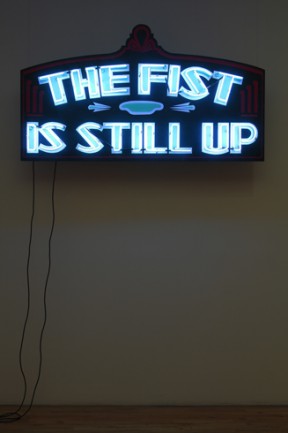
Wu Tsang, The Fist Is Stil Up, 2010, Neon, acrylic on wood panel, 40 x 70 x 10 inches

Wu Tsang, The Fist Is Still Up, 2010, Neon, acrylic on wood panel, 40 x 70 x 10 inches


Is it? Is the fist still up? I love this work – which I’m taking out of context here. The raised fist – what does it signify outside the context of the ’68 Olympics? That question has had me looking for raised fists in contemporary art – or, as is the case here – invocations of the fist.


Becoming an Image: In the Ring with Cassils

This slideshow requires JavaScript.

Last night I got to see Heather Cassils perform Becoming an Image. In this performance, Cassils boxes a plinth-like column of clay to the ground. This is done in the dark: the audience enters the room, stands in a ring around the clay sculpture which is lit from above. The room goes black and the artist and photographer are led into the circle. Cassils then attacks the clay – at first you can’t imagine that Cassils will be able to beat it down before “gassing out.”

The photographer (last night it was Manuel Vason) circles Cassils, taking photographs every now and again. The flash illuminates the action – but you of course don’t see action. You only see a flash image, frozen for a second into the retina. It took me a while to conceptually separate my experience of those images from the images captured by Vason’s camera – the image the audience member sees feel distinctly photographic.

For the duration of the approximately 20 minute performance, you hear Cassils breath and grunt like a fighter in the ring. Or a fighter working the bag. It’s gym noise.

I am sure this performance feels very different for people who have boxing or a martial arts practice. Your body knows what is happening to the artist’s body – people train and fight in three-minute rounds for a reason. Punching and kicking is exhausting; these are a technically and physically demanding actions. The more you tire, the harder it is to keep your concentration and hold your form – and if you don’t do the latter, not only will you tire even faster, you’ll hurt yourself. Even if you are fighting a lump of clay. Especially if you are fighting a lump of clay.

Training on a bag is very very hard – and a bag gives to impact. So, if you have some familiarity with the sport this work cites, you know that it is intensely durational. You can hear it in the artist’s breathing – weezing, gasping. A solid block of clay not only doesn’t give – after the performance the artist told me that it seems to push back. It has its own resilience.

Becoming an Image is an engagement with the idea of the object, but it is also a very intense workout with the idea of the athlete, and with the image of the artist. What this performance does to gender – that’s not only another blog post, that’s a whole book.


Kissing Contexts: Double Personal Fouls in the WNBA

Diana Tausari squares off against Seimone Augustus, looks like regular basketball. Shoulder checking and all that. But then in a lean in, she leans in!

It’s worth watching the post-game interview.  Augustus explains “As far as me and Diana and the tango dance we had – I always say she just wanted some of my deliciousness.”

When asked about this moment Tausari explained: “I was just trying to make sweet love, that’s it.”

That’s it. Just exactly the kind of queer playfulness that mainstream sports folks have feared like the coming of the four horsemen of the apocalypse.

Watching The Belles

IMG_0279

The Belles was aired in January 1995 on BBC 1.  This is perhaps one of the most unusual documentary portraits of women athletes I’ve ever seen. It covers a few weeks of the team’s season, moving back and forth between conversations with individual players, match footage, and peeks into the team’s life together off the pitch.

There are startlingly intimate moments, as players speak about their relationship to the sport while, say, lying in bed. Or celebrate a big win in the changing room and, perhaps more scandalously, at a gay bar. My favorite moment: players on the disco floor, FA cup in hand and mirrorball overhead.

FA Cup win The Belles

The FA didn’t take kindly to the documentary: Belles captain Gillian Coultard had captained the England squad and was demoted after The Belles aired.

Writing in the wake of that grim period, Pete Davies describes the team as scarred:

When the Belles let a BBC crew make a documentary that was broadcast last year, they thought they were helping promote women’s football. Instead, they got a sharp letter from Graham Kelly about the tone of the programme, and are now scared stiff about talking to the media. Last month, they felt obliged to turn down Yorkshire TV when that company wanted interviews – and a dread of publicity, when you’re needing sponsorship, isn’t too helpful. (The Independent 11 March 1996)

The Belles – the documentary and the story of this incredible club – inspired a television series that ran for five years (Playing the Field). But in 1995, its airing left the team with a difficult burden.

This weekend the Doncaster Belles will play their last match in the Women’s Super League – the FA’s attempt at the establishment of a professional women’s league. The FA is off to a flying start in confirming at least this writer’s belief that you cannot leave the administration of the women’s game to men whose decisions are guided by sexism and greed.

The Doncaster Belles were relegated to the second division at the start of this season in order to make room for Man City’s women’s side.

I still can’t wrap my head around the FA’s behavior towards The Belles, except as a continuation of their behavior towards the team ever since the FA was  forced to deal with the culture of the women’s game in the early 1990s, when the Belles were a super-dominant club and a fine expression of the independence and autonomy of  women’s football in England.

Some football fans might agree that today, “professionalizing” the sport is synonymous with ruining it for fans and for young players. The story of the FA’s behavior towards this team, which hasn’t not played in the top flight since the FA began organizing such things, is fine evidence of that dismal truth.

To read an excellent overview of the FA’s treatment of the Belles, read Glen Wilson’s article on The Popular Stand.

A Thought Against the World

The critic who would try to think of a world outside the World Cup and The Olympics is faced with a unique problem. FIFA and the IOC have a stranglehold on the global sport spectacle, on the presentation of the sporting event as a World Event. Their hold on the idea of the global event is so tight that even their harshest critics imagine that change will be brought about by participation in those events, or by boycotting those events. Within that critical discourse, change is possible if only we provide the right kind of pressure.

But real change will not happen either way. The larger these events become, the more media space they take up, the more public resources they use up – the worse it gets. By “it,” here, I think I mean “life.” Real change – is that a better Olympics? A better World Cup? Does one celebrate a Qatar World Cup or a Russian Olympics in the hope that these events will make Qatar and Russia more liberal environments for gays and women? In calling for that outcome, we enlist “gays and women” as neoliberal alibis, and lend legitimacy to the notion that the Olympic games improve every city that hosts them and that the idea that the World Cup unites the world’s football fans and creates possibilities for social change and better living. We all know that’s a lie.

These organizations are more notorious in sports media for their corruption than for their discriminatory practices. Sports media cares about the former only as long as it doesn’t jeopardize advertising revenue, and it doesn’t care about the latter at all. FIFA and the IOC are happy to deploy female, black and Muslim athletes as alibis justifying their work. That work being not social justice, but the amplification of their hegemony.

Artist Beatifies a Football Thug

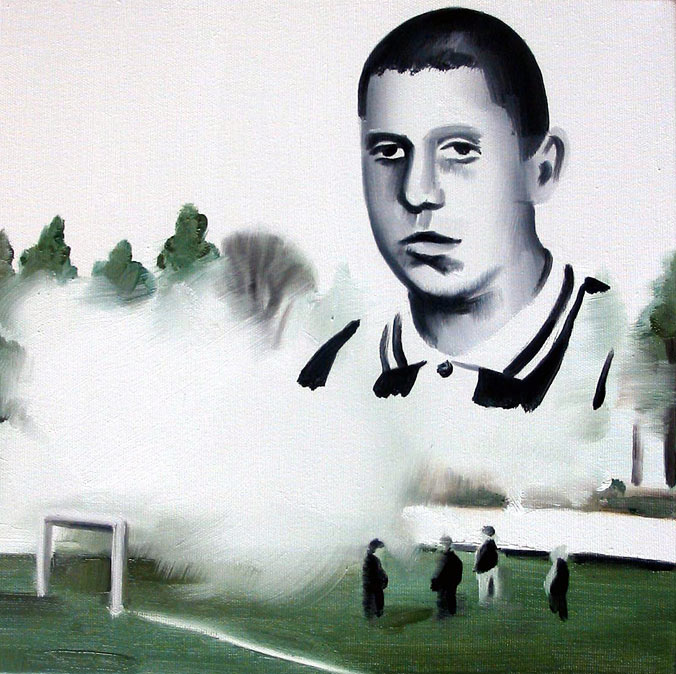
Art historian Przemysław Strożek gave one of the most memorable lectures at the Football 150 Conference, surveying the place of football in Polish contemporary art. He shared sophisticated work exploring the world of ultras – the hooligans, the fights between fans that seem to make the game a theater for social conflict in which all the action happens in the stands. As is the case in a lot of countries, in Poland the stands function like wounds – a place of intense emotion, pain, violence. I’m haunted by this painting by Marcin Maciejowski. Misiek (FC Wisła Kraków supporter) (2004) appears to memorialize an infamous hooligan who threw a knife at Italian footballer Dino Baggio during a championship match. Misiek (nickname for Pawel Michalski) was sent to prison for that and other offenses. Maciejowski’s painting is a record of, a comment on how Misiek is revered by fans.

Lyle Ashton Harris’s Blow Up

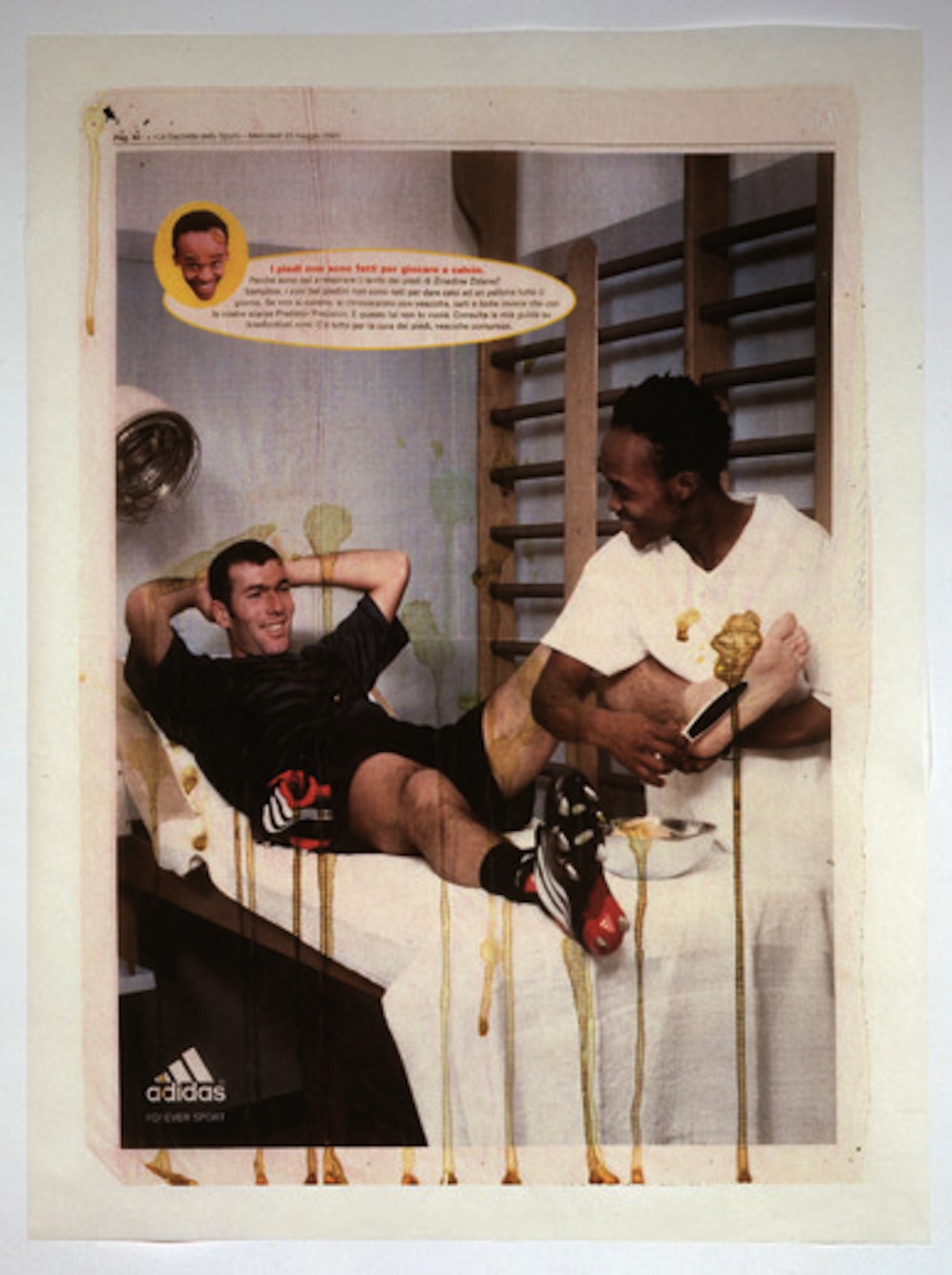
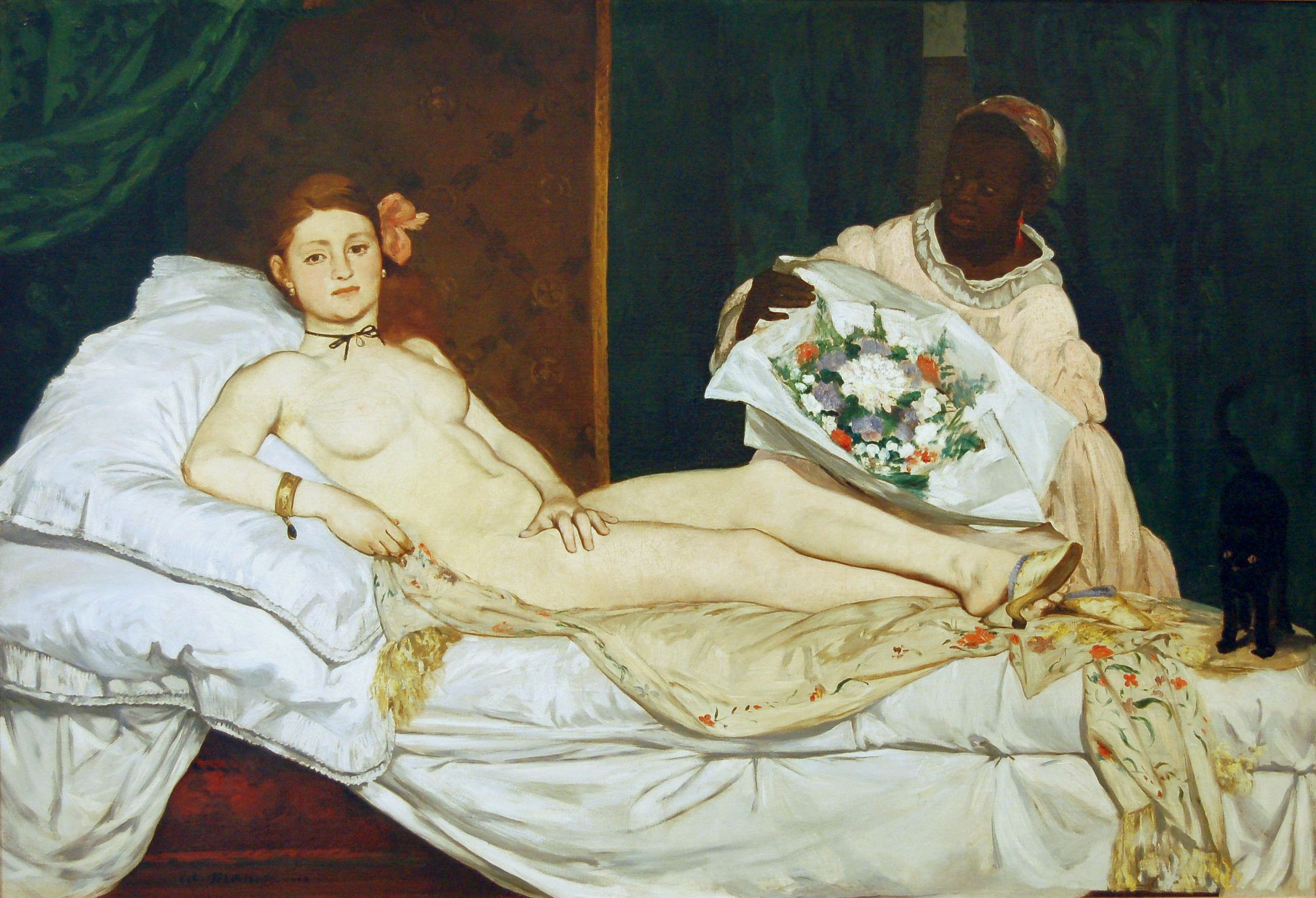
Yesterday I spent the day listening to excellent talks on soccer and art. Daniel Haxall, a professor at Kutztown University in Pennsylvania drew our attention to Blow Up, a series of installations by Lyle Ashton Harris. At the center of Blow Up is this shoe advertisement featuring Zindane in a pose that looks an awful lot like that of Manet’s Olympia (scroll down), as she’s being attended to by a black servant.

Lyle Ashton Harris Ready Made

Lyle Ashton Harris, Ready Made, 2001.

Ashton Harris Blow Up Sevilla

Lyle Ashton Harris, Blow Up (Sevilla), 2001

12_blowup_installation1_crop

Lyle Ashton Harris, installation view of Blow Up at Scottsdale Museum of Art, 2008

Manet, Olympia, 1863

Manet, Olympia, 1863

Diana Nyad by Catherine Opie (2012)

Diana Nyad by Catherine Opie (2012)

Catherine Opie has taken a range of startling portraits of Diana Nyad. Today, Nyad is closing in on realizing her dream of swimming the distance between Cuba and the United States (without a shark cage). This is her third try in three years. Follow her progress here.

Update: She did it!!