The Art of Conversation: Portugal – USA

conversationSoccer is a dialogic sport. It is shaped by opposition and struggle, by action and counteraction. There are no absolutes in these kinds of sports. The things that make for a great match, for example, are not the same things that make for a great race. A race is structured by a standard measurement of time, as well as by the idea of absolute performance (“the fastest human”). But a match is measured by the quality of the conversation.

Opponents will sink and rise to each other’s level – every fan and athlete knows this experience. A match might be halting and uneventful, or lopsided and boring because the two sides never connect in play. Very talented, organized and competitive sides are not always open to talk. Spain played like a team that was tired of talking. A team that had been the life of the party for too many years, and now just wants a quiet night in once and a while. England and Portugal gave their own versions of this kind of performance. Their play has been characterized by a weary narcissism – they are not tired of the party; they are tired of themselves.

Contrast that disengagement with Germany, France, Ghana, Chile and Colombia. It’s no wonder that Germany and Ghana’s match was so tremendous: the two play with an interest in the opposition. No gesture is unremarked upon; their conversation was fluid and elegant. Each side has the capacity for a certain brutality; each has the capacity to engage and diffuse the other’s attack. Like Dorothy Parker and Gore Vidal trading barbs.

Portugal and the US – they gave us a good dialogue but not a great one. The US, on a good day, will rise to an opponent’s level. But Portugal wasn’t interested helping them along. So Portugal exploited defensive errors, and did little more than that. Yes, CR7, when left completely alone, will send in a perfect cross to just the right person. In this case, it was a witty remark made on the way out the door to suggest the fun we might have had, if he wasn’t so utterly bored by us and the world. The US was a more entertaining guest. One got the sense that they were playing through fear and disorientation. Glad to be at the table, not quite sure what they were supposed to say and do – every now and again, they’d reach across the table to fill their wine glass, wash the anxiety down and throw themselves into the fray.

Yolanda de Sousa’s Mundial Scrapbook


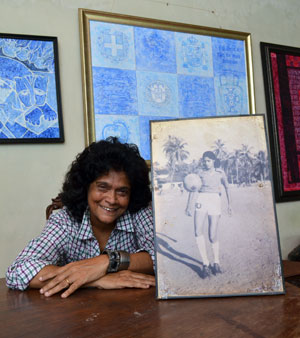
Yolanda de Sousa has been keeping a watercolor diary of this year’s World Cup. She has a painter’s eye for the ‘man of the match.’  As it happens, the Goan artist is an important figure in football history. In the late 1970s and 80s, she enjoyed a storied career playing women’s football in India. She was a real pathfinder. In 1980, she was voted player of the decade by India’s Women’s Football Federation. Sport-related work is not the mainstay of her practice, but every now and again she documents a match (football or cricket) with these player-portraits. (I wrote about her 2002 series a few years back.)

I’ve reproduced the bulk of a 2009 Times of India’s profile of the artist-footballer below. The brief article contains lots of information about her career as a player.

“It’s time for all of us to face the truth,” she says, sifting through memories when she was queen of the 100m field and the continent, her kingdom.

At a time when FIFA has struck off the Indian women’s football team from its world rankings for being out of sight or rather action for more than 18 months, Yolanda reminds us of the late seventies and early eighties when women’s football bettered the best in the continent and matched the rest of the world.

“Taiwan had an exceptionally strong team and was number one in Asia, but we always gave them plenty of problems. We were so strong in our belief and quality that we took the field knowing we could get the result we desired against most of the teams in the world,” says Yolanda, voted the player of the decade in 1980 by the Women’s’ Football Federation of India.

Yolanda’s story deserves to be told more so because it has the ability to instill the belief that women’s football still has the ability to enchant, entertain and inspire a generation.

It may not be the case elsewhere, but at least in this part of the world, many equate football with masculinity. But, as Yolanda’s story would demonstrate, that was never the case when she got enveloped by the magic of the game at a very young age.

“I would play along with my brother (Francisco) and his friends, but most of the times I was shunted to the goal. Whenever I got a chance to play up front, I would really put my best foot forward,” remembers Yolanda, who grew up to become one of Goa’s exemplary, if not, finest footballer.

Yolanda scored a goal in the first ever recorded women’s football match, playing against a men’s team appropriately called Adam’s in 1973, but it was not until 1976 when Goa took part in their first Nationals at Sultanpur and Yolanda scored a bag full of goals – 15 in all including two hat-tricks – and announced her arrival on the big scene.

“We lost in the final against Bengal by the narrowest of margins,” remembers Yolanda, dubbed the Madonna of Goan football.

The 1976 Nationals at Sultanpur was the first Goa ever participated in, and for the first time got to know what other players thought about Goa and Goans. “Since the facilities were not good enough, we wanted separate accommodations. This led to rumours that we sought a hotel elsewhere because the players wanted to enjoy their drinks! They believed we played well because we were drinking,” laughs the Calangute-based artiste.

Goa hosted the 3rd edition of the National football championship in 1977 and, true to expectations, won the tournament in style, defeating twice-champions Bengal 3-0 in front a lustily cheering capacity-crowd at the Bandodkar stadium at Campal.

Goa dominated the championship from start to finish, scoring an amazing 49 goals that included roaring wins over Madhya Pradesh (25-0), Punjab (10-0), Gujarat (5-0), Manipur (6-0) and, finally, Bengal (3-0).

Goa’s deadly strike pair of Succorinha Pereira (19 goals) and Yolanda (18 goals) scored 37 of the 49 goals, but often it was such a bore to score goals against the hapless opposition that even the strikers played the ball amongst themselves instead of taking aim at the goal!

“We were too strong for the other teams during Nationals. We used to score early in all the games since most of the goalkeepers remained clueless,” says the stylish striker.

Yolanda’s international debut came in 1976 when she, along with the likes of Rekha Karapurkar, Succorinha Pereira and Helen Fernandes, found a place in the Indian team against the visiting Swedish club BET.

She set all the venues on fire, ensuring seven victories and in the process becoming the first woman to score a hat-trick for India.

Since that memorable debut, Yolanda remained a permanent member of the Indian team until she was forced into premature retirement after the World Cup of 1981.

“Injury cut short my career. I was too scared to undergo an operation to correct the damage and instead opted to call it a day,” says Yolanda, who gave up hockey and badminton which she excelled at the highest level to nurse her football dream.

The artist with a photo from her playing days.

French Do-Over

Some more football art.

FIFA’s Gendered Laws of the Game

From the opening page of FIFA’s Laws of the Game (2014-2015): Women appear on the list of categories of disabled players for whom one can modify the size of the pitch, the ball and the goal. And: FIFA’s use of the male gender in all documents really means both men and women. This gets really confusing when considering a 2004 FIFA Executive Committee decision asserting that “the difference between men’s and women’s football must be absolute.” Women, who should not be expected to play by the same rules as men, are not men. Except when we say men and we mean women. That difference is absolute!

Screen Shot 2014-06-19 at 11.00.53 PM

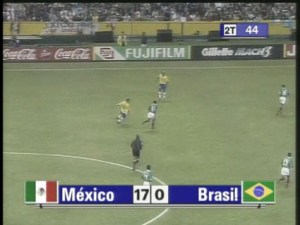
Mexico 17 – Brazil 0

Miguel Calderón, Mexico vs Brazil (2004).

Miguel Calderón, Mexico vs Brazil (2004).

Miguel Calderón watched hours and hours of football matches; he pulled footage of Mexico and Brazil matches to compile an imaginary world in which Mexico wins 17-0. Calderón’s 90-minute video was originally installed on a television in a sports bar in Brazil. Hopefully, someone has thought to install this work in a bar or two – a little World Cup static.

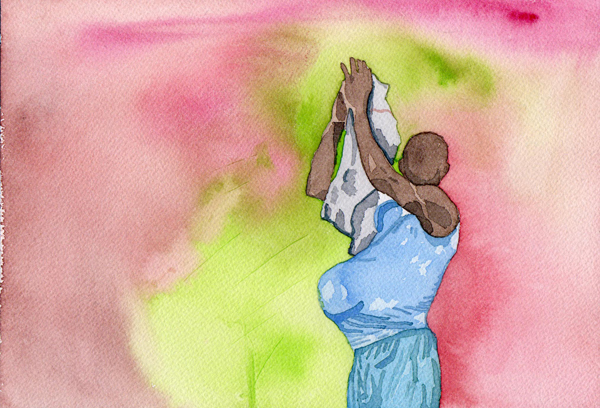
Pregnant with Ball


Yrsa Roca Fannberg, Resurrection (watercolour on paper, 2009)

Joel Campbell’s goal celebration belongs to a genre – Yrsa Roca Fannberg is the only artist I know to have honored that genre in paint.


The Inevitable World Cup

At this time of year, football fans with a conscience find themselves in a strange situation. We know FIFA is corrupt to the bone; we know that Football Associations are run by imperialist crooks. The people who administer the game are famously sexist, famously racist. We know that they are disgusted by the multitude whose happiness they exploit. At a recent conference on the sport, for example, a FIFA representative responded to a scholar’s paper on the problem of “white elephants” by describing the people to build them as “foolish.” He was obnoxious, but was he wrong? Are we surprised by his attitude, or by the fact that he feels entitled to express such open contempt for the miserable schemers who collaborate with FIFA’s overlords? We know that the FIFA World Cup is awful – and yet we tune in.

Because, of course, The World Cup is a spectacular event. Already, headlines about match fixing and worse have been replaced by headlines about underperformance, cynical play, unfair calls and other staples from football’s story cycle. In its inevitability, in its unavoidable nature we sense something of the World Cup’s ideological power. To call for the end of the World Cup: is that not an attack on happiness itself?

FIFA exists for this event alone. The World Cup is not a tournament, really; it is an economy and FIFA regulates its marketplace by ensuring that players play on something green and expensive, in front of synthetic crowds who are stripped of their drums and trumpets and made to sit down. FIFA makes the game into a currency. Every game looks like every other game, whether it is played in Rio de Janeiro or Johannesburg or Berlin. (Perhaps, however, not Manaus.)

Resistance to the World Cup, abolition of the World Cup – it is necessary and yet for football fans and even FIFA critics it is almost unimaginable. Nothing short of a full-scale revolution will bring it to a stop – is that what we are rooting for? People who can no longer afford the price of entry into a host city’s stadium take to the streets; they are replaced in the stands by a mass of silent witnesses. Which struggle will we see on the television – the one inside the stadium, or the one outside of it?

The football critic who would try to think of a world outside the World Cup is faced with a unique set of problems. The World Cup has a stranglehold on the presentation of football as “the global game.” But the pleasure promised to us by the mega-event is rooted outside the stadium, and outside of FIFA’s reach. The ordinary forms of joy we feel on the pitch are cited by nearly every advertisement that swarms the World Cup. An ad for a shoe or a television set, or soda or hamburgers will feature children threading a ball through the crowded narrow alleys of some nameless slum. Kids chase that ball to pop music one might hear in Atlanta, Montevideo, Seoul or Marseille. They are happy to be alive. What fan hasn’t had a taste of the happiness cited by such ads? The absolute joy of a weekly game with friends – the sort of game in which even the bickering is fun. That happiness is fleeting – the game can teach you how to live with that: you have to make yourself available to that pleasure by showing up hung-over, in the rain, in the hot sun. But what do we show up for, when we turn on our television sets?

The discourse of “the beautiful game” romances the idea that in poverty one’s pleasures have a certain nobility. It is one of the most cynical features of the mega event: a neo-liberal fantasy about the joy of the poor functions as an alibi for an inhuman economy in which stadiums are built not as homes for a team and its fans, but as sets for a handful of televised events; in which clubs are mortgaged into abstraction; in which the obscenity of one player’s income is dwarfed by the cosmic scale of the team-owner’s wealth. The identification of the game with keywords like “universal,” “global” and “beautiful” papers over the exclusion of women from this world. It celebrates the provincialism which assumes that there is no place on earth indifferent to this sport. It turns the scholar of the sport’s globalism into expert testimony justifying development schemes. The larger and the more inclusive these events become, the more media space they take up, the more public resources they use up – and the worse things gets. Resources are not redistributed around the World Cup; they are concentrated and absorbed by a ministry of corruption. This is not the view of the football extremist. To assert such a thing is not even interventionist. It is a given. What have I written here that hasn’t been said by Eduardo Galeano, years ago? Or by our grandparents?

The tournament is sold to us as the story of a level playing field from which a few deserving souls might be elevated to something more spectacular than equal access to opportunity. As if the latter were a given in our lives, and not, in fact, the elusive aim of an ongoing struggle. The level playing field of a bright green square of uniform grass produces a world of losers. What keeps the World Cup in place? What keeps national associations under FIFA’s sway?Who on earth really wants yet another tournament that concludes with a cynical exchange of fouls by two teams we imagine as enemies but who are, really, two sides of the same coin? Where, the fan asks, do we turn for a glimpse of some other possibility?

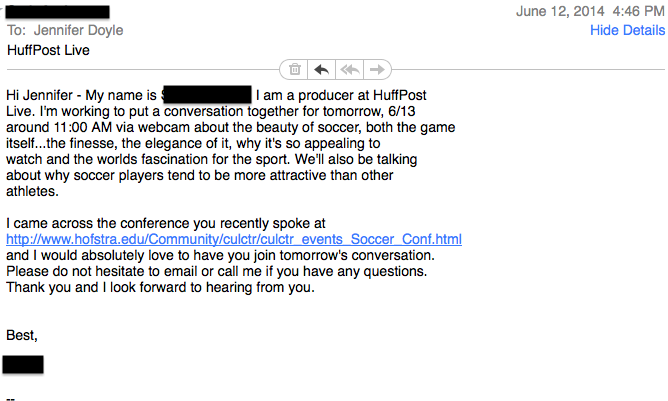
Things I Get in the Mail (Media Requests for World Cup Commentary)

Screen Shot 2014-06-12 at 7.18.44 PM

My reply: Just wondering, do you intend to run a story like this about the women’s game?

No Lesson Plan: notes on a shooting

As something people experience and express, sexism is intensely variable. For some, systems of hate and fear are never more than a background hum. For others, those systems manifest themselves as discrimination in the workplace, police violence, and worse.

People with the Isla Vista killer’s suite of disorders (a cocktail of schizo-paranoid-psychotic thinking mixed with who knows what disorders) will tap into the grid of hate and fear. Sexist thinking seems to have given a shape to his persecution complex. It seems to have legitimized a God-like complex. This is to say that aspects of this person’s writings are surely sexist, but they are also hallmarks of certain kinds of paranoid/psychotic formation. Supremacist logics are grounded in these paranoid/psychotic/schizo formations. History does not suffer from want of evidence on that score. What to do with the coincidence (the happening-in-the-same-time-and-place) of the crazy and the real? With the singular (the “shooter”) and the systemic (“sexism”)?

Not all people who go on murder sprees leave an accessible archive of their psychosis behind them – this seems to be more and more common, however, as social media gives people new ways of expressing those thoughts. How should we read them? In fact, why does the public read them at all? What do they tell us that his murder spree doesn’t?

I’ve had the unfortunate fortune of working with detectives who specialize in threats, stalking, and intimate partner violence. They have an interesting way of looking at things. They are concerned by the way that a person’s tilt into violence is generally accompanied by a suicidal not-caring about what might happen to others, or to themselves. These detectives have a chance to prevent murder. What makes a person violent – as a question – concerns them deeply.  One scary scenario involves the projection of the death-drive onto the object of a campaign of harassment – in which hate/fear/desire drives a fantasy of mutual destruction – the object of their hate/fear/desire (the person who is the object of attachment but also rage) is absorbed into a suicidal mission. A person might dream of that cataclysm, but an awareness, a certain grip on the sane – a desire to live, a desire to stay out of jail – might keep them from acting that fantasy out. When that awareness falls apart – when that sense of a modest future of not-murder/not-suicide fades – that is one place where murder happens.

Women victims constitute a vast majority of their cases; perhaps because in disordered thinking the consequences of harassing and threatening women feels less serious – easier to get away with. That is, indeed, one shape that sexism takes. And, statistically, men are more likely to act out these murder/suicide fantasies – one of patriarchy’s signatures is its naturalization of a man’s impulse to harm and destroy. (A bitter twist: socially, threats of violence issued by women are taken less seriously; threats between men may also be taken less seriously as men are imagined as less vulnerable. So same-sex intimate partner violence may be ignored, minimized, its murderous potential disavowed or absorbed into a homophobic narrative.)

Sexism circulates as an explanation and as a fertilizer and as a foundation for all kinds of misery. It explains everything and nothing.

What made the people murdered by that guy vulnerable to his violence? Sexism is a part of that story, but there are other things that escape that word. One might meditate on sex and its relation to power; one might consider this historical moment as one in which things feel pointless, when life within the US feels pretty desperate – like living in the middle of an egomaniacal and embittered monster. What makes the world so chaotic, what makes the college campus and the female student such a compelling target? That’s sexism but it is also, say, a distortion of class warfare.

What makes someone want to burn down not only their life, but the world? To shoot up a sorority or deli, to drive his car into a crowd, to murder men while the sleep (one theory as to how he killed his roommates). To mainline the worst of everything?

I will not read that guy’s text or watch his video – I refuse out of respect to his victims, for, in fact, the broadcast of those messages – some kind of master-narrative – was surely one of his desires – but I do not need to read them to know what they say. Master narratives are always sexist and racist, self-serving and, at their core, crazy.

Sexism gave a sense of legitimacy to his psychotic narrative. And yet he didn’t only murder women; he started off by murdering his male roommates and one of their friends. He did not only blame women for his unhappiness; he blamed the men around him, too. Yes, we can understand that as part of sexism’s logics. We might also understand heterosexual culture as fucked up – the designation of women as the obstacles to sexual happiness is one of the heterosexuality’s worst features. He started off killing the people closest to him, however – these men (whom we can guess he was also harassing) were murdered with a knife. He murdered two women, four men. Most of his victims were men of color.

Sexism is such a powerful narrative structure – it gave him his “reason” – should it also give us so much explanatory force with regards these horrific events? People are compelled by his own explanation for his actions. But how much more do we need to know in order to understand that racism, sexism and class warfare were part of his life, and are part of ours?

Of course it is a good thing that so many people are thinking and talking about the relationship of sexism to violence, especially if that conversation unfolds with an awareness of how proximate discourse on “protecting” women from violence is to racist expressions of violence, especially if that conversation unfolds in the interest of maximal sexual freedom and happiness, and less carving up of the world by gender. As a queer theorist, however, I notice that the state of sexual emergency which we encounter in and around today’s campus makes advocacy for sexual freedom, for sexual generosity more difficult. More confusing and strange.

That this killer – a man – drove to a sorority seems to give this story some kind of shape. But does it, really?

Last week, in Santa Barbara, a profoundly distressed young man took all the pain and all the misery of his experience and loaded it into a gun. He enacted a murderous fantasy in the name of his desire. Whatever his rationale, he was an equal opportunity killer.

The knife, the gun – the act of violence – what meaning it bestows on the world is itself a brutality. What is there to think from such a place?

On the Sexism of Football Scholars and Sports Critics

“People want excellence in sports, and the quality of women’s soccer is not there.”

“Nobody wants to watch women’s sports.”

“The top women can’t take on the top men.”

These three things were said by attendees at a recent congress of leading scholars and journalists working on soccer.

The organizers of Soccer as the Beautiful Game deserve a lot of credit for bringing scholars and sports writers together. What follows is not a criticism of that conference, or of its organizers – quite the opposite. At this moment, it is not possible to organize a conference at which the above statements would not be made, unless one either excluded women and women’s football from all discussion, or invited only feminists to the table. The conference’s organizers worked to make sure that feminist scholars like myself were in the room because they are committed to changing the field.

As long as people writing about the men’s game write only about men, they can maintain the delusion that their work isn’t sexist in its very foundation. But the world does not line up with their writing. It isn’t composed entirely of men – not even where the men’s game is concerned (one scholar’s presentation on the recollections of English women football fans of the 1966 World Cup was illuminating not only in its content, but also in its rarity – even scholarship on fans tends to assume that they are all and always only men). With even just a few women in the room (men outnumbered women at this conference by what felt like 7 to 3) – with a just a handful of experts on the women’s game among the audience – overt and inferential expressions of sexism were inevitable. You can’t put us – feminists, women, women’s football fans – in a room with them – sexists (men who only care about men’s sports) – and not provoke some awfulness from a few of the sexists. (Most sexist sports scholars and critics are benevolent in their approach to women’s sports: they want to see the field developed – by women.)

From left to right: Simon Kuper, John Foot, Brenda Elsey, Alex Galarza, Grant Wahl, Peter Alegi and Charles Korr.

From left to right: Simon Kuper, John Foot, Brenda Elsey, Alex Galarza, Grant Wahl, Peter Alegi and Charles Korr.

To wit: A plenary panel composed of leading scholars and journalists addressed their experiences writing about the sport. Each panelists spoke briefly about the way the sport’s history, politics and economy impacts their practice as scholars and as journalists. Featured on the panel*: Grant Wahl – [until recently] the lone full-time journalist covering soccer for Sports Illustrated; Brenda Elsey – one of the conference organizers and author of Citizens and Sportsmen (a study of the amateur men’s fútbol clubs in Chile; she is writing about the history of women’s fútbol in that country); and Simon Kuper – author of Football Against the Enemy and a journalist for The Financial Times. Kuper, in particular, is a darling of the academic world, frequently invited to speak about the politics of the men’s game – his book is something of a sports-writing/academic cross-over.

In their opening remarks all of the panelists spoke about their writing about the men’s game. That the context for the conversation was the men’s game was taken as a given. During the Q&A, I raised my hand to ask Elsey and Wahl (who have both written about the women’s game as well as the men’s) to address how the situation changes when their writing turns to women. (For example, with the men’s game journalists and scholars both wrestle with economic and political pressures unique to the scale of its economy.) Elsey made a provocative point when she asked how dangerous must the women’s game be to have been banned for so long in so many countries – especially as the men’s game has been the site of so much important social organization. Wahl pointed out that if he wrote about another sport, he might never get a chance to report on women athletes – he considered himself lucky on that front.

Some hands went up in the audience, and the moderator – Charles Korr (a distinguished sports historian at the University of Missouri, St Louis) – picked a man I don’t know (I think this man was a member of the public, neither a scholar nor a journalist). That man said something like the following:

The thing is, people don’t want to watch women’s soccer: they want excellence, and the women’s game is not as developed as the men’s game. It’s slower, not as powerful.

I can’t quite remember what happened. I made a noise of some kind and some sort of gesture; a whole bunch of hands went up. Another man was picked to speak. He sounded relieved. Finally someone expressed something that everyone knew but didn’t feel like they could say in front of people like myself – although they were clearly dying to.

This man, Kevin McCrudden – a local journalist – invoked the WNBA as a evidence that “no one” wants to watch women’s sports: they need to be subsidized by the NBA, right? Unlike men’s teams, women’s teams lose money. (McCrudden seemed unaware of the fact that the television audience for MLS is smaller than that of the WNBA.) Other men jumped in to argue with these statements.

None of the senior feminists in the room raised their hands that I can remember. We did some combination of the following.

We locked eyes with each other.

We thought “what do we do?”

We debated in our minds if we could walk out. (As a keynote speaker at the conference, I did not feel I could.)

We tweeted.

Screen shot 2014-05-12 at 2.11.12 PMThe conversation seemed to go on, no one seemed able to stop the flow of sexist statements.

Finally, a young woman in the audience stood up and called out the sexists on their language: their imperial “we” and presumed “no one” left no room for her, as an ardent fan of women’s soccer who sought out every opportunity to watch it. I think she had to stand up because the moderator hadn’t called on her. I think, too, that she was a student.

If I didn’t say anything it was because I’d given a keynote address earlier in the conference; I had called out the segregated structure of sports scholarship as part and parcel of the sexist, homophobic and transphobic segregationist logics that underpin administration of the sport. I had also asked the question drew out the sexists – a question not aimed at the sexists, but at the people who make women’s soccer a part of their work.

I didn’t want to get into a shouting match with idiots. The other women in the room were far more seasoned that I am and even less likely to take the bait. I’ve spent most of my career writing about queer performance art, after all. Jean Williams literally wrote the book on feminist sports history where soccer is concerned. (Actually, she’s written three.) The fact that none of us spoke up at this point was evidence of our collective experience – these “conversations” go absolutely nowhere. They are not conversations. They are symptoms.

And I was particularly tired, because I got caught in a similar “discussion” the night before, in a sports bar, with at least one of the men on the panel.

In any case, the moderator stepped in to kill the discussion – it needed to happen but it felt like the wrong kind of intervention. Had I been moderating I might have just called out those remarks as sexist, and asked Wahl and Elsey, for example, how such attitudes shaped their experience writing about the women’s game. That isn’t what happened however. The moderator just wanted to put the whole mess back in the box – which makes sense, as I don’t think he’s ever written about women’s sports or sexism and perhaps he couldn’t handle it. Because if you don’t write about women’s sports or sexism in women’s sports – well, you have no expertise in the expert non-defensive communication skills required of such a situation.

Brenda Elsey, however, does. The lone woman on the panel leaned forward at that point and asserted her prerogative, as the conference co-organizer, to have the last word. She said something like:

“This whole conversation – the fact that it is even happening – is sexist.”

The mere introduction of women’s soccer as a subject of conversation provokes “common sense” observations from sexists about how “no one wants to watch women’s soccer” because women are weaker, slower etc. That is sexist. That the people who work on women’s soccer have to defend women’s athletic ability in order to participate in any conversation about women’s soccer – that is sexist.

And as it happens, I had spent the previous night arguing this point with Simon Kuper.

Earlier that evening, I’d been hanging out with Jean Williams and Stacey Pope, swapping notes on the talks we’d seen. We talked about Pelé, who was honored at a banquet that night, and gossiped about NY Cosmos goalie Shep Messing, who seemed to be flirting with everyone – me, but also David Goldblatt, for example.

I was feeling really high on the whole experience: Joshua Nadel, a scholar at North Carolina Central University, shared television footage of the 1971 Mexico City women’s world championship tournament – an event I’ve been obsessed with because it is the largest known audience for a women’s sporting event: over 100,000 filled Estadio Azteca to watch Mexico lose to Sweden. I’d only seen references to the event, I’d never seen actual footage of it until Nadel shared it with me. Stacey’s presentation on English women’s recollections of the 1966 World Cup was really moving and inspiring. I wanted to hang out with these folks, kick back and relax as all of us had given our papers by then.

We got separated, though, as we caught different shuttle busses back to the hotel. I went to the bar with fellow blogger Andrew Guest, Simon Kuper and a bunch of other attendees.

Within minutes of sitting down, Kuper and I became embroiled in an argument. Kuper returned to my keynote address – I had come out as hating the World Cup, not only because it’s a completely corrupt boondoggle, but because it replicates segregationist logics and broadcasts a fantasy world from which women have been banished. I posited another kind of football culture – one that fought segregationist logics rather than reproduced them. So, Kuper baited me:

The top women can’t take on the top men.

He continued by making assertions like: women are slower than men; women are weaker than men. And he kept returning to the following:

Marta could not take on Neymar.

I replied with something like:

They would not take on each other; they are both attacking players. They’d likely be on the same team, or on opposite ends of the field. You mean ‘Marta could not take on Puyol.’ And I want to see that. Maybe she couldn’t, but what if she could? People don’t always ‘take on’ other players by, say, outrunning them. And if she’s slower than Puyol (I don’t know that she is), she’s also a lot smaller. He’d have a hard time tackling her.

Kuper didn’t find this satisfying: he kept returning to the statements about women’s physical weakness, and he seemed to need me to agree with him on those points – that I refused to do so seemed to rattle him, but in a way that I think he enjoyed. I think he thought I was enjoying the conversation too.

I was rattled, however, in a way that I do not enjoy: because there I was in a sports bar, wrangling with the most primary expression of sexism. Those attitudes were being expressed by a man that people in the field think of as an important intellectual where this sport is concerned. (I, for the record, do not.) Everything Kuper said in that conversation was sexist, and what was particularly shitty was that he seemed not to know this.

As he pressed on, I thought to myself: This is why Simon Kuper has never examined the situation of the women’s game in any of the stories that he has written about football and international politics. Why SAFA or the Nigerian or the Spanish FA’s behavior towards their women’s sides (each its own scandal) isn’t newsworthy to him – or to most people who write about football, be they scholars or journalists. Such stories, in the mind of the sexist journalist and scholar, cannot be connected to Politics or Economics because the abject status of women’s football is a product of Nature.

They find talking about women’s sports a drag because they know nothing about it. They only thing they “know” is that women are weaker. And so that’s the conversation they insist on having, over and over again.

Oh, how I wish that I’d been having drinks with Grant Wahl instead. So that we might process the recent dismissal of the USWNT coach, so that we might talk about the upcoming women’s world cup being played on artificial turf, or the uneven development of the women’s game, and what is going on with Brazil – with the women’s team, that is. So that we might cast our “dream” mixed team. Oh, that I’d been sitting at a table with Jean and Stacey – so that they might chime in with their perspective on the Super League, and continue our conversations about their work as public historians.

But no. I was in a sports bar having an argument with an “intellectual” who wanted me to agree to his premise – that women are weaker – an argument that I also had with boys on the school bus when I was 8 years old. This perspective does not mature as boys turn into men; men either shed that attitude or it cements into their brain structure, like some kind of thought-killing plaque.

I refuse to have ANY conversation about sports that naturalizes women as the weaker sex as a precondition for entering into the discussion. So, in our discussion I kept returning to Kuper’s desire to force me to “admit” that Marta was somehow less of a player than Neymar, as if the aim of my own scholarship could be boiled down to this point. (People like Kuper do not read the work of people like myself.)

Thankfully, Andrew Guest partnered up with me in this discussion. So I wasn’t alone. But we were in a minority.

If you are woman forced into having that conversation over and over again, at some point you really just want to leave the room. At some point you might decide that life is too short to waste your time talking to these people. So the next morning, when a conversation about the material difference in the experience of writing about men’s soccer and writing about women’s soccer turned into the “natural” difference between men and women, I was not surprised but I did want to leave the room.

What does surprise me is how oblivious people in the field are to the toxicity of such conversations – it shows a total disregard for the conversation one might have in reply to a conversation like “how dangerous must women’s football be to have been banned for so long.” There is a place we can go that looks less like an elementary school argument, and more like the utopian “universalism” to which discourse about the game appeals. A place of not only gender equity, but gender fluidity. A world divided not in two but united in its assembly of singularities. Not Marta or Neymar, but Marta with Neymar.

____

*The panel was organized by The Football Scholars Forum, a terrific on-line seminar run by terrific scholars at Michigan State – Peter Alegi and Alex Galarza. Also on this panel was John Foot, who is based at the University of Bristol and is an important sports studies scholar in the UK.