Jaime Lauriano: morte súbita (2014)

morte súbita from Jaime Lauriano on Vimeo.

from the artist’s vimeo page:

direção (director) jaime lauriano
direção de fotografia e câmera (cinematography) cassio luiz rothschild
edição e finalização (film editing) onze corujas

The Brazilian team which won the 1970 World Cup is considered by many to be the greatest of all time. In a spectacle transmitted, live, for the first time for the Brazilian people through television, this achievement was transformed into a heroic feat. With strong media coverage then, the Brazilian team’s victory in 1970 was used as a propaganda tool for the Brazilian military regime.

“Morte Subita (Death Sudden)” consists of a projection with people covering their faces with shirts of the Brazilian Soccer Team. In the background, listen to an audio that mixes sounds of football stadiums (shouts, clapping, fireworks) with sounds of protests and street demonstrations (bombs, shots, shouts, etc); as the camera tracks these people, we hear a sports announcer recite the names of dead and disappeared politicians in the year 1970, the hardest year of the Brazilian military dictatorship.

Sexism, Corruption, Sports (a brief note)

If you have yet to read Meg Linehan’s story about NWSL coach Paul Riley, you should read it now. And if you aren’t following the story about sexual abuse within Haiti’s national women’s team program, you should catch up. Not a women’s sports fan and think sexual abuse is just a women’s issue? You will want to read this, or this, or this, or this.

Struggling to understand why sexual abuse is such a strong feature of organized sports?

Patriarchy is a specific form of corruption: men only dominate by virtue of theft and betrayal. They only occupy positions of power and authority by working hard to undermine and destroy people whose competency and talent challenge their sense of entitlement. In patriarchal structures, sex operates as a vector for the accumulation of power, and wealth. One feels entitled to the bodies of one’s subordinates. And a whole sexual culture — white, heterosexist, patriarchal, homophobic, cis, binary — normalizes this association of power with sexual access.

Women, gay men, trans men and women, non-binary and genderqueer people in these systems become targets because they, in essence, are sex. Territory to be colonized. Sexualized forms of hazing and sexual abuse of men and boys within patriarchal, straight homosocial spaces operate as a means for expressing and consolidating power—you become implicated in a set of “crimes”—if you speak of it, you exit the scene.

In systems like this, that sexualized performance of abusive authority is treated as a form of competency—even professional achievement.

A few years back, I remember sitting in a meeting with men in charge at my campus. We were talking about some issues related to sexual harassment charges. In some of the cases we were talking about, women had been bad actors—enablers, mainly. Ironic, isn’t it, someone said. No, I replied. In these corrupt systems, the only women allowed close to that form of power are those who collaborate with it. Either by operating as an abuser’s enabler, or as an alibi — “I haven’t had any problems, so my example demonstrates that there is no problem.” Usually, those women end up under the bus.

As Brenda Elsey and I have argued, this shit sits on a continuum with the profound corruption that rots this sport from the inside out. Professional sports does not have to be like this—it really and truly doesn’t. The people running the game will have you thinking that the “ironies” of the system are key to its pleasures and its profits. This is flat out bullshit. OK. I am going to go punch something.

Carolee Schneemann, Kitch (figure skater)

Artist’s postcard (photo from auction). See also Ice Skating Naked.

Khaled Jarrar: Concrete

Marcin Dudek: The Lure of the Arena

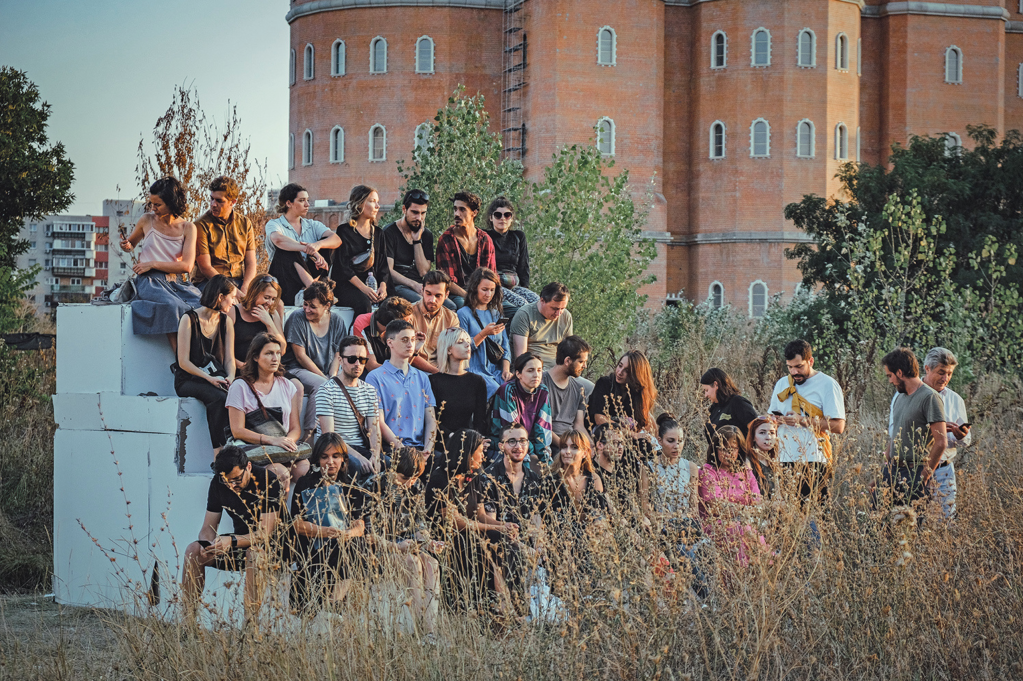
The Lure of the Arena, 2019 — a bit of football art, to recall the thing I know many of us can’t wait to get back to. Sitting in the stands together. Art historian and fantastic thinker of sports-art Przemyslaw Strozek wrote to me about Marcin Dudek a few years ago. Dudek tends to work with the situation of the fan/spectator, and has done some really provocative work exploring the relationship between sports, art and violence. Click on that first link for a slide show & text about Lure. I love this artist’s work, and find myself turning to it on a day when I’m planning to see some of the guys I used to play with.