
My reply: Just wondering, do you intend to run a story like this about the women’s game?
My reply: Just wondering, do you intend to run a story like this about the women’s game?
As something people experience and express, sexism is intensely variable. For some, systems of hate and fear are never more than a background hum. For others, those systems manifest themselves as discrimination in the workplace, police violence, and worse.
People with the Isla Vista killer’s suite of disorders (a cocktail of schizo-paranoid-psychotic thinking mixed with who knows what disorders) will tap into the grid of hate and fear. Sexist thinking seems to have given a shape to his persecution complex. It seems to have legitimized a God-like complex. This is to say that aspects of this person’s writings are surely sexist, but they are also hallmarks of certain kinds of paranoid/psychotic formation. Supremacist logics are grounded in these paranoid/psychotic/schizo formations. History does not suffer from want of evidence on that score. What to do with the coincidence (the happening-in-the-same-time-and-place) of the crazy and the real? With the singular (the “shooter”) and the systemic (“sexism”)?
Not all people who go on murder sprees leave an accessible archive of their psychosis behind them – this seems to be more and more common, however, as social media gives people new ways of expressing those thoughts. How should we read them? In fact, why does the public read them at all? What do they tell us that his murder spree doesn’t?
I’ve had the unfortunate fortune of working with detectives who specialize in threats, stalking, and intimate partner violence. They have an interesting way of looking at things. They are concerned by the way that a person’s tilt into violence is generally accompanied by a suicidal not-caring about what might happen to others, or to themselves. These detectives have a chance to prevent murder. What makes a person violent – as a question – concerns them deeply. One scary scenario involves the projection of the death-drive onto the object of a campaign of harassment – in which hate/fear/desire drives a fantasy of mutual destruction – the object of their hate/fear/desire (the person who is the object of attachment but also rage) is absorbed into a suicidal mission. A person might dream of that cataclysm, but an awareness, a certain grip on the sane – a desire to live, a desire to stay out of jail – might keep them from acting that fantasy out. When that awareness falls apart – when that sense of a modest future of not-murder/not-suicide fades – that is one place where murder happens.
Women victims constitute a vast majority of their cases; perhaps because in disordered thinking the consequences of harassing and threatening women feels less serious – easier to get away with. That is, indeed, one shape that sexism takes. And, statistically, men are more likely to act out these murder/suicide fantasies – one of patriarchy’s signatures is its naturalization of a man’s impulse to harm and destroy. (A bitter twist: socially, threats of violence issued by women are taken less seriously; threats between men may also be taken less seriously as men are imagined as less vulnerable. So same-sex intimate partner violence may be ignored, minimized, its murderous potential disavowed or absorbed into a homophobic narrative.)
Sexism circulates as an explanation and as a fertilizer and as a foundation for all kinds of misery. It explains everything and nothing.
What made the people murdered by that guy vulnerable to his violence? Sexism is a part of that story, but there are other things that escape that word. One might meditate on sex and its relation to power; one might consider this historical moment as one in which things feel pointless, when life within the US feels pretty desperate – like living in the middle of an egomaniacal and embittered monster. What makes the world so chaotic, what makes the college campus and the female student such a compelling target? That’s sexism but it is also, say, a distortion of class warfare.
What makes someone want to burn down not only their life, but the world? To shoot up a sorority or deli, to drive his car into a crowd, to murder men while the sleep (one theory as to how he killed his roommates). To mainline the worst of everything?
I will not read that guy’s text or watch his video – I refuse out of respect to his victims, for, in fact, the broadcast of those messages – some kind of master-narrative – was surely one of his desires – but I do not need to read them to know what they say. Master narratives are always sexist and racist, self-serving and, at their core, crazy.
Sexism gave a sense of legitimacy to his psychotic narrative. And yet he didn’t only murder women; he started off by murdering his male roommates and one of their friends. He did not only blame women for his unhappiness; he blamed the men around him, too. Yes, we can understand that as part of sexism’s logics. We might also understand heterosexual culture as fucked up – the designation of women as the obstacles to sexual happiness is one of the heterosexuality’s worst features. He started off killing the people closest to him, however – these men (whom we can guess he was also harassing) were murdered with a knife. He murdered two women, four men. Most of his victims were men of color.
Sexism is such a powerful narrative structure – it gave him his “reason” – should it also give us so much explanatory force with regards these horrific events? People are compelled by his own explanation for his actions. But how much more do we need to know in order to understand that racism, sexism and class warfare were part of his life, and are part of ours?
Of course it is a good thing that so many people are thinking and talking about the relationship of sexism to violence, especially if that conversation unfolds with an awareness of how proximate discourse on “protecting” women from violence is to racist expressions of violence, especially if that conversation unfolds in the interest of maximal sexual freedom and happiness, and less carving up of the world by gender. As a queer theorist, however, I notice that the state of sexual emergency which we encounter in and around today’s campus makes advocacy for sexual freedom, for sexual generosity more difficult. More confusing and strange.
That this killer – a man – drove to a sorority seems to give this story some kind of shape. But does it, really?
Last week, in Santa Barbara, a profoundly distressed young man took all the pain and all the misery of his experience and loaded it into a gun. He enacted a murderous fantasy in the name of his desire. Whatever his rationale, he was an equal opportunity killer.
The knife, the gun – the act of violence – what meaning it bestows on the world is itself a brutality. What is there to think from such a place?

“People want excellence in sports, and the quality of women’s soccer is not there.”
“Nobody wants to watch women’s sports.”
“The top women can’t take on the top men.”
These three things were said by attendees at a recent congress of leading scholars and journalists working on soccer.
The organizers of Soccer as the Beautiful Game deserve a lot of credit for bringing scholars and sports writers together. What follows is not a criticism of that conference, or of its organizers – quite the opposite. At this moment, it is not possible to organize a conference at which the above statements would not be made, unless one either excluded women and women’s football from all discussion, or invited only feminists to the table. The conference’s organizers worked to make sure that feminist scholars like myself were in the room because they are committed to changing the field.
As long as people writing about the men’s game write only about men, they can maintain the delusion that their work isn’t sexist in its very foundation. But the world does not line up with their writing. It isn’t composed entirely of men – not even where the men’s game is concerned (one scholar’s presentation on the recollections of English women football fans of the 1966 World Cup was illuminating not only in its content, but also in its rarity – even scholarship on fans tends to assume that they are all and always only men). With even just a few women in the room (men outnumbered women at this conference by what felt like 7 to 3) – with a just a handful of experts on the women’s game among the audience – overt and inferential expressions of sexism were inevitable. You can’t put us – feminists, women, women’s football fans – in a room with them – sexists (men who only care about men’s sports) – and not provoke some awfulness from a few of the sexists. (Most sexist sports scholars and critics are benevolent in their approach to women’s sports: they want to see the field developed – by women.)

From left to right: Simon Kuper, John Foot, Brenda Elsey, Alex Galarza, Grant Wahl, Peter Alegi and Charles Korr.
To wit: A plenary panel composed of leading scholars and journalists addressed their experiences writing about the sport. Each panelists spoke briefly about the way the sport’s history, politics and economy impacts their practice as scholars and as journalists. Featured on the panel*: Grant Wahl – [until recently] the lone full-time journalist covering soccer for Sports Illustrated; Brenda Elsey – one of the conference organizers and author of Citizens and Sportsmen (a study of the amateur men’s fútbol clubs in Chile; she is writing about the history of women’s fútbol in that country); and Simon Kuper – author of Football Against the Enemy and a journalist for The Financial Times. Kuper, in particular, is a darling of the academic world, frequently invited to speak about the politics of the men’s game – his book is something of a sports-writing/academic cross-over.
In their opening remarks all of the panelists spoke about their writing about the men’s game. That the context for the conversation was the men’s game was taken as a given. During the Q&A, I raised my hand to ask Elsey and Wahl (who have both written about the women’s game as well as the men’s) to address how the situation changes when their writing turns to women. (For example, with the men’s game journalists and scholars both wrestle with economic and political pressures unique to the scale of its economy.) Elsey made a provocative point when she asked how dangerous must the women’s game be to have been banned for so long in so many countries – especially as the men’s game has been the site of so much important social organization. Wahl pointed out that if he wrote about another sport, he might never get a chance to report on women athletes – he considered himself lucky on that front.
Some hands went up in the audience, and the moderator – Charles Korr (a distinguished sports historian at the University of Missouri, St Louis) – picked a man I don’t know (I think this man was a member of the public, neither a scholar nor a journalist). That man said something like the following:
The thing is, people don’t want to watch women’s soccer: they want excellence, and the women’s game is not as developed as the men’s game. It’s slower, not as powerful.
I can’t quite remember what happened. I made a noise of some kind and some sort of gesture; a whole bunch of hands went up. Another man was picked to speak. He sounded relieved. Finally someone expressed something that everyone knew but didn’t feel like they could say in front of people like myself – although they were clearly dying to.
This man, Kevin McCrudden – a local journalist – invoked the WNBA as a evidence that “no one” wants to watch women’s sports: they need to be subsidized by the NBA, right? Unlike men’s teams, women’s teams lose money. (McCrudden seemed unaware of the fact that the television audience for MLS is smaller than that of the WNBA.) Other men jumped in to argue with these statements.
None of the senior feminists in the room raised their hands that I can remember. We did some combination of the following.
We locked eyes with each other.
We thought “what do we do?”
We debated in our minds if we could walk out. (As a keynote speaker at the conference, I did not feel I could.)
We tweeted.
 The conversation seemed to go on, no one seemed able to stop the flow of sexist statements.
Finally, a young woman in the audience stood up and called out the sexists on their language: their imperial “we” and presumed “no one” left no room for her, as an ardent fan of women’s soccer who sought out every opportunity to watch it. I think she had to stand up because the moderator hadn’t called on her. I think, too, that she was a student.
If I didn’t say anything it was because I’d given a keynote address earlier in the conference; I had called out the segregated structure of sports scholarship as part and parcel of the sexist, homophobic and transphobic segregationist logics that underpin administration of the sport. I had also asked the question drew out the sexists – a question not aimed at the sexists, but at the people who make women’s soccer a part of their work.
I didn’t want to get into a shouting match with idiots. The other women in the room were far more seasoned that I am and even less likely to take the bait. I’ve spent most of my career writing about queer performance art, after all. Jean Williams literally wrote the book on feminist sports history where soccer is concerned. (Actually, she’s written three.) The fact that none of us spoke up at this point was evidence of our collective experience – these “conversations” go absolutely nowhere. They are not conversations. They are symptoms.
And I was particularly tired, because I got caught in a similar “discussion” the night before, in a sports bar, with at least one of the men on the panel.
In any case, the moderator stepped in to kill the discussion – it needed to happen but it felt like the wrong kind of intervention. Had I been moderating I might have just called out those remarks as sexist, and asked Wahl and Elsey, for example, how such attitudes shaped their experience writing about the women’s game. That isn’t what happened however. The moderator just wanted to put the whole mess back in the box – which makes sense, as I don’t think he’s ever written about women’s sports or sexism and perhaps he couldn’t handle it. Because if you don’t write about women’s sports or sexism in women’s sports – well, you have no expertise in the expert non-defensive communication skills required of such a situation.
Brenda Elsey, however, does. The lone woman on the panel leaned forward at that point and asserted her prerogative, as the conference co-organizer, to have the last word. She said something like:
“This whole conversation – the fact that it is even happening – is sexist.”
The mere introduction of women’s soccer as a subject of conversation provokes “common sense” observations from sexists about how “no one wants to watch women’s soccer” because women are weaker, slower etc. That is sexist. That the people who work on women’s soccer have to defend women’s athletic ability in order to participate in any conversation about women’s soccer – that is sexist.
And as it happens, I had spent the previous night arguing this point with Simon Kuper.
Earlier that evening, I’d been hanging out with Jean Williams and Stacey Pope, swapping notes on the talks we’d seen. We talked about Pelé, who was honored at a banquet that night, and gossiped about NY Cosmos goalie Shep Messing, who seemed to be flirting with everyone – me, but also David Goldblatt, for example.
I was feeling really high on the whole experience: Joshua Nadel, a scholar at North Carolina Central University, shared television footage of the 1971 Mexico City women’s world championship tournament – an event I’ve been obsessed with because it is the largest known audience for a women’s sporting event: over 100,000 filled Estadio Azteca to watch Mexico lose to Sweden. I’d only seen references to the event, I’d never seen actual footage of it until Nadel shared it with me. Stacey’s presentation on English women’s recollections of the 1966 World Cup was really moving and inspiring. I wanted to hang out with these folks, kick back and relax as all of us had given our papers by then.
We got separated, though, as we caught different shuttle busses back to the hotel. I went to the bar with fellow blogger Andrew Guest, Simon Kuper and a bunch of other attendees.
Within minutes of sitting down, Kuper and I became embroiled in an argument. Kuper returned to my keynote address – I had come out as hating the World Cup, not only because it’s a completely corrupt boondoggle, but because it replicates segregationist logics and broadcasts a fantasy world from which women have been banished. I posited another kind of football culture – one that fought segregationist logics rather than reproduced them. So, Kuper baited me:
The top women can’t take on the top men.
He continued by making assertions like: women are slower than men; women are weaker than men. And he kept returning to the following:
Marta could not take on Neymar.
I replied with something like:
They would not take on each other; they are both attacking players. They’d likely be on the same team, or on opposite ends of the field. You mean ‘Marta could not take on Puyol.’ And I want to see that. Maybe she couldn’t, but what if she could? People don’t always ‘take on’ other players by, say, outrunning them. And if she’s slower than Puyol (I don’t know that she is), she’s also a lot smaller. He’d have a hard time tackling her.
Kuper didn’t find this satisfying: he kept returning to the statements about women’s physical weakness, and he seemed to need me to agree with him on those points – that I refused to do so seemed to rattle him, but in a way that I think he enjoyed. I think he thought I was enjoying the conversation too.
I was rattled, however, in a way that I do not enjoy: because there I was in a sports bar, wrangling with the most primary expression of sexism. Those attitudes were being expressed by a man that people in the field think of as an important intellectual where this sport is concerned. (I, for the record, do not.) Everything Kuper said in that conversation was sexist, and what was particularly shitty was that he seemed not to know this.
As he pressed on, I thought to myself: This is why Simon Kuper has never examined the situation of the women’s game in any of the stories that he has written about football and international politics. Why SAFA or the Nigerian or the Spanish FA’s behavior towards their women’s sides (each its own scandal) isn’t newsworthy to him – or to most people who write about football, be they scholars or journalists. Such stories, in the mind of the sexist journalist and scholar, cannot be connected to Politics or Economics because the abject status of women’s football is a product of Nature.
They find talking about women’s sports a drag because they know nothing about it. They only thing they “know” is that women are weaker. And so that’s the conversation they insist on having, over and over again.
Oh, how I wish that I’d been having drinks with Grant Wahl instead. So that we might process the recent dismissal of the USWNT coach, so that we might talk about the upcoming women’s world cup being played on artificial turf, or the uneven development of the women’s game, and what is going on with Brazil – with the women’s team, that is. So that we might cast our “dream” mixed team. Oh, that I’d been sitting at a table with Jean and Stacey – so that they might chime in with their perspective on the Super League, and continue our conversations about their work as public historians.
But no. I was in a sports bar having an argument with an “intellectual” who wanted me to agree to his premise – that women are weaker – an argument that I also had with boys on the school bus when I was 8 years old. This perspective does not mature as boys turn into men; men either shed that attitude or it cements into their brain structure, like some kind of thought-killing plaque.
I refuse to have ANY conversation about sports that naturalizes women as the weaker sex as a precondition for entering into the discussion. So, in our discussion I kept returning to Kuper’s desire to force me to “admit” that Marta was somehow less of a player than Neymar, as if the aim of my own scholarship could be boiled down to this point. (People like Kuper do not read the work of people like myself.)
Thankfully, Andrew Guest partnered up with me in this discussion. So I wasn’t alone. But we were in a minority.
If you are woman forced into having that conversation over and over again, at some point you really just want to leave the room. At some point you might decide that life is too short to waste your time talking to these people. So the next morning, when a conversation about the material difference in the experience of writing about men’s soccer and writing about women’s soccer turned into the “natural” difference between men and women, I was not surprised but I did want to leave the room.
What does surprise me is how oblivious people in the field are to the toxicity of such conversations – it shows a total disregard for the conversation one might have in reply to a conversation like “how dangerous must women’s football be to have been banned for so long.” There is a place we can go that looks less like an elementary school argument, and more like the utopian “universalism” to which discourse about the game appeals. A place of not only gender equity, but gender fluidity. A world divided not in two but united in its assembly of singularities. Not Marta or Neymar, but Marta with Neymar.
____
*The panel was organized by The Football Scholars Forum, a terrific on-line seminar run by terrific scholars at Michigan State – Peter Alegi and Alex Galarza. Also on this panel was John Foot, who is based at the University of Bristol and is an important sports studies scholar in the UK.
Jessica Luther’s “Changing the Narrative” offers sports writers valuable guidance regarding the responsible reporting of stories about rape. It is full of good advice that should help sports writers to at least not make things worse. Luther’s excellent article inspired me to write out a few thoughts for the sports critic who wants to take their writing to a related, but slightly different place.
Given how often sports writers have to cover this kind of story, they might be wondering why “sports culture” has become synonymous with “rape culture.” Given the ubiquity of rape stories in sports news, perhaps it is time we entertained the possibility that sexual violence is not at the margin of sports culture, but is, in fact, at its center.
Some axiomatic observations:
Where there is segregation there is violence: Apartheid structures are enforced through violence. Radical segregation is enforced by terrorizing people. We need only look to the US’s history of lynchings to be reminded of this.
Mainstream sports culture is segregated culture: Sports culture is segregated by gender. This “sports nexus,” as Ann Travers defines it, is “an androcentric sex-segregated commercially powerful set of institutions that is highly visible and at the same time almost completely taken for granted to the extent that its anti-democratic impetus goes virtually unnoticed.” (See Travers, “The Sport Nexus and Gender Injustice” in Studies in Social Injustice” 2:1 [2008])
Where we find segregation, we find sexual violence: Whether we are talking about segregation by race or gender, sexual violence is a vehicle for terrorizing people into keeping in their place. Within an intensely segregated environment, sexual harassment and sexual violence are normalized as a means for marking who belongs and who does not belong to a gendered space. The sex-segregated culture of sports, unfolding as it does within a racist framework risks producing women as “to-be-raped” and black men in particular as latent-rapist.
So – we might ask writers addressing rape in the sports world to consider whether or not their reporting participates in the above structures or fights against them.
Do we have to wait for a rape victim to file charges for a sports journalist to report on women in the sports world? To take up the question of the sports world’s sexism? Because as long as that’s the case, as long as women are naturalized as a sub-species by sports media – that media collaborates in creating the conditions of possibility for the normalization of sexual violence.


Ronda Rousey and Sara McMann came out swinging, and for a little while it looked like we were going to have an excellent and entertaining fight. But soon Rousey had McMann against the fence – and while McMann defended herself well against a take-down, Rousey kneed McMann’s body – hard. On taking a shot to her liver, McMann dropped to her hands and knees. Before much else could happen, the referee stopped the fight. Did he stop the fight too soon? It certainly felt preliminary to the crowd and to a lot of fans who, of course, tweeted their frustration.
Controversial decisions happen – the same referee had just stopped another fight late, allowing TJ Waldburger to take an astonishing beating from Mike Pyle: there was a moment when Waldburger appeared to flicker out of consciousness. And maybe that experience pushed Herb Dean to take a pre-emptive step which he might not otherwise have done.
Given the importance of the fight (it was long anticipated, it was a championship fight and the main event), and given the quality of that opening minute – it is natural for us to cry foul when the drama is cut short. Surely McMann should have been given more of a chance to stand up?
Given that it was a women’s fight, Dean’s decision brings out into the public something many women athletes and fans of women’s sports know well. Gender difference impacts how referees see women athletes. And gender difference also impacts how spectators see refereeing decisions. It can be hard to distinguish between these two things in reading a referee’s decision.
Did Dean allow himself to give in to the social conditioning which tells us that women are to be protected? On the football pitch, especially at the lower levels, referees will stop play over the smallest thing – assuming that any time a woman falls over she must be hurt; or, one encounters the opposite problem – referees will let women foul each other viciously on the assumption that anger between two teams over cynical play won’t erupt into dangerous play, or a fight. (My arm was broken in just such a match.) Of course, sometimes poor refereeing is just that – someone times one wants to see such things as about gender when, in fact, decisions will have been shaped by lots of other things. Gender might be the story, it might be a part of the story, it might also be how we see the story – sexism is not necessarily to blame for a crap decision made by a male referee working a women’s fight. The question is: how do we know where gender fits into our reading, our assessment of how women athletes are treated?
In general, we do not get to directly contrast refereeing in men’s and women’s sports. Until the UFC absorbed women into its professional world, we didn’t see – on the same night, on television and in the same hour – the same referee making decisions about men and women.
Immediately after the fight, McMann very graciously reminded people that the referee is there to protect the fighters; that this responsibility is paramount. Of course, this is why people – including the television announcers – were concerned about how long it took Dean to stop Pyle vs Waldburger. Why would Dean wait so long to stop one fight, and then stop the other so quickly, so reflexively? The contrast between the two refereeing decisions is stark.
The placement of women within a relatively desegregated context allows us to think the decisions together. And also to think about our investments in a fight, as a gendered story. For example: perhaps we ought to ask ourselves why, in general, we are more ready to accept the expression of brutality towards a man’s body than towards a woman’s? Or, why, as fans, we need McMann to have the chance to handle that brutality. I’m using the word brutality here (rather than violence) to mean that moment when a fighter is down – perhaps out – and when the opponent swarms, with the aim of “finishing” them. When the fighter losing the fight can barely buster any resistance – and begins to seem helpless. Dean kept the women’s fight – the main event, the last fight of the night – from going there.
And we are wondering: Was it just a conservative decision? If it were men fighting, would he have made that call? Would Dana White be championing it? Is it fair for us read the call as, perhaps, sexist? Or was it just a bad call, overcompensating for another bad call?
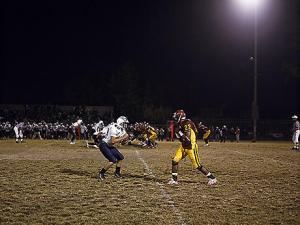
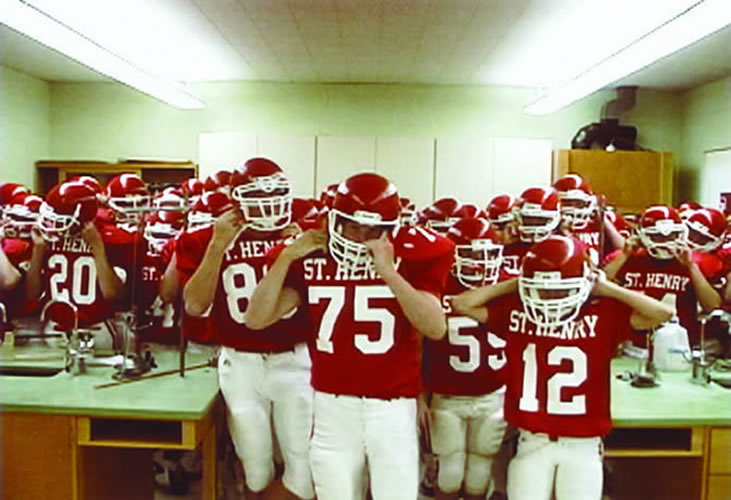
Joe Sola, Saint Henry Composition, 2001 (still)
It is a marvelous thing when an athlete tells the world that he is not going to bargain with his happiness.
It is marvelous thing that Michael Sam, a serious NFL prospect, has announced to the people who run the show that he’s gay – it’s just plain wonderful that he made this announcement as publicly as possible through mainstream and LGBT media. Michael Sam is daring the sports world to turn its back on him. Daring the suits to defy the (relatively) easy acceptance shown him by his teammates and coaching staff.
“And, by the way, I’m GAY” is something that gay men in the most macho of sports usually say on their way out the door. Retiring as a player is accompanied by a release – for many LGBT athletes, participation in a sport is synonymous with the suppression of one’s life as gay, lesbian or transgendered. A robust professional career becomes a straight-jacket. Hanging up the uniform is done with a certain joy, and a lot of bitterness.
In 2009, the Welsh rugby player Gareth Thomas, a real star in an international game, asserted the possibility of a different story for men. Thomas came out to the media in 2009 (he retired in 2011). He was already out to his teammates and his coach: he was in his late 30s and in the rare position of being so loved, so admired that his coming out could not have unsettled people’s understanding of his value as an athlete. Most queer folks walk away much sooner. As teenagers. They walk away from the track, they walk off the field. If they read as gay to the people around them – they get kicked off the team, they don’t get selected for national development programs, they are bullied and shamed and never get to a place where they might be offered a spot on a big college team. Most say something like, FUCK THIS BULLSHIT and do something else.
A few of these young people find it within themselves to fall on the sword and file lawsuits, and it is thanks to them that we have any legal tools for confronting the intense homophobia that shapes lesbian and gay athletes’ experiences of sports. Penn State basketball stand-out Jennifer Harris did so in 2007 when she was bullied by her coach – Rene Portland had a “no lesbians” policy which she advertised to the media for 20 years. Portland didn’t think there was anything wrong with her policy, it felt totally natural to her to ban lesbians from her team (lesbian, here, meant any woman who doesn’t appear feminine). Those people never get to take their sport up again – people who fight for social justice are not, according this side of the sports world, “team players.” That kind of attitude still prevails among the corporate drones of the sports world. The people writing endorsement contracts, making media deals – the people in the business of selling the game, the people who make selling out into a profession – they are the ones holding us all back. As Chris Kluwe told the New York Times:
These are the people who force the lesbian, gay and trans athlete to choose. Sport or sex. And by “sex” here, I mean the whole things – everything that word means. The gender of one’s romantic partners, sexual acts and identities, one’s own relationship to gender and sexuality, one’s social relationships to gendered people, the gender-culture of one’s sport, the sexual culture of that sport. One is asked to suppress and participate; embrace and exile.
That suppression might require that one deep-six one’s happiness, all expression of gender rebellion, all expressions of same-sex love and attachment. It might require something lighter – but still quite heavy – an undercover cop’s level of discretion as one leads the classic double-life – and in which the more successful you are in your sport, the more vulnerable you are for having made even the smallest gesture towards that word ‘gay.’ Maybe, as is the case with a lot of women athletes, one “just” watches the team’s management, the Olympic committee’s administration, and corporate sponsors quash all things that signal “gay” – from the existence of a long-term, live-in girlfriend and the importance of a gay family as part of an athlete’s support team (athletes have gay parents!), to an athlete’s haircut, outfit choices, participation in Pride or mentorship of other LGBT athletes. All of that might be conducted “off-the-record” to make a bunch of out-of-touch assholes feel like they are stewarding the development of your sport. Which usually involves putting women athletes in bikinis, giving them make-overs, and finding stories about teammates who are getting married – to men. To reassure themselves that women are not lesbians, lesbians are not women. If Sam wants to talk to out pro athletes about negotiating all of that – new territory in men’s sports – he’d do well to seek out the women who’ve been out there in sports world’s genderwarzone for decades. Now that he’s out, he gets to navigate the problem of being visible.
It is interesting to watch the straight media struggle to describe the shape of Sam’s life. All media accounts describe him as open in a way that is perfectly commensurate with the lives of young gay men who are in college, who are finding their way through a homophobic world – telling friends, finding the right bars and making more friends. Right now, the media is making a lot out of his family’s homophobia, for example. The New York Times profile dedicates a fair amount to space to his father’s discomfort, and suggests that being closer to friends than family is some sort of tragedy – even given the hundred other things Sam had to overcome, the idea of a homophobic father – especially one who is a black man – will prove irresistible as headline fodder. For queer folks, a family’s homophobia is a misery, but it is often also part of a more complicated story. A family’s homophobia may be just one ingredient in a toxic cocktail, and homophobia has all sorts of shapes, textures and sounds. Sometimes a family just can’t support you for who you are and there might be a thousand reasons why that might be so. Discovering a whole world of people – friends – who are happy to mentor and guide you, who are dedicated to your happiness and to the realization of your potential – who will open up their homes, shelter you and more – that is a magic time in one’s life and queer folks turn away from all sorts of trouble in favor of this other family. The families we choose. Queer friendship, in fact, points out the poverty of the system that only validates relationships that fit a heternormative, reproductive paradigm. We should not look at biological families or friendships through the lens of that paradigm. Friends are not a poor substitute for a “real” family. It seems like Michael Sam is really good at making friends, finding family in the larger world. And that this is the place he’s coming from.
This is what I like about his timing. This is not just a coming out, this is an athlete who is already making a home for himself in the world as a gay man. His announcement to the media is a very public demonstration of the choice that LGBT athletes make every day, especially in their youth – a decision, often made by necessity – as a matter of survival – to live otherwise and to make the world into something different – something better. His message: “This game is asking something of me that I don’t want to give it. A denial of who I am. So I’m going to demand a different kind of game.” Few are in a position to force a game to change. Michael Sam is, and he’s going for it.

For the past couple weeks I’ve been posting artwork centered on women’s football, partly in response to the exclusion of such work from curatorial projects on “the beautiful game.” I have a professional responsibility as a feminist art critic and as a feminist sports writer to point out when the marginalization of women’s sports is extended into the art world, to educate people as to how one might counter that tendency, but also to explain why it is important that we do so.
As I talk with people about this kind of artwork, and the condition of women’s football globally, I’m constantly reminded of cultural attitudes about the women’s game. For most people, women’s football is an obscure subject. It’s an obscure subject, in fact, for most women sports fans. People are committed to the idea that women’s football is slow and boring. They might enjoy the Olympics, or the Women’s World Cup – but what they seem to relish is the surprise that they liked the tournament. Sports media feeds the fan this narrative – that anytime a women’s game is exciting, it’s a “new” thing. It’s a surprise because mainstream fans of football are committed to the idea that women just don’t have the skill, strength, or speed to play an “entertaining” game. When not enthralled by an international tournament in which women are somehow possessed by demons and play well, those (sexist) fans entertain (comfort?) themselves with stories of women’s monstrosity and ineptitude. These people sit at home and make video montages, evidencing what they already know. Women can’t play.
This gross problem is perhaps nowhere more in evidence than in popular ideas about women goalkeepers. The above youtube video has been, since 2007, the first video that appears in a google search for “women goalkeepers.” The first (at least from my computers and in my locations). Not season highlights of the first goalkeeper (male or female) to win FIFA’s World Player of the Year (Germany’s Nadine Angerer) but a weird compilation of low points in the early rounds of an old tournament. Ask the world what it wants to know about women goalkeepers, and you will learn that the world cares only about how awful they are. This is the story that world is determined to see. The question “Why is women’s goalkeeping so poor?” takes as a given the idea that women are inherently bad at goalkeeping; it assumes that the limits one might see in the early rounds of an international tournament reflect a biological limitation. A deficiency. In fact, any mistake a woman makes in goal at any level is likely to be read as the result of her having a vagina.

But ask the world what it wants to know about goalkeepers – who are assumed to be men – and you will see that the world wants a definition of the position and it wants to know which ones are the best. Given the ruthlessness of the sexism of the sports world, I think it’s important – necessary – that when we take up football as a subject in our research, writing and cultural programing we actively refuse the impulse to take the men’s game as a universal standard, and the women’s game as some form of deviation. We need to think them both together, and in relation to one another.

Youtube is, frankly, the best place to for an artist and art critic to check herself. What you see in a museum was probably done by a fan and posted on Youtube – and discussed on Reddit – years ago.

The artist Cris Bierrenbach dressed in diverse uniforms, photographed herself, and then fired shots at the self-portraits, defacing each. “Fired” (2013) uses the different meanings of that word to provide a disturbing comment on labor, gender and precarity. Wedged into this project is a photograph of the artist in the uniform of Brazil’s national team. A given: women footballers in Brazil are vulnerable in the same way that ordinary women are vulnerable. That is not something you would assume if a male artist made this gesture to the national team. This work has me thinking about the relationship between gender and violence in experiences of/stories about the men’s game, and the violence that women encounter in the world as the background (the given) against which they play. The artist is from São Paulo.

Jaskirt Dhaliwal’s photographs are very similar to those I’ve posted earlier by Andrew Esiebo and by Moira Lovell. In researching contemporary art about this sport, I’ve found huge differences between work engaging the men’s game and the women’s. Work engaging the men’s game tends to address men’s football as spectacle – thus Douglas Gordon and Philippe Parreno’s cinematic project Zidane: a 21st Century Portrait, Jürgen Teller’s film of himself watching Germany lose to Brazil (Germany 0: Brazil 2), Harun Faroki’s Deep Play. One can see Lyle Ashton Harris’s project as a meditation on the politics of the football spectacle (e.g. Blow Up, see earlier post). The televisual spectacle, the crowds, the iconic figure at the center of it all – this is the subject of art about the men’s game. Women footballers are overwhelmingly isolated by the artist’s camera – rarely pictured as a team – and they are frequently photographed in street clothes, off the pitch, in ordinary and fairly anonymous settings. As Dhaliwal writes on her website, “The idea that some of the nation’s best female footballers could pass you on the street and you would not know them is a telling fact in a world where male footballers are ranked as celebrities.” Artists make this statement over and over again about women footballers. Nobody knows who they are. The woman sitting next to you on the train could be an international player, and you’d never know it. You’d never know it because you have to work hard to learn who these women are – trekking out to minor pitches in the outskirts of the metropolis to sit with a few hundred folks watching an untelevised match played between largely amateur athletes. That’s where you’ll find the women Dhaliwal photographed; their images are not splashed across the tabloids, broadcast on your televisions, or peopling advertisements for everything under the sun.
 The Sport Spectacle