A More Perfect World

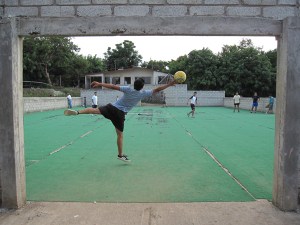
Daniel Lara’s An Imperfect Universe is a beautiful project. We pass by pick-up games and local league matches every day; small communities of futbolistas are a part of our lives and our sense of home. If you’ve observed these games or played in them, you know that the balls are often worn. They are worn because they are in constant use and carry the traces of their travel across packed dirt and cement. Lara exchanged old balls for new ones; he carefully dissassembled and then patched together the worn balls to make sculptures. Each is an appreciation of the local; lo-fi love for the game.

This slideshow requires JavaScript.

A New World Cup Anthem

Sia’s Chandelier is vast improvement over We Are One (Ole Ola) [The Official 2014 FIFA World Cup Song]. Backed up the Gay Men’s Chorus, Ryan Heffington’s choreography…the lyrics…I don’t know, it works for me. Especially now that Uruguay is going home.

http://www.youtube.com/watch?v=XSCjodlENWY

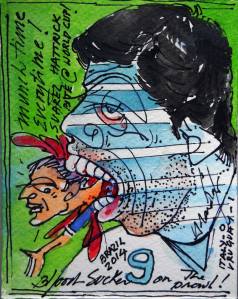
The Cannibal

Yolanda de Sousa, Uruguay - Italy

Yolanda de Sousa, Uruguay – Italy

“The cannibal, as we know, has a devouring affection for his enemies and only devours people of whom he is fond.” — Sigmund Freud

Luis Suárez’s biting is a tactic. The bite is a gesture of infantile and intimate aggression. It’s child-like and animal-like. It is the gesture of the figure outside of society and the impulse of the cannibal. (The cannibal—a colonial expression of desire/fear as a fantasy of eating/being eaten by the Other.)

All sports play with social structures, and a dialogic team sport like soccer plays with the social contract—the founding agreements struck between and within communities which allow those communities to exist in a more or less stable order. The “Laws of the Game” don’t just regulate a match, they are a part of the game (e.g. debate about offside, goal-line technology, replay – the sense that the subjective nature of the referee’s calls is necessary to the game’s spirit).

One of the agreements made between teams, players, referees and spectators involves a promise to not harm each other, a willingness to address and prevent injury. When you are playing an opponent who violates that agreement so intensely and so deliberately—it throws you completely out of the organizing structures of play. It is no longer play. The victim of this violence is momentarily exiled from the social order. A game that plays with violence (and football does) is only possible if all of its participants resist the impulse to brutality.

Results hinge on how teams bear up under the strain of 90 minutes, the stress of the match. Deciding goals are scored in the 89th, 90th, 94th minute by teams with the capacity to exploit a moment of distraction, an error made from weariness. In this case, a goal was scored against a team that was left bewildered. Suárez has made an art of creating this state of confusion; team management know perfectly well that if he can score a goal, he can also goad and shock and disgust an opponent in a campaign to force them to surrender not the match, but the game itself.

The Art of Conversation: Portugal – USA

conversationSoccer is a dialogic sport. It is shaped by opposition and struggle, by action and counteraction. There are no absolutes in these kinds of sports. The things that make for a great match, for example, are not the same things that make for a great race. A race is structured by a standard measurement of time, as well as by the idea of absolute performance (“the fastest human”). But a match is measured by the quality of the conversation.

Opponents will sink and rise to each other’s level – every fan and athlete knows this experience. A match might be halting and uneventful, or lopsided and boring because the two sides never connect in play. Very talented, organized and competitive sides are not always open to talk. Spain played like a team that was tired of talking. A team that had been the life of the party for too many years, and now just wants a quiet night in once and a while. England and Portugal gave their own versions of this kind of performance. Their play has been characterized by a weary narcissism – they are not tired of the party; they are tired of themselves.

Contrast that disengagement with Germany, France, Ghana, Chile and Colombia. It’s no wonder that Germany and Ghana’s match was so tremendous: the two play with an interest in the opposition. No gesture is unremarked upon; their conversation was fluid and elegant. Each side has the capacity for a certain brutality; each has the capacity to engage and diffuse the other’s attack. Like Dorothy Parker and Gore Vidal trading barbs.

Portugal and the US – they gave us a good dialogue but not a great one. The US, on a good day, will rise to an opponent’s level. But Portugal wasn’t interested helping them along. So Portugal exploited defensive errors, and did little more than that. Yes, CR7, when left completely alone, will send in a perfect cross to just the right person. In this case, it was a witty remark made on the way out the door to suggest the fun we might have had, if he wasn’t so utterly bored by us and the world. The US was a more entertaining guest. One got the sense that they were playing through fear and disorientation. Glad to be at the table, not quite sure what they were supposed to say and do – every now and again, they’d reach across the table to fill their wine glass, wash the anxiety down and throw themselves into the fray.

Yolanda de Sousa’s Mundial Scrapbook


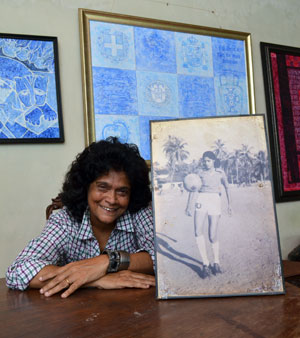
Yolanda de Sousa has been keeping a watercolor diary of this year’s World Cup. She has a painter’s eye for the ‘man of the match.’  As it happens, the Goan artist is an important figure in football history. In the late 1970s and 80s, she enjoyed a storied career playing women’s football in India. She was a real pathfinder. In 1980, she was voted player of the decade by India’s Women’s Football Federation. Sport-related work is not the mainstay of her practice, but every now and again she documents a match (football or cricket) with these player-portraits. (I wrote about her 2002 series a few years back.)

I’ve reproduced the bulk of a 2009 Times of India’s profile of the artist-footballer below. The brief article contains lots of information about her career as a player.

“It’s time for all of us to face the truth,” she says, sifting through memories when she was queen of the 100m field and the continent, her kingdom.

At a time when FIFA has struck off the Indian women’s football team from its world rankings for being out of sight or rather action for more than 18 months, Yolanda reminds us of the late seventies and early eighties when women’s football bettered the best in the continent and matched the rest of the world.

“Taiwan had an exceptionally strong team and was number one in Asia, but we always gave them plenty of problems. We were so strong in our belief and quality that we took the field knowing we could get the result we desired against most of the teams in the world,” says Yolanda, voted the player of the decade in 1980 by the Women’s’ Football Federation of India.

Yolanda’s story deserves to be told more so because it has the ability to instill the belief that women’s football still has the ability to enchant, entertain and inspire a generation.

It may not be the case elsewhere, but at least in this part of the world, many equate football with masculinity. But, as Yolanda’s story would demonstrate, that was never the case when she got enveloped by the magic of the game at a very young age.

“I would play along with my brother (Francisco) and his friends, but most of the times I was shunted to the goal. Whenever I got a chance to play up front, I would really put my best foot forward,” remembers Yolanda, who grew up to become one of Goa’s exemplary, if not, finest footballer.

Yolanda scored a goal in the first ever recorded women’s football match, playing against a men’s team appropriately called Adam’s in 1973, but it was not until 1976 when Goa took part in their first Nationals at Sultanpur and Yolanda scored a bag full of goals – 15 in all including two hat-tricks – and announced her arrival on the big scene.

“We lost in the final against Bengal by the narrowest of margins,” remembers Yolanda, dubbed the Madonna of Goan football.

The 1976 Nationals at Sultanpur was the first Goa ever participated in, and for the first time got to know what other players thought about Goa and Goans. “Since the facilities were not good enough, we wanted separate accommodations. This led to rumours that we sought a hotel elsewhere because the players wanted to enjoy their drinks! They believed we played well because we were drinking,” laughs the Calangute-based artiste.

Goa hosted the 3rd edition of the National football championship in 1977 and, true to expectations, won the tournament in style, defeating twice-champions Bengal 3-0 in front a lustily cheering capacity-crowd at the Bandodkar stadium at Campal.

Goa dominated the championship from start to finish, scoring an amazing 49 goals that included roaring wins over Madhya Pradesh (25-0), Punjab (10-0), Gujarat (5-0), Manipur (6-0) and, finally, Bengal (3-0).

Goa’s deadly strike pair of Succorinha Pereira (19 goals) and Yolanda (18 goals) scored 37 of the 49 goals, but often it was such a bore to score goals against the hapless opposition that even the strikers played the ball amongst themselves instead of taking aim at the goal!

“We were too strong for the other teams during Nationals. We used to score early in all the games since most of the goalkeepers remained clueless,” says the stylish striker.

Yolanda’s international debut came in 1976 when she, along with the likes of Rekha Karapurkar, Succorinha Pereira and Helen Fernandes, found a place in the Indian team against the visiting Swedish club BET.

She set all the venues on fire, ensuring seven victories and in the process becoming the first woman to score a hat-trick for India.

Since that memorable debut, Yolanda remained a permanent member of the Indian team until she was forced into premature retirement after the World Cup of 1981.

“Injury cut short my career. I was too scared to undergo an operation to correct the damage and instead opted to call it a day,” says Yolanda, who gave up hockey and badminton which she excelled at the highest level to nurse her football dream.

The artist with a photo from her playing days.

French Do-Over

Some more football art.

FIFA’s Gendered Laws of the Game

From the opening page of FIFA’s Laws of the Game (2014-2015): Women appear on the list of categories of disabled players for whom one can modify the size of the pitch, the ball and the goal. And: FIFA’s use of the male gender in all documents really means both men and women. This gets really confusing when considering a 2004 FIFA Executive Committee decision asserting that “the difference between men’s and women’s football must be absolute.” Women, who should not be expected to play by the same rules as men, are not men. Except when we say men and we mean women. That difference is absolute!

Screen Shot 2014-06-19 at 11.00.53 PM

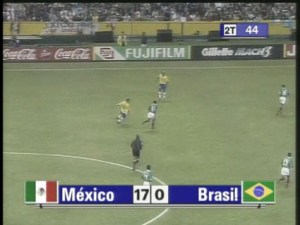
Mexico 17 – Brazil 0

Miguel Calderón, Mexico vs Brazil (2004).

Miguel Calderón, Mexico vs Brazil (2004).

Miguel Calderón watched hours and hours of football matches; he pulled footage of Mexico and Brazil matches to compile an imaginary world in which Mexico wins 17-0. Calderón’s 90-minute video was originally installed on a television in a sports bar in Brazil. Hopefully, someone has thought to install this work in a bar or two – a little World Cup static.

Pregnant with Ball


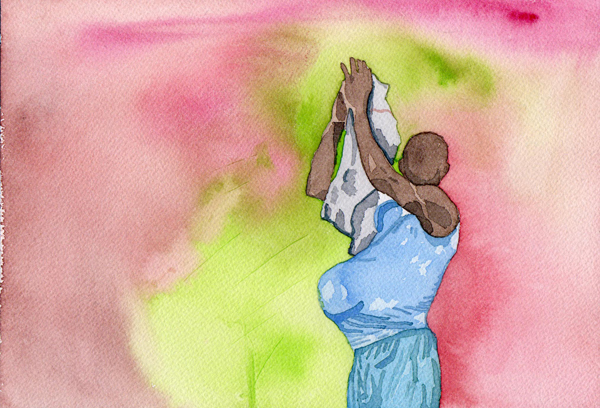
Yrsa Roca Fannberg, Resurrection (watercolour on paper, 2009)

Joel Campbell’s goal celebration belongs to a genre – Yrsa Roca Fannberg is the only artist I know to have honored that genre in paint.


The Inevitable World Cup

At this time of year, football fans with a conscience find themselves in a strange situation. We know FIFA is corrupt to the bone; we know that Football Associations are run by imperialist crooks. The people who administer the game are famously sexist, famously racist. We know that they are disgusted by the multitude whose happiness they exploit. At a recent conference on the sport, for example, a FIFA representative responded to a scholar’s paper on the problem of “white elephants” by describing the people to build them as “foolish.” He was obnoxious, but was he wrong? Are we surprised by his attitude, or by the fact that he feels entitled to express such open contempt for the miserable schemers who collaborate with FIFA’s overlords? We know that the FIFA World Cup is awful – and yet we tune in.

Because, of course, The World Cup is a spectacular event. Already, headlines about match fixing and worse have been replaced by headlines about underperformance, cynical play, unfair calls and other staples from football’s story cycle. In its inevitability, in its unavoidable nature we sense something of the World Cup’s ideological power. To call for the end of the World Cup: is that not an attack on happiness itself?

FIFA exists for this event alone. The World Cup is not a tournament, really; it is an economy and FIFA regulates its marketplace by ensuring that players play on something green and expensive, in front of synthetic crowds who are stripped of their drums and trumpets and made to sit down. FIFA makes the game into a currency. Every game looks like every other game, whether it is played in Rio de Janeiro or Johannesburg or Berlin. (Perhaps, however, not Manaus.)

Resistance to the World Cup, abolition of the World Cup – it is necessary and yet for football fans and even FIFA critics it is almost unimaginable. Nothing short of a full-scale revolution will bring it to a stop – is that what we are rooting for? People who can no longer afford the price of entry into a host city’s stadium take to the streets; they are replaced in the stands by a mass of silent witnesses. Which struggle will we see on the television – the one inside the stadium, or the one outside of it?

The football critic who would try to think of a world outside the World Cup is faced with a unique set of problems. The World Cup has a stranglehold on the presentation of football as “the global game.” But the pleasure promised to us by the mega-event is rooted outside the stadium, and outside of FIFA’s reach. The ordinary forms of joy we feel on the pitch are cited by nearly every advertisement that swarms the World Cup. An ad for a shoe or a television set, or soda or hamburgers will feature children threading a ball through the crowded narrow alleys of some nameless slum. Kids chase that ball to pop music one might hear in Atlanta, Montevideo, Seoul or Marseille. They are happy to be alive. What fan hasn’t had a taste of the happiness cited by such ads? The absolute joy of a weekly game with friends – the sort of game in which even the bickering is fun. That happiness is fleeting – the game can teach you how to live with that: you have to make yourself available to that pleasure by showing up hung-over, in the rain, in the hot sun. But what do we show up for, when we turn on our television sets?

The discourse of “the beautiful game” romances the idea that in poverty one’s pleasures have a certain nobility. It is one of the most cynical features of the mega event: a neo-liberal fantasy about the joy of the poor functions as an alibi for an inhuman economy in which stadiums are built not as homes for a team and its fans, but as sets for a handful of televised events; in which clubs are mortgaged into abstraction; in which the obscenity of one player’s income is dwarfed by the cosmic scale of the team-owner’s wealth. The identification of the game with keywords like “universal,” “global” and “beautiful” papers over the exclusion of women from this world. It celebrates the provincialism which assumes that there is no place on earth indifferent to this sport. It turns the scholar of the sport’s globalism into expert testimony justifying development schemes. The larger and the more inclusive these events become, the more media space they take up, the more public resources they use up – and the worse things gets. Resources are not redistributed around the World Cup; they are concentrated and absorbed by a ministry of corruption. This is not the view of the football extremist. To assert such a thing is not even interventionist. It is a given. What have I written here that hasn’t been said by Eduardo Galeano, years ago? Or by our grandparents?

The tournament is sold to us as the story of a level playing field from which a few deserving souls might be elevated to something more spectacular than equal access to opportunity. As if the latter were a given in our lives, and not, in fact, the elusive aim of an ongoing struggle. The level playing field of a bright green square of uniform grass produces a world of losers. What keeps the World Cup in place? What keeps national associations under FIFA’s sway?Who on earth really wants yet another tournament that concludes with a cynical exchange of fouls by two teams we imagine as enemies but who are, really, two sides of the same coin? Where, the fan asks, do we turn for a glimpse of some other possibility?