One of the artists I’m hoping to write about in my next book helped choreograph this ad for Gillette.
That artist is Heather Cassils. Cassils is performing this weekend in Birmingham, UK.
One of the artists I’m hoping to write about in my next book helped choreograph this ad for Gillette.
That artist is Heather Cassils. Cassils is performing this weekend in Birmingham, UK.
Diana Tausari squares off against Seimone Augustus, looks like regular basketball. Shoulder checking and all that. But then in a lean in, she leans in!
It’s worth watching the post-game interview. Augustus explains “As far as me and Diana and the tango dance we had – I always say she just wanted some of my deliciousness.”
When asked about this moment Tausari explained: “I was just trying to make sweet love, that’s it.”
That’s it. Just exactly the kind of queer playfulness that mainstream sports folks have feared like the coming of the four horsemen of the apocalypse.
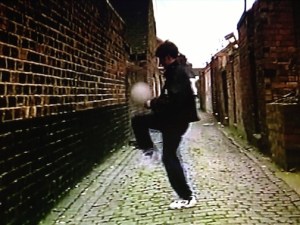

The Belles was aired in January 1995 on BBC 1. This is perhaps one of the most unusual documentary portraits of women athletes I’ve ever seen. It covers a few weeks of the team’s season, moving back and forth between conversations with individual players, match footage, and peeks into the team’s life together off the pitch.
There are startlingly intimate moments, as players speak about their relationship to the sport while, say, lying in bed. Or celebrate a big win in the changing room and, perhaps more scandalously, at a gay bar. My favorite moment: players on the disco floor, FA cup in hand and mirrorball overhead.

The FA didn’t take kindly to the documentary: Belles captain Gillian Coultard had captained the England squad and was demoted after The Belles aired.
Writing in the wake of that grim period, Pete Davies describes the team as scarred:
When the Belles let a BBC crew make a documentary that was broadcast last year, they thought they were helping promote women’s football. Instead, they got a sharp letter from Graham Kelly about the tone of the programme, and are now scared stiff about talking to the media. Last month, they felt obliged to turn down Yorkshire TV when that company wanted interviews – and a dread of publicity, when you’re needing sponsorship, isn’t too helpful. (The Independent 11 March 1996)
The Belles – the documentary and the story of this incredible club – inspired a television series that ran for five years (Playing the Field). But in 1995, its airing left the team with a difficult burden.
This weekend the Doncaster Belles will play their last match in the Women’s Super League – the FA’s attempt at the establishment of a professional women’s league. The FA is off to a flying start in confirming at least this writer’s belief that you cannot leave the administration of the women’s game to men whose decisions are guided by sexism and greed.
The Doncaster Belles were relegated to the second division at the start of this season in order to make room for Man City’s women’s side.
I still can’t wrap my head around the FA’s behavior towards The Belles, except as a continuation of their behavior towards the team ever since the FA was forced to deal with the culture of the women’s game in the early 1990s, when the Belles were a super-dominant club and a fine expression of the independence and autonomy of women’s football in England.
Some football fans might agree that today, “professionalizing” the sport is synonymous with ruining it for fans and for young players. The story of the FA’s behavior towards this team, which hasn’t not played in the top flight since the FA began organizing such things, is fine evidence of that dismal truth.
To read an excellent overview of the FA’s treatment of the Belles, read Glen Wilson’s article on The Popular Stand.
The critic who would try to think of a world outside the World Cup and The Olympics is faced with a unique problem. FIFA and the IOC have a stranglehold on the global sport spectacle, on the presentation of the sporting event as a World Event. Their hold on the idea of the global event is so tight that even their harshest critics imagine that change will be brought about by participation in those events, or by boycotting those events. Within that critical discourse, change is possible if only we provide the right kind of pressure.
But real change will not happen either way. The larger these events become, the more media space they take up, the more public resources they use up – the worse it gets. By “it,” here, I think I mean “life.” Real change – is that a better Olympics? A better World Cup? Does one celebrate a Qatar World Cup or a Russian Olympics in the hope that these events will make Qatar and Russia more liberal environments for gays and women? In calling for that outcome, we enlist “gays and women” as neoliberal alibis, and lend legitimacy to the notion that the Olympic games improve every city that hosts them and that the idea that the World Cup unites the world’s football fans and creates possibilities for social change and better living. We all know that’s a lie.
These organizations are more notorious in sports media for their corruption than for their discriminatory practices. Sports media cares about the former only as long as it doesn’t jeopardize advertising revenue, and it doesn’t care about the latter at all. FIFA and the IOC are happy to deploy female, black and Muslim athletes as alibis justifying their work. That work being not social justice, but the amplification of their hegemony.

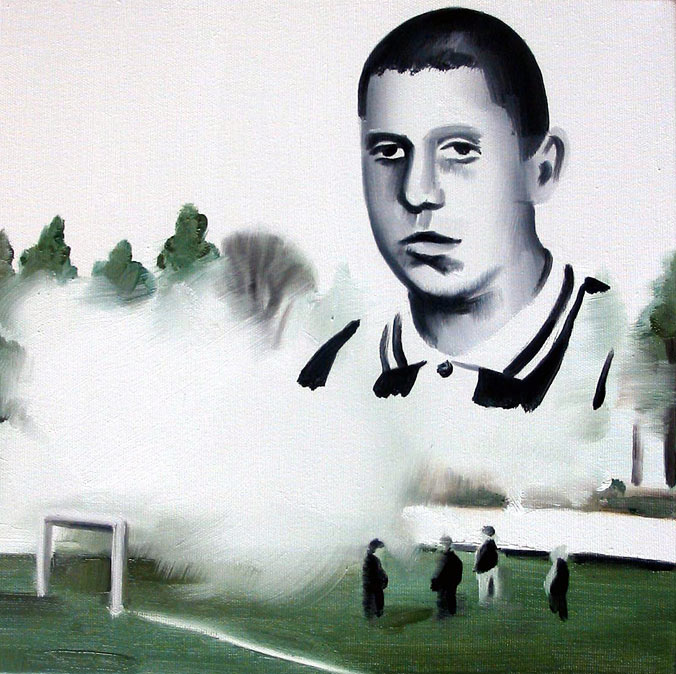
Art historian Przemysław Strożek gave one of the most memorable lectures at the Football 150 Conference, surveying the place of football in Polish contemporary art. He shared sophisticated work exploring the world of ultras – the hooligans, the fights between fans that seem to make the game a theater for social conflict in which all the action happens in the stands. As is the case in a lot of countries, in Poland the stands function like wounds – a place of intense emotion, pain, violence. I’m haunted by this painting by Marcin Maciejowski. Misiek (FC Wisła Kraków supporter) (2004) appears to memorialize an infamous hooligan who threw a knife at Italian footballer Dino Baggio during a championship match. Misiek (nickname for Pawel Michalski) was sent to prison for that and other offenses. Maciejowski’s painting is a record of, a comment on how Misiek is revered by fans.
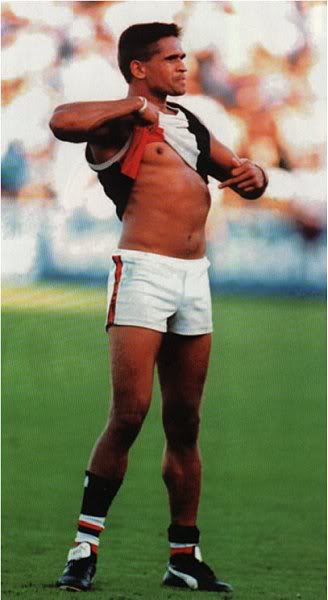
In 1993, at the end of a match he’d helped his team win, footballer Nicky Winmar responded to racist abuse by lifting his shirt and pointing to his skin. He said “I’m black and I’m proud to be black.” This action and this image have become an instantly recognizable symbol of pride and empowerment for Indigenous people in Australia. (Thank you to sport historian Matthew Klugman for introducing me to this image and story!)

Yesterday I spent the day listening to excellent talks on soccer and art. Daniel Haxall, a professor at Kutztown University in Pennsylvania drew our attention to Blow Up, a series of installations by Lyle Ashton Harris. At the center of Blow Up is this shoe advertisement featuring Zindane in a pose that looks an awful lot like that of Manet’s Olympia (scroll down), as she’s being attended to by a black servant.
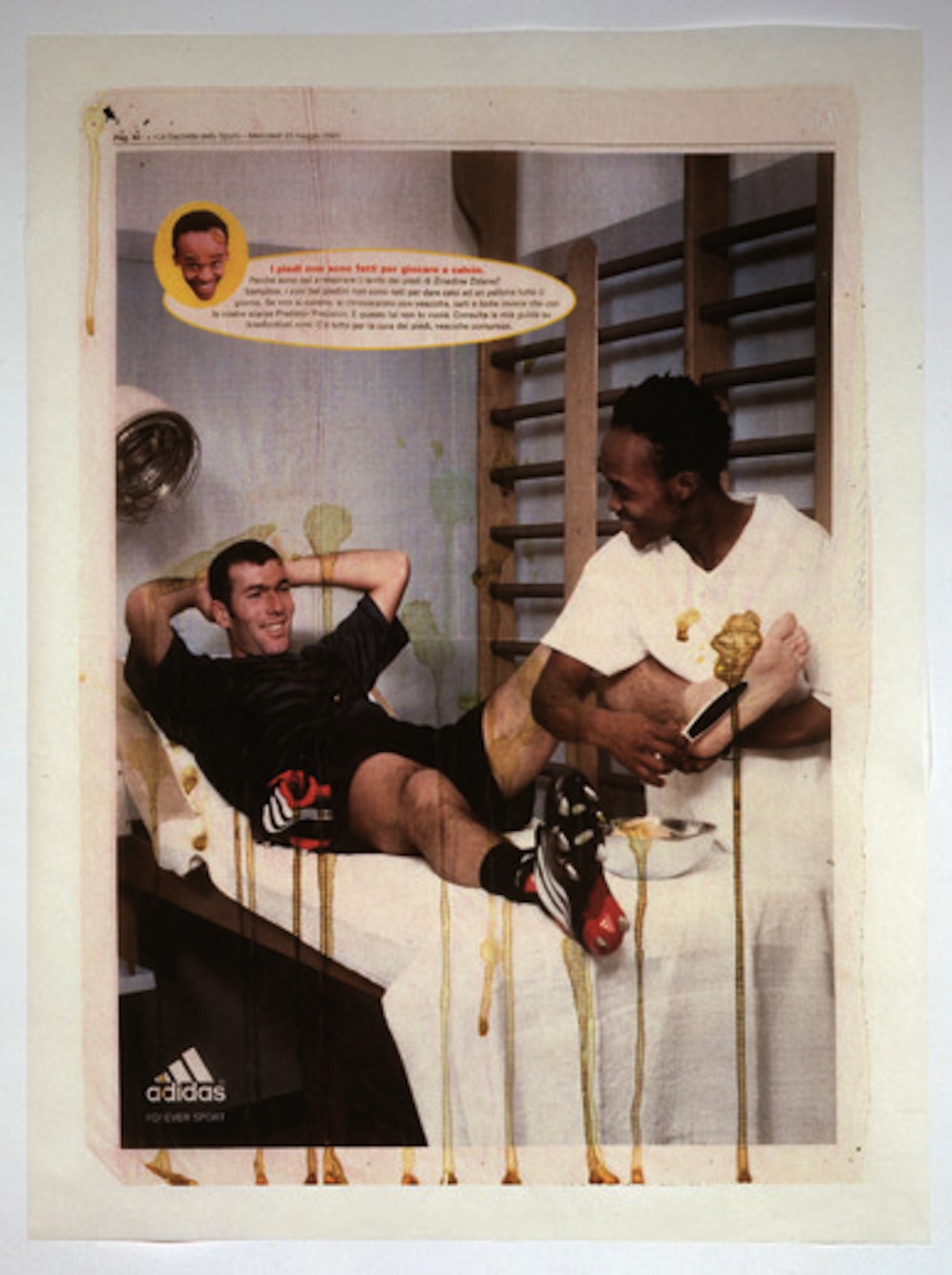
Lyle Ashton Harris, Ready Made, 2001.
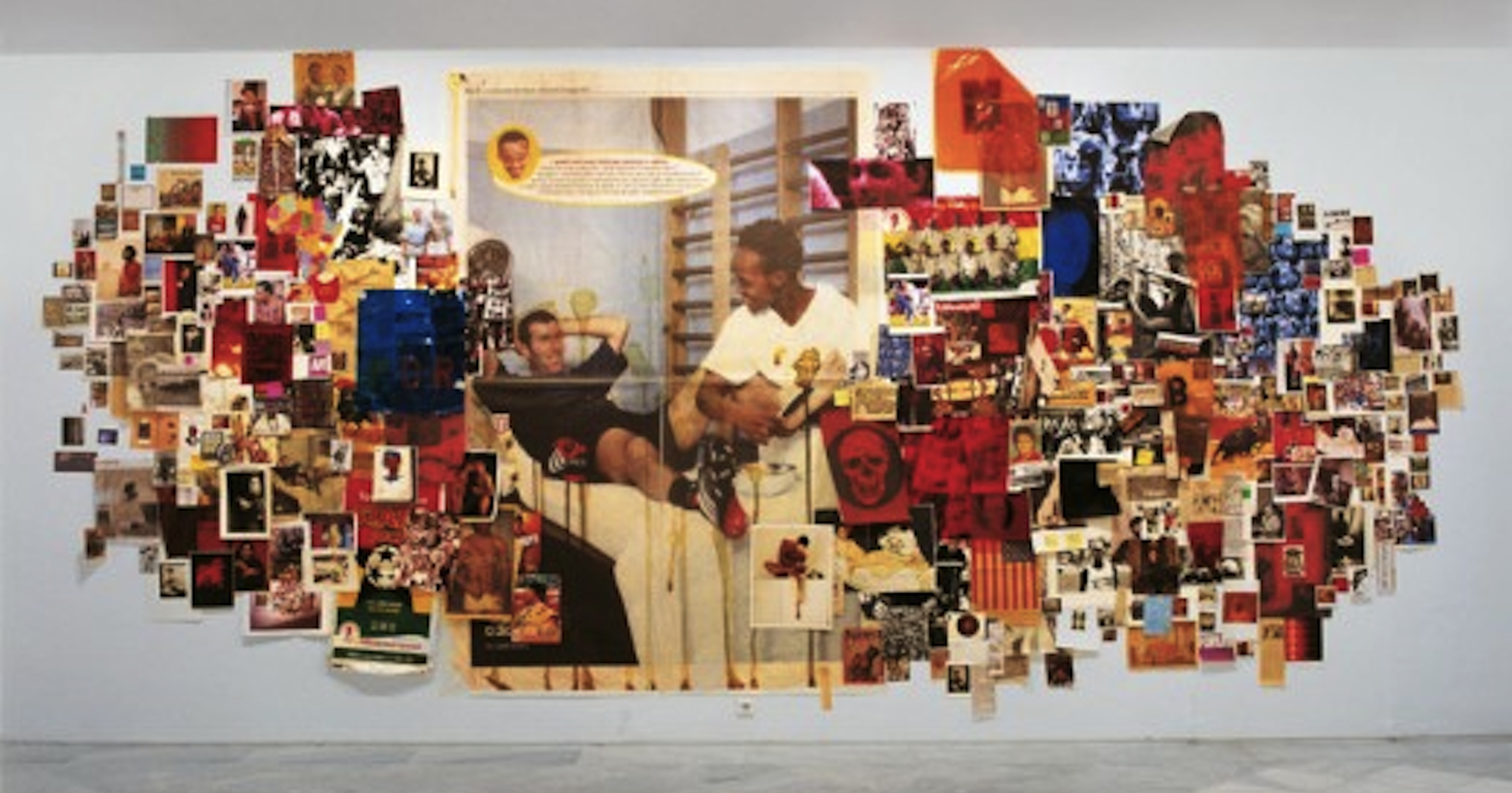
Lyle Ashton Harris, Blow Up (Sevilla), 2001

Lyle Ashton Harris, installation view of Blow Up at Scottsdale Museum of Art, 2008
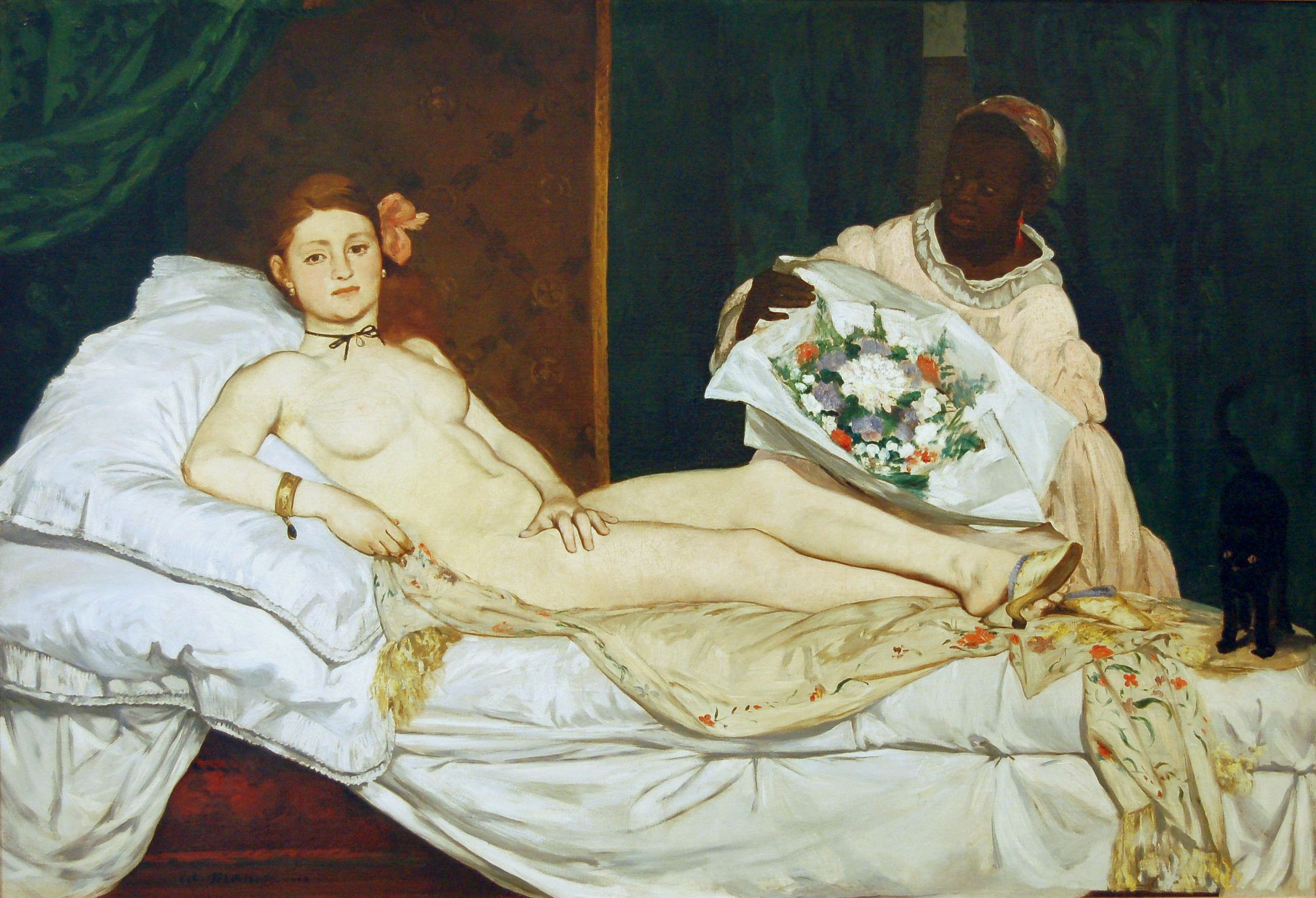
Manet, Olympia, 1863

Catherine Opie has taken a range of startling portraits of Diana Nyad. Today, Nyad is closing in on realizing her dream of swimming the distance between Cuba and the United States (without a shark cage). This is her third try in three years. Follow her progress here.
Update: She did it!!

This weekend, the members of Russia’s 4×400 relay team made a point of exchanging kisses on the medal stand at the World Championships in Moscow. A photograph of two of the gold medalists has been widely circulated as a protest image. Folks wonder: Is this a European-style greeting or a political intervention? Is this women being friendly? Or is it anti-homophobic and maybe even lesbian?
Footage of the ceremony shows that it wasn’t just two who kissed. Each member of the relay squad kissed every other member of the squad. It was a flurry of kisses.
If you’ve spent time in environments in which people kiss when they meet, the gesture is certainly recognizable as a polite greeting. But it should also seem out of context. Usually you only kiss someone the first time you see them in the day. Kissing someone again after you’ve kissed them hello is odd. And kissing them like this in a medal ceremony is unnatural. There are implicit rules about who kisses who and how – men might kiss each other in one place but not another. Men might kiss women in one place, but not another. But generally, if folks are in the practice of greeting with a kiss, women kiss and are kissed. But not when they are getting medals. In that case, maybe the person putting the medal around your neck kisses you. On the cheek. Maybe. (Generally, it’s a handshake.) But you don’t kiss your teammates. You hug. Which is much friendlier, actually, than a kiss. And, in any case, kissing on the lips – that’s reserved for very particular exchanges. Yes, people kiss on the lips as a greeting – but it is definitely a (very polite) step towards rather than away from intimacy.
The runners gave photographers a very specific photo opportunity. Again and again.
Are these the polite kisses of housewives or are they expressions of gender rebellion? Is it politics? Or is this personal? Is this Western media run amok, looking for gay anything because it makes a good story? In a homophobic environment lesbian desire, love and attachment is both prohibited and also persistently erased. It is erased by the determination to imagine that women have no active sexuality at all (in which case, a woman wants only to be the object of a man’s desire), and also by massive cultural hostility to feminism – as a practice of caring for and about women.
As Dave Zirin writes, folks want to draw from this kiss an analogy to John Carlos and Tommie Smith’s 1968 black power salute. But, he rightly observes, we can’t. He notes, for example that where Carlos and Smith’s raised fists silenced the whole stadium and then drew jeers, people in the Moscow stadium seemed not to notice that the kisses might be an intervention. They didn’t interrupt the ceremony in any way.
The difference between these moments is interesting for all sorts of reasons. But here I’ll just ask: What would a queer feminist power salute look like, if not a kiss? What could be more queer, in fact, than a gesture that makes you look at the explicit homosociality of sports differently – as potentially, at least where women are concerned, always already political? Is it the kiss itself that does that? Or is it, in fact, the homophobic context in which the kiss is staged?
When we look for gay signs and signals, we mirror the homophobic public sphere conjured by Russia’s prohibition of queer “propaganda.” It is not, in other words, Western media that is making a gay spectacle out of sports – it is the virulence of the homophobic public sphere that Russia’s government is nurturing. We can trust that the sport spectacle will inspire new heights of paranoia and fantasy within this Russian context.
Athletes have been asked to tone down even the most discreet demonstrations of support for Russia’s LGBITQ community. Even Rainbow colored finger nails are too political. Nevertheless, women can kiss on the podium at a world championship event in that context, and folks ask themselves “what did we see”? Russian officials are happy to tell us: nothing.

This speaks to a big question – a question at the heart of Russia’s hateful laws: How do we see sexuality? How does one regulate sexuality as something that is seen? That question has never not framed queer activism. It was taken up most explicitly and most consistently, however, by AIDS activist organizations like Gran Fury.
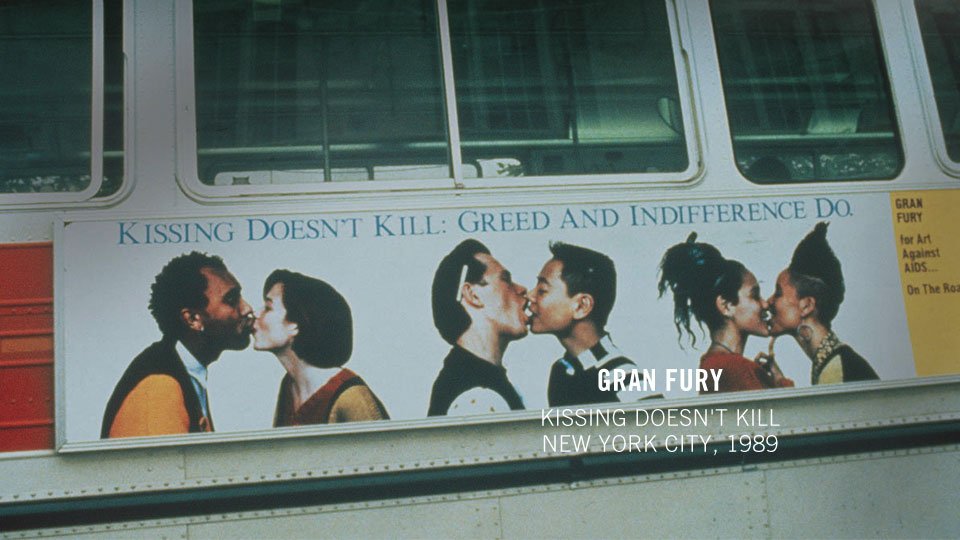
In 1989 and 1990, a poster of lesbian, gay and straight couples kissing was mounted onto the sides of NYC buses. It was a part of a series of images of queer kisses – others were captioned with the demand, “READ MY LIPS.”
The Russian team’s kiss draws out their context: a world that scrutinizes every gesture, every movement towards members of the same sex, looking for and beating out signs of the queer from the social body. All public displays of affection unfold within cultural tradition and social practice. There is something distinctly powerful about a group of women athletes staging the warmest and most polite of gestures within a context in which that gesture is also quite clearly political.
What could be nicer, more queer or more feminist that meeting the world with a kiss on the lips?

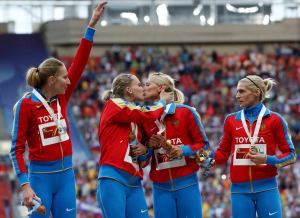

The beauty of absolute gender segregation in sports is that it makes a display like this almost impossible to avoid! It’s always either all women or all men on a podium at the IAAF World Track and Field Championship. Every medal ceremony has the capacity to be a gay kiss-in!
They fought for this medal. It’s a great race.
The furtive kiss-in:
I count seven. Maybe eight kisses.
 The Sport Spectacle